Five years ago, the commercial function in the pharmaceutical industry was often summarized as a Sales Director reporting to the General Manager, responsible for driving quarterly numbers. Today, in a growing number of management committees, this same function goes by another name, another level of responsibility, and an entirely different strategic weight: Chief Commercial Officer.
This shift is not cosmetic. It tells a story of a profound transformation in how laboratories think about their growth, market access, and relationships with patients, prescribers, and payers.
Market Context
The pharmaceutical industry is going through a period of reorganization. Price pressure exerted by public healthcare systems and private insurers is intensifying. Product development cycles are shortening under the influence of therapeutic innovation, particularly in biotherapies, precision oncology, and treatments derived from advances in artificial intelligence applied to research. At the same time, market access is becoming unprecedentedly complex: a multiplicity of stakeholders, growing requirements for proof of value, digitalization of prescribing pathways, and new expectations from patients who have become informed actors in their own treatment.
In this context, the commercial function can no longer be limited to executing a sales plan designed elsewhere. It must anticipate regulatory changes, engage in dialogue with health authorities, build partnerships with payers, orchestrate an omnichannel presence with healthcare professionals, and transform therapeutic innovation into real adoption on the ground. This shift explains the emergence of the Chief Commercial Officer as a full-fledged management committee function, rather than as an execution role placed under the supervision of general management or marketing.
Analysis
Three underlying trends explain this rise in importance:
The first is the convergence of functions. Historically separate, sales, marketing, market access, and patient experience departments often operated in silos, sometimes with contradictory goals. The most successful laboratories have understood that a unified steering of these functions under a single management committee responsibility made it possible to align the commercial strategy with the reality of the care pathway, from diagnosis to reimbursement. The Chief Commercial Officer thus becomes the point of convergence for challenges that, until recently, fell to distinct and sometimes competing internal departments.
The second trend is the growing complexity of market access. Launching a product is no longer enough to guarantee its adoption. It is now necessary to demonstrate its value to demanding health authorities, negotiate with reimbursement systems that vary from country to country, convince oversolicited prescribers, and support patients seeking transparency. This long, multi-factorial decision chain requires an overall vision that only a leader with cross-functional authority can carry effectively. The Chief Commercial Officer is precisely the organizational response to this complexity.
The third trend is the arrival of new tools for managing commercial performance, driven by data and artificial intelligence. Laboratories are investing heavily in predictive analysis capabilities to better understand prescribing behavior, anticipate patient needs, and optimize their commercial investments. However, these tools only generate value if they are run by a leader capable of making them a strategic decision-making lever rather than a simple operational dashboard. This requirement redefines the desired profile: today's Chief Commercial Officer must know how to read a market as much as understand the scientific, regulatory, and technological dynamics that transform it.
Impacts for Leaders
This evolution has direct consequences for the general management and executive committees of companies in the sector.
First, there is the challenge of defining the role. Many organizations create this position without having clarified its exact scope: is it about unifying sales and marketing, integrating market access, or linking patient experience? This initial lack of clarity is one of the main causes of failure in the first twelve months, and it significantly complicates the identification of the right profile.
Next, there is the challenge of talent scarcity. Leaders capable of operating at this intersection of commercial strategy, scientific understanding of the market, mastery of regulatory dynamics, and data culture remain few in number. Many candidates who excel on the commercial side lack the expected sector depth. Conversely, profiles that are very strong on the scientific or regulatory front sometimes lack the commercial instinct necessary to translate a strategy into results. The right profile lies precisely at this intersection, and it is rare.
Finally, there is a governance challenge. The arrival of a Chief Commercial Officer on the executive committee often redistributes responsibilities from other functions, notably marketing, market access, and sometimes medical affairs. This redistribution must be anticipated, explained, and supported; otherwise, it risks creating internal tensions that undermine the onboarding of the new leader, regardless of their caliber.
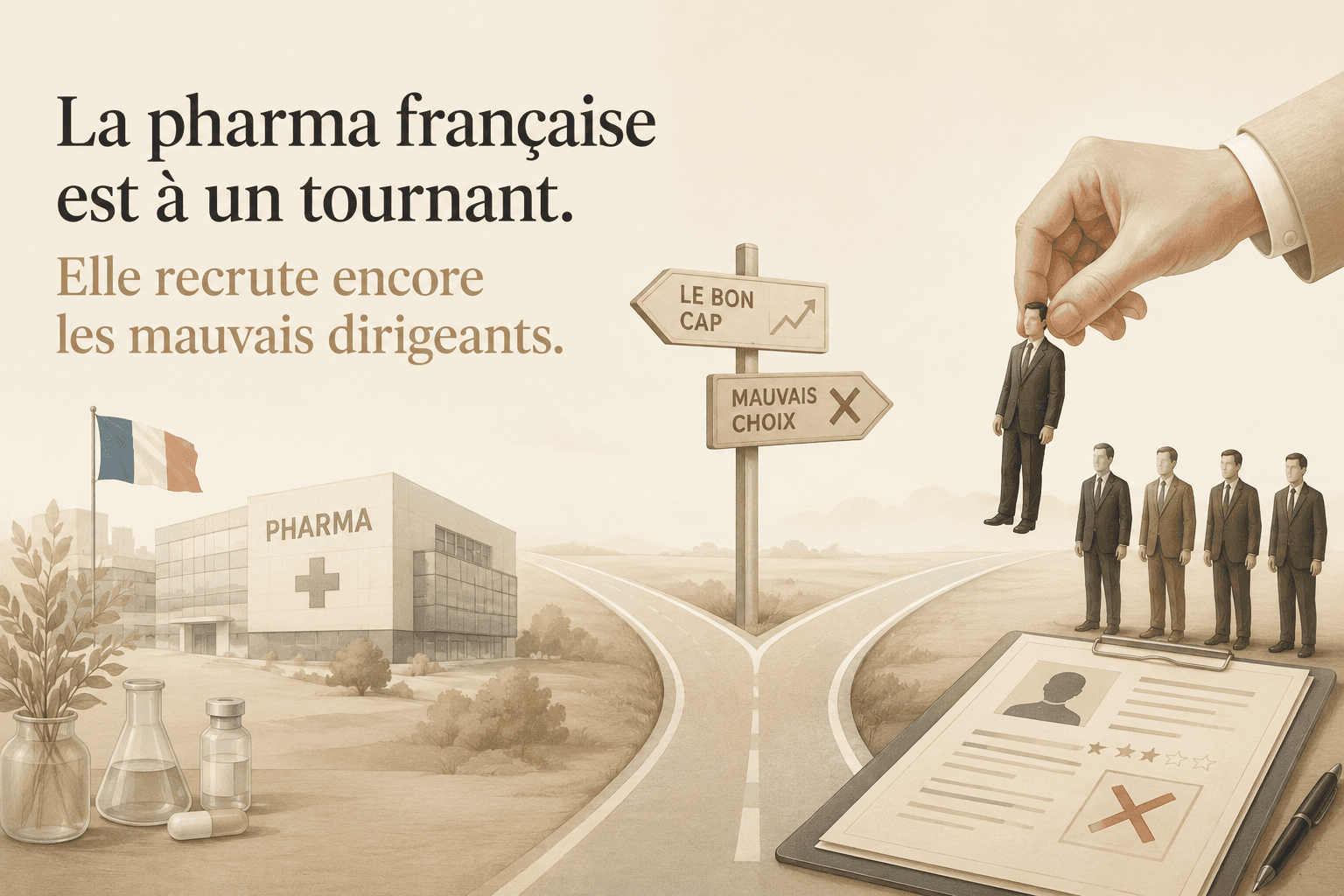
For leaders considering this recruitment, the question is therefore not just "who to recruit", but first "for what purpose, with what authority, and in what organization". Answering these questions before launching the search radically changes the quality of the final outcome.
Laroze Partners Perspective
Our conviction is that this type of recruitment cannot be handled like a traditional sales recruitment, or even like generic executive recruitment. It requires a fine-tuned reading of the candidates' trajectories: how have they built their understanding of the sector, how have they managed the tension between scientific requirements and commercial imperatives, and how have they behaved within organizations undergoing a complete overhaul of their governance.
This is precisely what we equip with the Laroze Pattern®, a strategic method of reading career trajectories, leadership behaviors, and performance dynamics. It allows us to go beyond the resume to understand how a leader actually made decisions in contexts comparable to those the hiring company will face, and to anticipate how they will integrate into a restructuring executive committee.
We also advise executive management ahead of the recruitment on the very definition of the role. In most cases, a poorly scoped mandate produces a hire that fails within the first year—not because the candidate was bad, but because the position had not been sufficiently thought through before being opened. Our role is as much about helping to formulate the right question as it is about finding the right answer.
The emergence of the Chief Commercial Officer in pharmaceutical executive committees is not a management fad. It is the direct consequence of a market that has become more complex, more demanding, and faster, where the ability to transform a therapeutic innovation into real-world adoption has become a competitive advantage in its own right. Organizations that can identify, attract, and integrate these rare profiles will secure a lasting head start. Those that settle for simply renaming an existing position without rethinking its role risk turning a good intention into a costly disappointment.