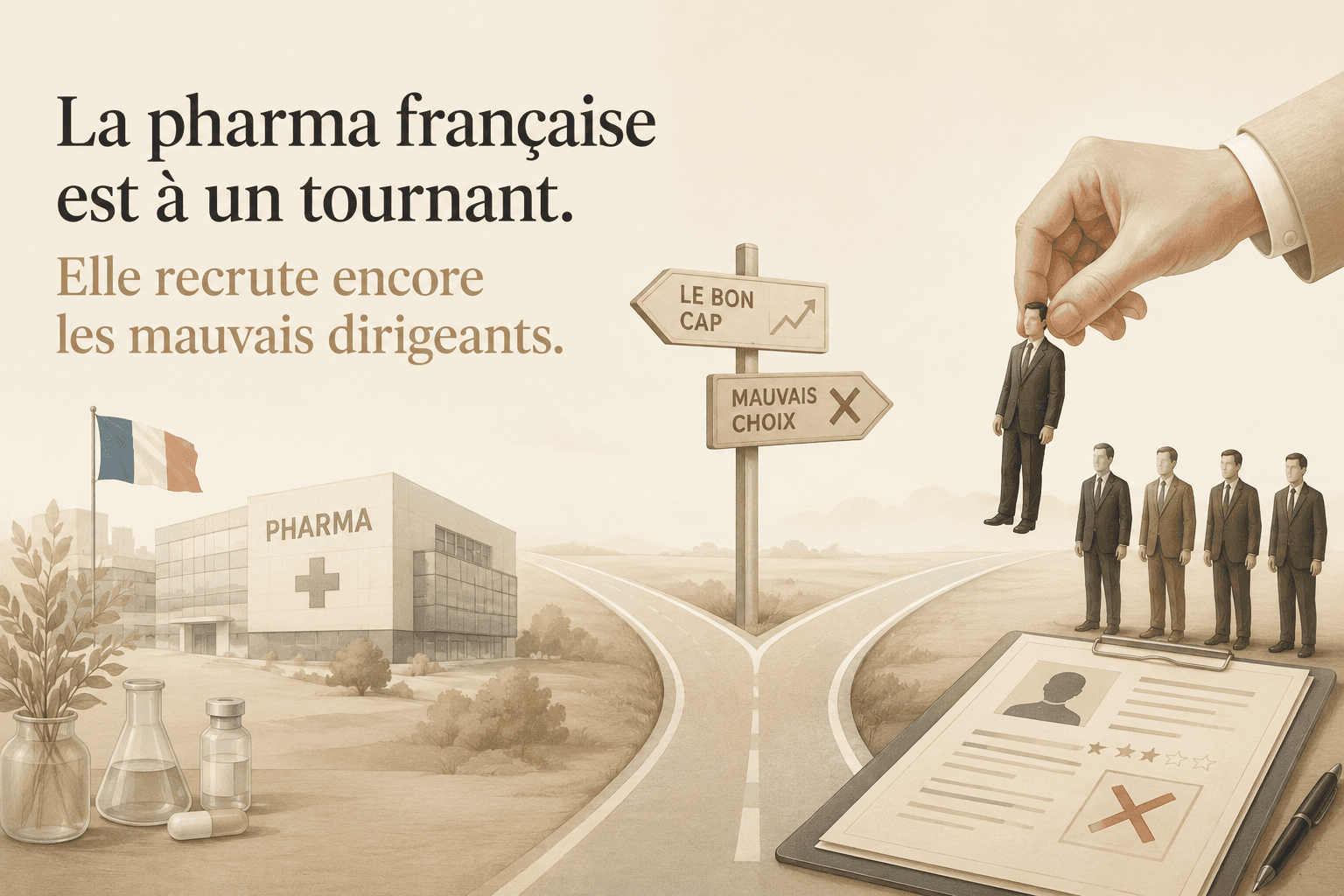
The French pharmaceutical industry is at a turning point. It is still recruiting the wrong leaders.
The French pharmaceutical industry is at a turning point. It is still recruiting the wrong leaders.
The French pharmaceutical industry is at a turning point. It is still recruiting the wrong leaders.
SECTOR ANALYSIS: HEALTHCARE & PHARMA - MAY 2026
The figures are in. The strategy is set. The plans are announced. What no one is talking about: the profiles required to execute this transformation do not look like those the sector knows how to recruit.
THE CONTEXT IN THREE FIGURES
×10 | 9% | 7 |
|---|---|---|
Access delay to therapeutic innovations vs Germany | Only of new treatments produced in France | Major founding laboratories of Initiative Pharma: Sanofi, Ipsen, Servier, Pierre Fabre, LFB, Guerbet, Théa |
Source: Leem/PwC Barometer, June 2025 | Source: Leem/PwC Barometer, June 2025 | Source: Initiative Pharma, January 2026 |
In June 2025, Leem's 360° Barometer delivered a blunt assessment. Six months later, seven of the largest French laboratories left Leem to found Initiative Pharma, with the ambition of "laying the foundations for a refoundation."
The answers being mobilized are systemic: R&D taxation, regulation, pricing policy, production sovereignty. These are the right subjects. One is missing, and it is probably the most crucial one for execution:
Who are the leaders tasked with transforming this sector? And do their profiles match what the transformation demands?
WHAT THE SECTOR IS STILL RECRUITING — and why it is not enough?
The French pharmaceutical industry has long recruited its executives based on an established model: a solid scientific background, linear progression within the sector, mastery of the regulatory framework, and a culture of process and compliance.
This model worked in a stable environment. It is reaching its limits in today's environment, where the "retailization" of healthcare models, pressure on margins, the rise of non-regulatory areas, and the expectations of exhausted teams call for a different type of leadership.
What the brief says | What the process selects |
|---|---|
The transformer | The expert executor |
Comfortable with uncertainty. Results- and customer-oriented. Capable of navigating between regulatory and non-regulatory areas. Possesses a vision that can bring teams on board. | Pure sector profile. Linear career in pharma. Mastery of regulatory vocabulary. No visible areas of vulnerability on the CV. Reassuring. Predictable. |
THE RETAILIZATION OF HEALTHCARE CREATES A NEW PROFILE AND A NEW TYPE OF FRICTION
A fundamental shift is sweeping the sector: distribution models in healthcare, parapharmacy, nutrition, and wellness are moving closer to consumer logics. Patient-customer orientation, speed of commercial execution, and understanding user behaviors—these skills, forged in FMCG, beauty, or nutrition, are becoming strategic in pharma organizations seeking to transform.
These profiles exist. They have an energy, a results culture, and an ability to bring teams on board that pharma organizations are looking for, yet often fail to articulate clearly in their briefs. But importing an FMCG profile into a regulated environment does not happen without friction. And the nature of this friction is precisely what recruitment processes do not know how to anticipate.
FIELD OBSERVATION |
|---|
The friction does not come from the field teams. These teams, often running on empty, lacking a clear vision, and used to organizations that move by slow consensus, quickly recognize these profiles as leaders capable of driving, deciding, and rallying people. The friction comes from the top. From the executive committee. From the decision-makers. From the medical and regulatory functions who see someone arriving who does not speak their language, who challenges their reference frameworks, and whose sectoral legitimacy remains to be proven.
Before any formalized strategic plan, before any presentation to the executive committee, they built a coalition. They identified internal allies, such as the medical director open to innovation, the CFO responsive to performance arguments, and the HR director aware of the teams' fatigue. They worked with these connections bilaterally, testing their ideas in informal conversations, and adjusting their approach without ever deviating from their vision. When the plan reached the executive committee, it did not arrive alone. It arrived already supported. This is an organizational intelligence that classic recruitment processes do not know how to evaluate. And it is precisely this intelligence that determines whether a "disruptive" profile succeeds or fails in such a standardized sector. |
THE REAL QUESTION IS NOT REGULATORY, IT IS STRATEGIC
Pharma organizations that hesitate to recruit these profiles often raise the same objection: "They will disrupt our regulatory framework." The objection is legitimate. It is not nuanced.
The real tension is not between the profile and compliance. It is between two visions of the sector's future: remaining in a shifting, mostly regulated logic, or accepting that growth challenges are permanently moving toward non-regulatory areas.
In this second, growing horizon, profiles coming from "retail" are not disruptors to be managed. They are accelerators to be protected.
The real question is not: will this profile disrupt the regulatory framework? It is: will they be able to navigate subtly enough to transform without fracturing?
WHAT THIS CHANGES IN THE WAY WE RECRUIT AND EVALUATE
The brief must map the internal political landscape and not just the expected skills. A transformative profile in an organization where the executive committee is not ready to welcome them is a recruitment destined to fail, regardless of the candidate’s quality.
The evaluation must test the intelligence to navigate the ecosystem, the ability to build allies before formalizing, to adapt the tone depending on the interlocutor, and to maintain a long-term vision while managing short-term resistance. This cannot be evaluated through a standard interview.
The internal sponsor is a condition for success, not an accessory. In missions where these recruitments lasted and produced results, there was always someone on the executive committee or board who chose to politically support this profile. Identifying and securing this sponsor is part of the recruitment process, even before they start the job.
French pharma has the resources to rebuild itself. The investments are announced. The institutional will is real. The innovation ecosystem is intact.
What it still underestimates: the profiles capable of executing this transformation do not look like the profiles it is used to recruiting. They come from elsewhere. They think differently. They disrupt, and that is precisely why they are needed.
Knowing how to identify them, evaluate them properly, and create the internal conditions for their success: that is where a large part of the sector's transformation is played out.
—
Laroze Partners — Executive Search Firm
Sources: 360° Leem/PwC Barometer, June 2025 · Initiative Pharma, January 2026 · Usine Nouvelle, December 2024
SECTOR ANALYSIS: HEALTHCARE & PHARMA - MAY 2026
The figures are in. The strategy is set. The plans are announced. What no one is talking about: the profiles required to execute this transformation do not look like those the sector knows how to recruit.
THE CONTEXT IN THREE FIGURES
×10 | 9% | 7 |
|---|---|---|
Access delay to therapeutic innovations vs Germany | Only of new treatments produced in France | Major founding laboratories of Initiative Pharma: Sanofi, Ipsen, Servier, Pierre Fabre, LFB, Guerbet, Théa |
Source: Leem/PwC Barometer, June 2025 | Source: Leem/PwC Barometer, June 2025 | Source: Initiative Pharma, January 2026 |
In June 2025, Leem's 360° Barometer delivered a blunt assessment. Six months later, seven of the largest French laboratories left Leem to found Initiative Pharma, with the ambition of "laying the foundations for a refoundation."
The answers being mobilized are systemic: R&D taxation, regulation, pricing policy, production sovereignty. These are the right subjects. One is missing, and it is probably the most crucial one for execution:
Who are the leaders tasked with transforming this sector? And do their profiles match what the transformation demands?
WHAT THE SECTOR IS STILL RECRUITING — and why it is not enough?
The French pharmaceutical industry has long recruited its executives based on an established model: a solid scientific background, linear progression within the sector, mastery of the regulatory framework, and a culture of process and compliance.
This model worked in a stable environment. It is reaching its limits in today's environment, where the "retailization" of healthcare models, pressure on margins, the rise of non-regulatory areas, and the expectations of exhausted teams call for a different type of leadership.
What the brief says | What the process selects |
|---|---|
The transformer | The expert executor |
Comfortable with uncertainty. Results- and customer-oriented. Capable of navigating between regulatory and non-regulatory areas. Possesses a vision that can bring teams on board. | Pure sector profile. Linear career in pharma. Mastery of regulatory vocabulary. No visible areas of vulnerability on the CV. Reassuring. Predictable. |
THE RETAILIZATION OF HEALTHCARE CREATES A NEW PROFILE AND A NEW TYPE OF FRICTION
A fundamental shift is sweeping the sector: distribution models in healthcare, parapharmacy, nutrition, and wellness are moving closer to consumer logics. Patient-customer orientation, speed of commercial execution, and understanding user behaviors—these skills, forged in FMCG, beauty, or nutrition, are becoming strategic in pharma organizations seeking to transform.
These profiles exist. They have an energy, a results culture, and an ability to bring teams on board that pharma organizations are looking for, yet often fail to articulate clearly in their briefs. But importing an FMCG profile into a regulated environment does not happen without friction. And the nature of this friction is precisely what recruitment processes do not know how to anticipate.
FIELD OBSERVATION |
|---|
The friction does not come from the field teams. These teams, often running on empty, lacking a clear vision, and used to organizations that move by slow consensus, quickly recognize these profiles as leaders capable of driving, deciding, and rallying people. The friction comes from the top. From the executive committee. From the decision-makers. From the medical and regulatory functions who see someone arriving who does not speak their language, who challenges their reference frameworks, and whose sectoral legitimacy remains to be proven.
Before any formalized strategic plan, before any presentation to the executive committee, they built a coalition. They identified internal allies, such as the medical director open to innovation, the CFO responsive to performance arguments, and the HR director aware of the teams' fatigue. They worked with these connections bilaterally, testing their ideas in informal conversations, and adjusting their approach without ever deviating from their vision. When the plan reached the executive committee, it did not arrive alone. It arrived already supported. This is an organizational intelligence that classic recruitment processes do not know how to evaluate. And it is precisely this intelligence that determines whether a "disruptive" profile succeeds or fails in such a standardized sector. |
THE REAL QUESTION IS NOT REGULATORY, IT IS STRATEGIC
Pharma organizations that hesitate to recruit these profiles often raise the same objection: "They will disrupt our regulatory framework." The objection is legitimate. It is not nuanced.
The real tension is not between the profile and compliance. It is between two visions of the sector's future: remaining in a shifting, mostly regulated logic, or accepting that growth challenges are permanently moving toward non-regulatory areas.
In this second, growing horizon, profiles coming from "retail" are not disruptors to be managed. They are accelerators to be protected.
The real question is not: will this profile disrupt the regulatory framework? It is: will they be able to navigate subtly enough to transform without fracturing?
WHAT THIS CHANGES IN THE WAY WE RECRUIT AND EVALUATE
The brief must map the internal political landscape and not just the expected skills. A transformative profile in an organization where the executive committee is not ready to welcome them is a recruitment destined to fail, regardless of the candidate’s quality.
The evaluation must test the intelligence to navigate the ecosystem, the ability to build allies before formalizing, to adapt the tone depending on the interlocutor, and to maintain a long-term vision while managing short-term resistance. This cannot be evaluated through a standard interview.
The internal sponsor is a condition for success, not an accessory. In missions where these recruitments lasted and produced results, there was always someone on the executive committee or board who chose to politically support this profile. Identifying and securing this sponsor is part of the recruitment process, even before they start the job.
French pharma has the resources to rebuild itself. The investments are announced. The institutional will is real. The innovation ecosystem is intact.
What it still underestimates: the profiles capable of executing this transformation do not look like the profiles it is used to recruiting. They come from elsewhere. They think differently. They disrupt, and that is precisely why they are needed.
Knowing how to identify them, evaluate them properly, and create the internal conditions for their success: that is where a large part of the sector's transformation is played out.
—
Laroze Partners — Executive Search Firm
Sources: 360° Leem/PwC Barometer, June 2025 · Initiative Pharma, January 2026 · Usine Nouvelle, December 2024
Read also





Read also
CONTACT
Let's work together.
At Laroze Partners, we believe that recruiting a leader is a strategic, foundational, and engaging act. That’s why we have turned it into an art of precision: listening, intuition, method. We offer customized support over time for a real impact in service of the success of your executive teams.
CONTACT
Let's work together.
At Laroze Partners, we believe that recruiting a leader is a strategic, foundational, and engaging act. That’s why we have turned it into an art of precision: listening, intuition, method. We offer customized support over time for a real impact in service of the success of your executive teams.
CONTACT
Let's work together.
At Laroze Partners, we believe that recruiting a leader is a strategic, foundational, and engaging act. That’s why we have turned it into an art of precision: listening, intuition, method. We offer customized support over time for a real impact in service of the success of your executive teams.