AI and consulting: groupthink is the real risk
AI and consulting: groupthink is the real risk
AI and consulting: groupthink is the real risk
Laroze Partners · Sector Analysis · Consulting · June 2026
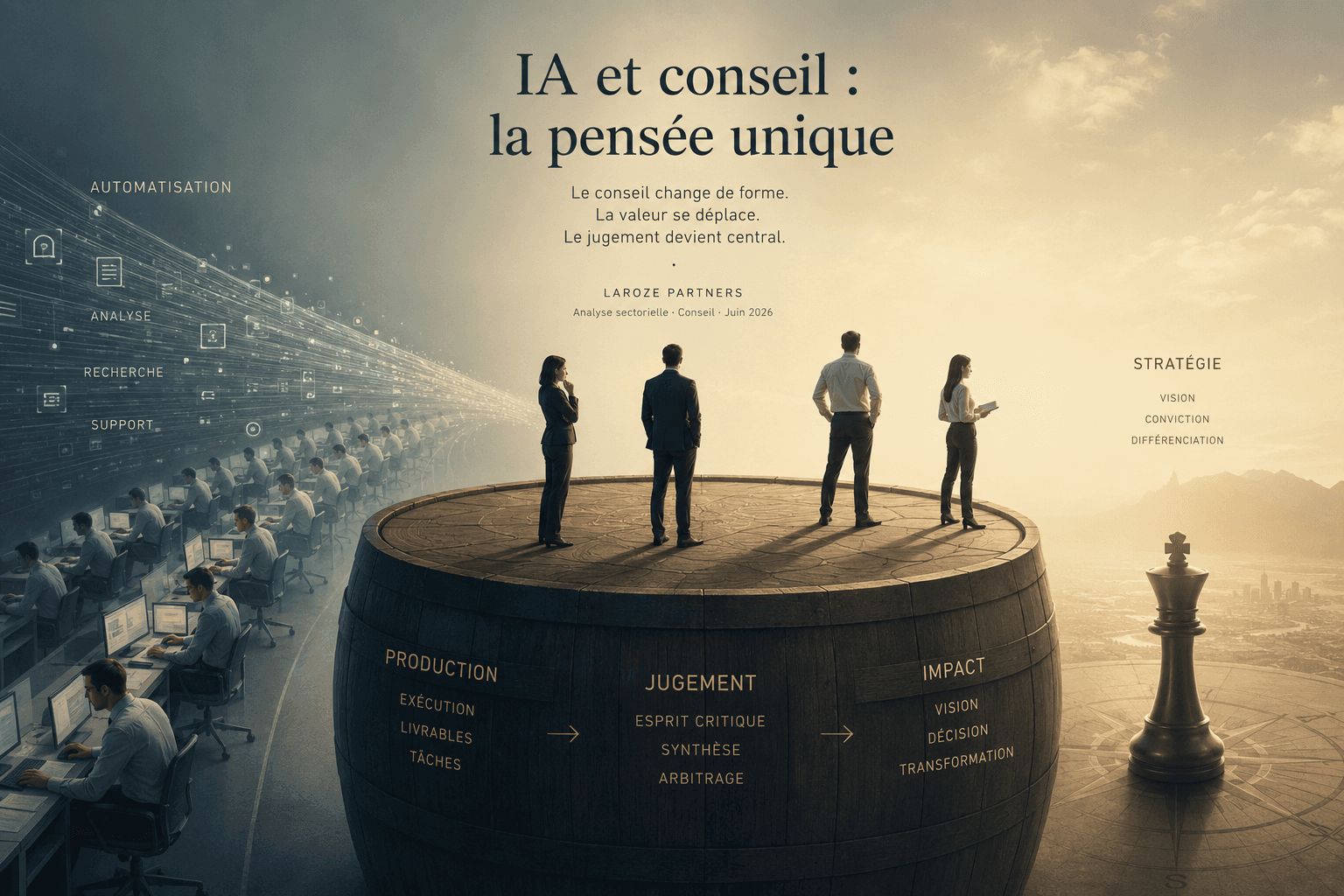
The consulting sector is going through its first contraction since the post-Covid euphoria. In parallel, AI is absorbing the tasks that used to keep juniors busy, and the pyramid is changing into a barrel. Behind these two movements lies the same shift: what creates the value of consulting is moving from production to judgment. And this is redefining the profile of both the consultant and the firm's leader.
The sector in a few numbers
−1.5% | −15% | 41% vs 37% | 45% |
|---|---|---|---|
Decline in strategy and management consulting in 2025, which accounts for 77% of the sector's activity | Drop in recruitment consulting in 2025, the most vulnerable segment | Share of experienced profiles, compared to juniors, in anticipated recruitments for 2026. The pyramid is changing into a barrel | Share of young graduates leaving a Big Four firm in the first three years, in search of work-life balance |
A new phase for consulting
After years of sustained growth, driven by the post-Covid catch-up, consulting has entered a different phase. Strategy and management consulting, which represents more than three-quarters of the sector's activity, fell by 1.5% in 2025, after stagnating in 2024 and experiencing growth of 12% in 2023 and 15% in 2022. The recruitment segment, meanwhile, dropped by 15%, weakened by hiring freezes.
Market players anticipate a cautious 2% rebound in 2026. But what is striking is not the figure, it is the change in nature. In a context of permacrisis, clients are prioritizing more operational, faster-to-implement projects that are directly linked to immediate business challenges. They no longer want to pay for a diagnosis, they want a measurable impact. And they now demand to see the actual value of assignments, while fewer than one in four assignments are currently subject to an impact assessment.
The need for consulting is not disappearing. But its value is shifting.
AI attacks the base of the pyramid
The consulting model has historically rested on a pyramid: a wide base of juniors who produce the analysis, supervised by managers, and led by partners. It is this base that AI is hitting first.
The tasks historically assigned to young consultants, like data collection, data processing, producing initial analyses, and formatting presentations, are now absorbed by generative AI. The junior consultant is facing a transformation. And clients know it: they are using AI adoption by firms as a lever for fee negotiations, which directly impacts the business model.
The consequence is structural. The president of Syntec Conseil puts it bluntly: the pyramid is going to change into a barrel. Firms are looking for more experienced profiles and fewer juniors. For 2026, 41% of anticipated recruitments concern experienced profiles, compared to 37% of juniors. The overall recruitment volume, on the other hand, has collapsed: 20% of workforce headcount in 2025, compared to 33% in 2023.
This is not a temporary cyclical adjustment. It is a transformation of the consulting production model.
The risk of groupthink
Here is what I observe, which macroeconomic analyses do not mention. As AI democratizes access to analytical capabilities, a new risk emerges: the standardization of thought.
If all consultants, at all levels, are trained on the same tools, fed the same models, and trained to produce in the same way, the sector is exposed to the rise of groupthink. When analysis becomes a commodity accessible to all, it ceases to be a differentiating factor. Those who stand out will not be those who master the tool, because everyone will master it. They will be those who know how to ask better questions, contextualize better, and make better decisions. Those who have a point of view.
This is precisely where the value of consulting is shifting: toward judgment, decision support, and the ability to mobilize executives when facing a complex situation. AI produces the analysis. It does not carry the responsibility of a recommendation before an executive committee. This shift does not weaken the profession; it raises its standards.
The end of the boutique advantage?
This transformation is combined with a market turnaround that I see directly affecting the attractiveness of consulting firms.
In 2022, at the peak of the cycle, boutique firms had the wind in their sails. Faced with soaring compensation, with increases of 8% to 20% and equity opportunities at all levels, they attracted talent with something else: human-sized teams, genuine proximity to a partner, and an entrepreneurial mindset. This resonated with managers seeking impact and autonomy. Their agility was a decisive argument.
Since 2024, the pressure has mounted, and the logic has reversed. When the market tightens, candidates again prioritize the reputation of large firms and the prestige they offer on a resume. Salary scales have homogenized: large firms have caught up, and boutiques can no longer attract talent solely by outbidding on salaries. Furthermore, structures born from spin-offs of large firms, such as Interpath in restructuring & transaction services, are reshuffling the established hierarchy.
This signal also applies to the giants. At Accenture France, the prolonged salary freeze and the drop in promotions since 2022 show that even the big players are not immune to tension. Attractiveness is no longer determined by the same factors as three years ago.
The escape to corporate
The third movement, and the most revealing one for anyone who recruits: the relationship between work and personal life has taken a central role in consultants' career choices.
Long hours are accepted when they are exceptional. It is their recurrence that exhausts and drives departures. The figures are clear: over 45% of young graduates leave a Big Four firm within the first three years, and 65% of young graduates state they prioritize purpose and flexibility over resume prestige. Turnover in large firms is close to 20% per year.
Yet these talents are not leaving the market; they are changing playing fields. They are moving to corporate roles in mergers and acquisitions, corporate finance, strategy, or transformation, where they find an impactful operational role and a better balance. Experience in consulting remains a passport to leadership roles in major groups.
For an executive search firm, this flow is not a net loss for the sector. It is a market in its own right: the former consultant becomes an executive, and the bridge between consulting and corporate is built right there.
What this changes for profiles and recruiting
Taken together, these three dynamics reshape both the profile of the firm leader and the nature of recruitment in consulting.
The partner of tomorrow is no longer primarily an organizer of production. They are a bearer of judgment, capable of embodying a point of view in a market where analysis is commoditized, building a lasting trust-based relationship with clients, and mobilizing executives around difficult decisions. Value is shifting toward what AI cannot provide.
Three key observations emerge from this, which firms tend to underestimate.
First: seniorization changes the very nature of recruitment. We no longer recruit interchangeable juniors in large volumes; we headhunt experienced and rare profiles in a tight market where these profiles are highly sought after.
Second: attractiveness is no longer about compensation alone. Salary scales have homogenized. What retains a good profile today is purpose, autonomy, career path, and the quality of the project. This is built and evaluated far beyond the compensation package.
Third: leaving for corporate roles should be viewed as a flow, not a flight. The former consultant who becomes a CFO, Head of M&A, or Corporate Transformation Director is exactly the type of profile that we support toward leadership roles in large groups. Understanding this flow means knowing where tomorrow's best leaders are located.
What this context requires
AI is not killing consulting. It is forcing it to prove its value where AI cannot reach: judgment, trust, and executive mobilization. The firms that succeed in this transition will not be those that have automated the most, but those that have been able to attract and retain the right profiles in a barrel-shaped market, where analysis is commoditized and where unique thinking becomes the real differentiator.
And the leaders emerging from consulting will increasingly shape the corporate world. Understanding these flows, identifying these rare profiles, and knowing where tomorrow's value is being built is exactly where our work takes place.
Laroze Partners — Executive Search Firm: Consulting · Tech & Services · Health & Pharma · Retail
Sources: Syntec Conseil, 2024-2025 and 2025-2026 studies (David Mahé) · Consultor · Les Echos · APEC · Universum 2024 · McKinsey 2024.
Laroze Partners · Sector Analysis · Consulting · June 2026
The consulting sector is going through its first contraction since the post-Covid euphoria. In parallel, AI is absorbing the tasks that used to keep juniors busy, and the pyramid is changing into a barrel. Behind these two movements lies the same shift: what creates the value of consulting is moving from production to judgment. And this is redefining the profile of both the consultant and the firm's leader.
The sector in a few numbers
−1.5% | −15% | 41% vs 37% | 45% |
|---|---|---|---|
Decline in strategy and management consulting in 2025, which accounts for 77% of the sector's activity | Drop in recruitment consulting in 2025, the most vulnerable segment | Share of experienced profiles, compared to juniors, in anticipated recruitments for 2026. The pyramid is changing into a barrel | Share of young graduates leaving a Big Four firm in the first three years, in search of work-life balance |
A new phase for consulting
After years of sustained growth, driven by the post-Covid catch-up, consulting has entered a different phase. Strategy and management consulting, which represents more than three-quarters of the sector's activity, fell by 1.5% in 2025, after stagnating in 2024 and experiencing growth of 12% in 2023 and 15% in 2022. The recruitment segment, meanwhile, dropped by 15%, weakened by hiring freezes.
Market players anticipate a cautious 2% rebound in 2026. But what is striking is not the figure, it is the change in nature. In a context of permacrisis, clients are prioritizing more operational, faster-to-implement projects that are directly linked to immediate business challenges. They no longer want to pay for a diagnosis, they want a measurable impact. And they now demand to see the actual value of assignments, while fewer than one in four assignments are currently subject to an impact assessment.
The need for consulting is not disappearing. But its value is shifting.
AI attacks the base of the pyramid
The consulting model has historically rested on a pyramid: a wide base of juniors who produce the analysis, supervised by managers, and led by partners. It is this base that AI is hitting first.
The tasks historically assigned to young consultants, like data collection, data processing, producing initial analyses, and formatting presentations, are now absorbed by generative AI. The junior consultant is facing a transformation. And clients know it: they are using AI adoption by firms as a lever for fee negotiations, which directly impacts the business model.
The consequence is structural. The president of Syntec Conseil puts it bluntly: the pyramid is going to change into a barrel. Firms are looking for more experienced profiles and fewer juniors. For 2026, 41% of anticipated recruitments concern experienced profiles, compared to 37% of juniors. The overall recruitment volume, on the other hand, has collapsed: 20% of workforce headcount in 2025, compared to 33% in 2023.
This is not a temporary cyclical adjustment. It is a transformation of the consulting production model.
The risk of groupthink
Here is what I observe, which macroeconomic analyses do not mention. As AI democratizes access to analytical capabilities, a new risk emerges: the standardization of thought.
If all consultants, at all levels, are trained on the same tools, fed the same models, and trained to produce in the same way, the sector is exposed to the rise of groupthink. When analysis becomes a commodity accessible to all, it ceases to be a differentiating factor. Those who stand out will not be those who master the tool, because everyone will master it. They will be those who know how to ask better questions, contextualize better, and make better decisions. Those who have a point of view.
This is precisely where the value of consulting is shifting: toward judgment, decision support, and the ability to mobilize executives when facing a complex situation. AI produces the analysis. It does not carry the responsibility of a recommendation before an executive committee. This shift does not weaken the profession; it raises its standards.
The end of the boutique advantage?
This transformation is combined with a market turnaround that I see directly affecting the attractiveness of consulting firms.
In 2022, at the peak of the cycle, boutique firms had the wind in their sails. Faced with soaring compensation, with increases of 8% to 20% and equity opportunities at all levels, they attracted talent with something else: human-sized teams, genuine proximity to a partner, and an entrepreneurial mindset. This resonated with managers seeking impact and autonomy. Their agility was a decisive argument.
Since 2024, the pressure has mounted, and the logic has reversed. When the market tightens, candidates again prioritize the reputation of large firms and the prestige they offer on a resume. Salary scales have homogenized: large firms have caught up, and boutiques can no longer attract talent solely by outbidding on salaries. Furthermore, structures born from spin-offs of large firms, such as Interpath in restructuring & transaction services, are reshuffling the established hierarchy.
This signal also applies to the giants. At Accenture France, the prolonged salary freeze and the drop in promotions since 2022 show that even the big players are not immune to tension. Attractiveness is no longer determined by the same factors as three years ago.
The escape to corporate
The third movement, and the most revealing one for anyone who recruits: the relationship between work and personal life has taken a central role in consultants' career choices.
Long hours are accepted when they are exceptional. It is their recurrence that exhausts and drives departures. The figures are clear: over 45% of young graduates leave a Big Four firm within the first three years, and 65% of young graduates state they prioritize purpose and flexibility over resume prestige. Turnover in large firms is close to 20% per year.
Yet these talents are not leaving the market; they are changing playing fields. They are moving to corporate roles in mergers and acquisitions, corporate finance, strategy, or transformation, where they find an impactful operational role and a better balance. Experience in consulting remains a passport to leadership roles in major groups.
For an executive search firm, this flow is not a net loss for the sector. It is a market in its own right: the former consultant becomes an executive, and the bridge between consulting and corporate is built right there.
What this changes for profiles and recruiting
Taken together, these three dynamics reshape both the profile of the firm leader and the nature of recruitment in consulting.
The partner of tomorrow is no longer primarily an organizer of production. They are a bearer of judgment, capable of embodying a point of view in a market where analysis is commoditized, building a lasting trust-based relationship with clients, and mobilizing executives around difficult decisions. Value is shifting toward what AI cannot provide.
Three key observations emerge from this, which firms tend to underestimate.
First: seniorization changes the very nature of recruitment. We no longer recruit interchangeable juniors in large volumes; we headhunt experienced and rare profiles in a tight market where these profiles are highly sought after.
Second: attractiveness is no longer about compensation alone. Salary scales have homogenized. What retains a good profile today is purpose, autonomy, career path, and the quality of the project. This is built and evaluated far beyond the compensation package.
Third: leaving for corporate roles should be viewed as a flow, not a flight. The former consultant who becomes a CFO, Head of M&A, or Corporate Transformation Director is exactly the type of profile that we support toward leadership roles in large groups. Understanding this flow means knowing where tomorrow's best leaders are located.
What this context requires
AI is not killing consulting. It is forcing it to prove its value where AI cannot reach: judgment, trust, and executive mobilization. The firms that succeed in this transition will not be those that have automated the most, but those that have been able to attract and retain the right profiles in a barrel-shaped market, where analysis is commoditized and where unique thinking becomes the real differentiator.
And the leaders emerging from consulting will increasingly shape the corporate world. Understanding these flows, identifying these rare profiles, and knowing where tomorrow's value is being built is exactly where our work takes place.
Laroze Partners — Executive Search Firm: Consulting · Tech & Services · Health & Pharma · Retail
Sources: Syntec Conseil, 2024-2025 and 2025-2026 studies (David Mahé) · Consultor · Les Echos · APEC · Universum 2024 · McKinsey 2024.
Laroze Partners · Sector Analysis · Consulting · June 2026
The consulting sector is going through its first contraction since the post-Covid euphoria. In parallel, AI is absorbing the tasks that used to keep juniors busy, and the pyramid is changing into a barrel. Behind these two movements lies the same shift: what creates the value of consulting is moving from production to judgment. And this is redefining the profile of both the consultant and the firm's leader.
The sector in a few numbers
−1.5% | −15% | 41% vs 37% | 45% |
|---|---|---|---|
Decline in strategy and management consulting in 2025, which accounts for 77% of the sector's activity | Drop in recruitment consulting in 2025, the most vulnerable segment | Share of experienced profiles, compared to juniors, in anticipated recruitments for 2026. The pyramid is changing into a barrel | Share of young graduates leaving a Big Four firm in the first three years, in search of work-life balance |
A new phase for consulting
After years of sustained growth, driven by the post-Covid catch-up, consulting has entered a different phase. Strategy and management consulting, which represents more than three-quarters of the sector's activity, fell by 1.5% in 2025, after stagnating in 2024 and experiencing growth of 12% in 2023 and 15% in 2022. The recruitment segment, meanwhile, dropped by 15%, weakened by hiring freezes.
Market players anticipate a cautious 2% rebound in 2026. But what is striking is not the figure, it is the change in nature. In a context of permacrisis, clients are prioritizing more operational, faster-to-implement projects that are directly linked to immediate business challenges. They no longer want to pay for a diagnosis, they want a measurable impact. And they now demand to see the actual value of assignments, while fewer than one in four assignments are currently subject to an impact assessment.
The need for consulting is not disappearing. But its value is shifting.
AI attacks the base of the pyramid
The consulting model has historically rested on a pyramid: a wide base of juniors who produce the analysis, supervised by managers, and led by partners. It is this base that AI is hitting first.
The tasks historically assigned to young consultants, like data collection, data processing, producing initial analyses, and formatting presentations, are now absorbed by generative AI. The junior consultant is facing a transformation. And clients know it: they are using AI adoption by firms as a lever for fee negotiations, which directly impacts the business model.
The consequence is structural. The president of Syntec Conseil puts it bluntly: the pyramid is going to change into a barrel. Firms are looking for more experienced profiles and fewer juniors. For 2026, 41% of anticipated recruitments concern experienced profiles, compared to 37% of juniors. The overall recruitment volume, on the other hand, has collapsed: 20% of workforce headcount in 2025, compared to 33% in 2023.
This is not a temporary cyclical adjustment. It is a transformation of the consulting production model.
The risk of groupthink
Here is what I observe, which macroeconomic analyses do not mention. As AI democratizes access to analytical capabilities, a new risk emerges: the standardization of thought.
If all consultants, at all levels, are trained on the same tools, fed the same models, and trained to produce in the same way, the sector is exposed to the rise of groupthink. When analysis becomes a commodity accessible to all, it ceases to be a differentiating factor. Those who stand out will not be those who master the tool, because everyone will master it. They will be those who know how to ask better questions, contextualize better, and make better decisions. Those who have a point of view.
This is precisely where the value of consulting is shifting: toward judgment, decision support, and the ability to mobilize executives when facing a complex situation. AI produces the analysis. It does not carry the responsibility of a recommendation before an executive committee. This shift does not weaken the profession; it raises its standards.
The end of the boutique advantage?
This transformation is combined with a market turnaround that I see directly affecting the attractiveness of consulting firms.
In 2022, at the peak of the cycle, boutique firms had the wind in their sails. Faced with soaring compensation, with increases of 8% to 20% and equity opportunities at all levels, they attracted talent with something else: human-sized teams, genuine proximity to a partner, and an entrepreneurial mindset. This resonated with managers seeking impact and autonomy. Their agility was a decisive argument.
Since 2024, the pressure has mounted, and the logic has reversed. When the market tightens, candidates again prioritize the reputation of large firms and the prestige they offer on a resume. Salary scales have homogenized: large firms have caught up, and boutiques can no longer attract talent solely by outbidding on salaries. Furthermore, structures born from spin-offs of large firms, such as Interpath in restructuring & transaction services, are reshuffling the established hierarchy.
This signal also applies to the giants. At Accenture France, the prolonged salary freeze and the drop in promotions since 2022 show that even the big players are not immune to tension. Attractiveness is no longer determined by the same factors as three years ago.
The escape to corporate
The third movement, and the most revealing one for anyone who recruits: the relationship between work and personal life has taken a central role in consultants' career choices.
Long hours are accepted when they are exceptional. It is their recurrence that exhausts and drives departures. The figures are clear: over 45% of young graduates leave a Big Four firm within the first three years, and 65% of young graduates state they prioritize purpose and flexibility over resume prestige. Turnover in large firms is close to 20% per year.
Yet these talents are not leaving the market; they are changing playing fields. They are moving to corporate roles in mergers and acquisitions, corporate finance, strategy, or transformation, where they find an impactful operational role and a better balance. Experience in consulting remains a passport to leadership roles in major groups.
For an executive search firm, this flow is not a net loss for the sector. It is a market in its own right: the former consultant becomes an executive, and the bridge between consulting and corporate is built right there.
What this changes for profiles and recruiting
Taken together, these three dynamics reshape both the profile of the firm leader and the nature of recruitment in consulting.
The partner of tomorrow is no longer primarily an organizer of production. They are a bearer of judgment, capable of embodying a point of view in a market where analysis is commoditized, building a lasting trust-based relationship with clients, and mobilizing executives around difficult decisions. Value is shifting toward what AI cannot provide.
Three key observations emerge from this, which firms tend to underestimate.
First: seniorization changes the very nature of recruitment. We no longer recruit interchangeable juniors in large volumes; we headhunt experienced and rare profiles in a tight market where these profiles are highly sought after.
Second: attractiveness is no longer about compensation alone. Salary scales have homogenized. What retains a good profile today is purpose, autonomy, career path, and the quality of the project. This is built and evaluated far beyond the compensation package.
Third: leaving for corporate roles should be viewed as a flow, not a flight. The former consultant who becomes a CFO, Head of M&A, or Corporate Transformation Director is exactly the type of profile that we support toward leadership roles in large groups. Understanding this flow means knowing where tomorrow's best leaders are located.
What this context requires
AI is not killing consulting. It is forcing it to prove its value where AI cannot reach: judgment, trust, and executive mobilization. The firms that succeed in this transition will not be those that have automated the most, but those that have been able to attract and retain the right profiles in a barrel-shaped market, where analysis is commoditized and where unique thinking becomes the real differentiator.
And the leaders emerging from consulting will increasingly shape the corporate world. Understanding these flows, identifying these rare profiles, and knowing where tomorrow's value is being built is exactly where our work takes place.
Laroze Partners — Executive Search Firm: Consulting · Tech & Services · Health & Pharma · Retail
Sources: Syntec Conseil, 2024-2025 and 2025-2026 studies (David Mahé) · Consultor · Les Echos · APEC · Universum 2024 · McKinsey 2024.
Read also




Read also
CONTACT
Let's work together.
At Laroze Partners, we believe that recruiting a leader is a strategic, foundational, and engaging act. That’s why we have turned it into an art of precision: listening, intuition, method. We offer customized support over time for a real impact in service of the success of your executive teams.
CONTACT
Let's work together.
At Laroze Partners, we believe that recruiting a leader is a strategic, foundational, and engaging act. That’s why we have turned it into an art of precision: listening, intuition, method. We offer customized support over time for a real impact in service of the success of your executive teams.
CONTACT
Let's work together.
At Laroze Partners, we believe that recruiting a leader is a strategic, foundational, and engaging act. That’s why we have turned it into an art of precision: listening, intuition, method. We offer customized support over time for a real impact in service of the success of your executive teams.