Share
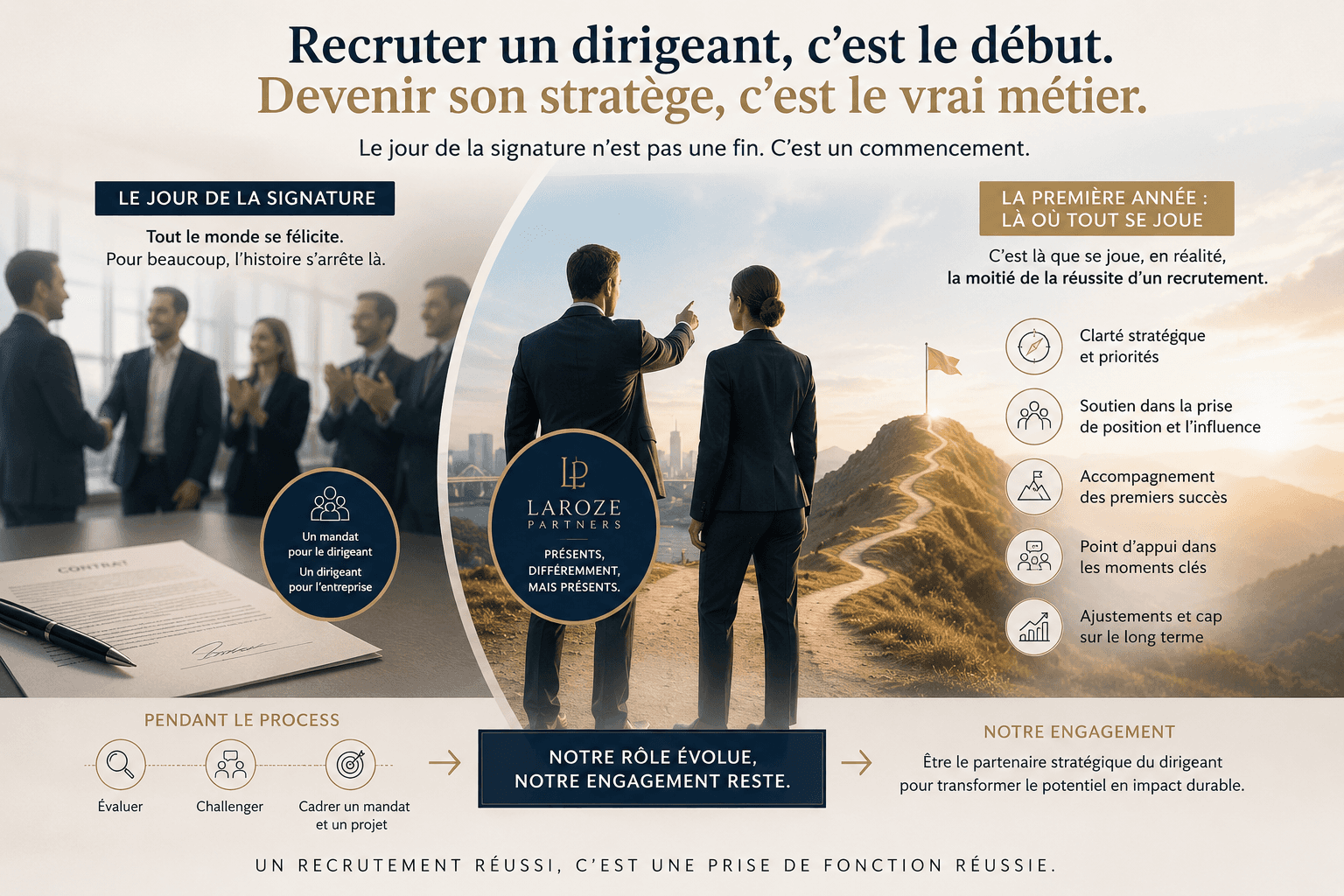
On signing day, everyone congratulates themselves. The client has found their executive, the leader has found their mandate, and for many, the story ends there. At Laroze Partners, that day marks a beginning, not an end. It is the moment when our role changes in nature. During the process, we evaluated, challenged, and framed a mandate with the client and a project with the candidate. Once the signature is done, we remain present, differently, but present.
This text speaks of that period which is rarely mentioned in executive recruitment: the first year of taking office. This is where, in reality, half of the success of a recruitment is played out.
What actually happens in the first 12 months
An executive arriving in a new organization, no matter how experienced, discovers a system they do not yet know. The process tells us nothing about the actual power play between functions, the unspoken rules of a management committee, or how decisions are truly made beyond the organization chart. A CEO, a Chairman, a Country Manager, arrives with a roadmap presented to them during the interview. Once in office, they discover a more nuanced reality, sometimes slower, sometimes more political.
The first thing a leader must rebuild is not their action plan, but their legitimacy. The title gives formal authority, the one showing on the organization chart. It is never enough on its own. True legitimacy is earned in the first weeks, through the way the executive listens, asks questions, and makes their first decisions. An executive who arrives thinking their title speaks for itself quickly runs into a team waiting to see before following.
This phase also requires reading a power play that is never obvious right away: who really decides on a given subject, what historical relationship exists between two departments supposed to simply collaborate, what balances a board spent years building and which should not be shaken up without understanding the reasons. None of this is on an organization chart, and ignoring it sometimes leads to making decisions that are right in substance but poorly received in form.
The first few weeks are often the most fragile. The executive is in doubt, finding their bearing, hesitating between asserting themselves too quickly and being absorbed by what already exists. This is exactly the moment when support makes a difference, not to dictate what to do, but to help them read their situation correctly before acting.
The real risk, at this stage, is not being wrong on the substance. It is being wrong about the timing. Deciding too early, before having understood why things work the way they do, exposes one to decisions that seem brutal or disconnected from the context. Waiting too long, out of excess caution, sends the opposite signal: that of a leader who observes without ever acting, which wears out a board's patience as much as a clumsy decision. Between the two, there is a window, often narrower than we think, where the first decisions truly commit the remainder of the mandate.
Then comes an equally decisive question: who will this executive build with. A CEO rarely inherits a management committee tailored for the project entrusted to them. They often have to restructure it, recruit certain key positions, sometimes let go of employees who can no longer keep up. This step commits the organization for several years. It deserves as much rigor as the recruitment of the executive themselves.
What it changes for an executive and for the company that chose them
An executive left to their own devices in their first few months moves on instinct. They may go too fast out of a desire to prove their worth, or too slowly out of excessive caution. Both behaviors worry a board or a shareholder expecting visible results quickly, without always measuring the actual time it takes to settle into an executive position.
A well-supported executive moves differently. They take the time to understand before making a decision, without letting themselves be overwhelmed by urgency. They structure their management team methodically rather than in a rush. They arrive at their first strategic decisions with a sharper reading of the context, which significantly reduces the risk of a false start, for them as for the company that recruited them.
And on the other side, the client company gains something it does not always measure at the time of signing: a partner who already knows its context, who has met its market through the talent search carried out to find this executive, and who can continue to advise them long after the recruitment is finished.
Our way of working after the signature
At Laroze Partners, the relationship with an executive we have recruited does not end on the day of their arrival. In the first month, we stay by their side just as we support any onboarding: we answer their questions, we help them understand the difficulties they encounter, and show them how to position themselves and act in their new context. Our role at that moment is like that of an onboarding coach. We help them dispel their doubts, build confidence, and not rush, so they can avoid the classic traps of a starting mandate.
This proximity naturally continues in building their team. We recently recruited a CEO in the industrial sector. Since then, we have been supporting them to recruit their CFO, VP of Sales, and HRD. Why does this continuity exist? Because the trust built during the recruitment process does not disappear at the signature; it extends. We know this CEO, their way of deciding, what they need to be credible facing their board and their market. We help them surround themselves with solid profiles, sometimes better than them in their specific function, which strengthens their credibility rather than weakening it. A leader who surrounds themselves well has nothing to prove by surrounding themselves with weaker profiles than their own.
The majority of our executive recruitments thus extend into strategic guidance. When we recruit a CEO, a Managing Director, or a Country Manager, we build a special relationship with the client that goes beyond the framework of the initial mandate. We become somewhat of their ambassador and their thought partner on the subjects that follow.
This capability comes directly from our craft. While hunting for an executive, we typically meet a dozen profiles operating in contexts close to theirs: the same sector, the same growth or transformation challenges, sometimes the same competitors. This material allows us to provide a market orientation to the client: what is working elsewhere, what took longer than expected, what is better to anticipate. As executive search consultants, we have this unique capability to gather a wealth of information and quickly gain expertise in highly strategic matters.
In practical terms, this support does not follow a rigid protocol. We remain available at the request of the executive and the client. Outside of these requests, we organize a catch-up every six months to ensure everything is moving forward smoothly. It is a rhythm that gives the executive space to settle in, without ever leaving them alone for too long.
This approach also relies on what we build right from the recruitment process, with the Laroze Pattern®, our method of strategic reading of trajectories, leadership behaviors, and performance dynamics. This reading, done beforehand, tremendously helps us avoid making mistakes right from the recruitment stage, and to better support what we helped put in place. Of all our executive recruitments with high strategic stakes, none has been revoked. This is no coincidence; it is the result of work that starts before the signature and continues long after.
What remains true, once you have lived it
Recruiting a good executive is a major decision. But a decision alone guarantees nothing. What turns a successful recruitment into a successful transformation is what happens in the months that follow: the way the executive is helped to understand their new context, the way they build their team, and the way their client continues to be advised on the choices that follow.
This is the period that we choose not to let slip away. Not because it is our role on paper, but because it is the moment when everything built during recruitment either takes hold, or doesn't.
You have just recruited an executive, or you are in the process of doing so
If you are going through this period, the one where an executive is finding their bearings and their management committee is being built or rebuilt, let’s talk. This is precisely the moment when an external perspective, already familiar with your context, can make a real difference.