Mental health of executives: protecting time to think for better decision-making
Mental health of executives: protecting time to think for better decision-making
Mental health of executives: protecting time to think for better decision-making
Share
Laroze Partners · Conviction · Leadership & Mental Health · June 2026
A leader is asked to carry a vision, to rewrite their organization's trajectory, to dare, and to decide. All these faculties require an essential resource: time to think, and a mental state that allows for it. Yet, this is the first thing that the role sacrifices. A leader's mental health is not a matter of well-being. It is the very condition of the mission entrusted to them.
The topic in a few figures
72% | $1,000 Billion | 83% Vs. 66% | 41% |
|---|---|---|---|
Share of business founders describing their physical or mental state as poor. | Productivity lost each year worldwide due to depression and anxiety, representing 12 billion working days. | Psychological health of employees covered by a comprehensive prevention plan, compared to those who do not benefit from one. | Share of active French workers stating they have already experienced burnout in 2026. |
What is really demanded of a leader
When a company recruits a leader, it does not buy an execution capacity. It will find that elsewhere. It buys judgment, vision, the ability to decide amidst uncertainty, and to lead an organization toward a model that does not yet exist.
Yet, these faculties do not unfold in permanent urgency. They require distance, time to observe, connect, and anticipate. The paradox is cruel: the higher the responsibility, the more pressure consumes precisely the time and clarity necessary to exercise it. The leader is swallowed up by operational tasks, the calendar fills up, and the function for which they were chosen—to think about what lies ahead—becomes the first victim.
The best advice a leader can receive
Alexandre Bompard publicly shared the best advice he was given at the start of his mandate. Newly appointed to head a large group, he boasted to a director about a full agenda, a constant presence on the ground, and total availability to his teams. He recounts his interlocutor's silence, and then his response. That was not why they had chosen him. He was expected to free up time to think about tomorrow's model and build the group's strategy, which such an agenda made simply impossible.
The anecdote may seem trivial. In reality, it is extremely powerful because it says the essentials. What distinguishes a leader is not their ability to absorb everything, but their ability to look up from the handlebars when everyone around them keeps their head down. Stepping back is not a failure of the function. It is the function.
A matter of performance, not well-being
We must move this topic out of the compassionate register in which it is too often confined. A leader's mental health is a question of performance, and it can be measured.
Chronic stress and the lack of perspective degrade the exact faculties we recruit. Clarity of judgment, creativity, and the ability to decide calmly under uncertainty erode under prolonged mental fatigue. The asset we pay for, the quality of decision-making, directly depends on the state of the decider.
The signals are there. In 2024, 72% of founders qualified their physical or mental state as poor. Globally, depression and anxiety cause the loss of the equivalent of $1,000 billion in productivity each year. When a leader deteriorates, they are not the only one to falter; the quality of all decisions depending on them does too.
The paradox, and a personal conviction
Organizations recruit excellence with great care, and then set up the conditions that erode it. This is a waste, and it is avoidable.
I will speak here on my own behalf. I have made stepping back a discipline, not a luxury I afford myself when time allows. Every week, I block out slots that belong to this alone: sports, meditation, a cultural outing, or an experience that feeds me. And walking, especially. The most important disruptive decisions, those that allowed me to move forward better afterward, I took after long walks that allowed me to recenter and think clearly. Everyone has their own way, whichever it is. What is non-negotiable is the principle: without protected time to think, there is no good decision, only reaction.
The organization's responsibility
Mental health cannot rely on individual discipline alone. It is also, and above all, an organizational responsibility. And that is where the credibility of the subject is played out.
There is a gap between a real initiative and a facade. Posting a charter, setting up a rest room, or communicating on the subject is not enough, and teams see it immediately. What works is structural. The numbers prove it: 83% of employees covered by a comprehensive prevention plan are in good psychological health, compared to 66% for others. Serious prevention produces measurable results. Yet, 70% of working professionals still feel that companies are not doing enough.
The Executive Committee sets the tone, by example as much as by discourse. HR and CSR functions translate this tone into credible initiatives that take the subject seriously rather than merely cosmetizing it. An organization that protects its leaders' capacity for reflection and its teams' well-being is not being generous. It is protecting its own performance.
What this changes for recruitment and retention
This subject directly touches our line of work. The judgment we recruit in a leader is precisely the one that must then be preserved. Recruiting an exceptional profile and then exhausting them in an environment that does not protect their capacity to think is destroying the asset we just acquired.
The consequences are concrete. An eroded leader decides less well, inspires less, and eventually leaves. Exhaustion feeds attrition at the highest level, with a considerable cost of replacement and strategic discontinuity. A leader's retention is not just a matter of compensation or the project. It is also played out in the conditions that allow them to remain lucid and high-performing over time.
A leader's mental health is not just another HR topic, nor is it a trend. It is the condition of the mission entrusted to them. We cannot ask someone to design the future of an organization, to dare and decide, while depriving them of the time and balance that make this thinking possible.
Protecting this capacity, in oneself as in those we lead, is not an extra soul. It is a requirement of performance and responsibility. We pay a leader to think. We still need to give them the means to do so, and give them to ourselves.
Laroze Partners — Executive Search Firm Healthcare & Pharma · Medtech · Retail · Tech & Services · Consulting
Sources: World Health Organization · Entrepreneur Mental Health Panorama, 2024 · mental health at work barometers 2026 (Qualisocial-Ipsos, Great Place To Work) · Ipsos data on corporate prevention · advice shared by Alexandre Bompard in a public interview (Legend show). This article reflects the practitioner perspective of Laroze Partners.
Laroze Partners · Conviction · Leadership & Mental Health · June 2026
A leader is asked to carry a vision, to rewrite their organization's trajectory, to dare, and to decide. All these faculties require an essential resource: time to think, and a mental state that allows for it. Yet, this is the first thing that the role sacrifices. A leader's mental health is not a matter of well-being. It is the very condition of the mission entrusted to them.
The topic in a few figures
72% | $1,000 Billion | 83% Vs. 66% | 41% |
|---|---|---|---|
Share of business founders describing their physical or mental state as poor. | Productivity lost each year worldwide due to depression and anxiety, representing 12 billion working days. | Psychological health of employees covered by a comprehensive prevention plan, compared to those who do not benefit from one. | Share of active French workers stating they have already experienced burnout in 2026. |
What is really demanded of a leader
When a company recruits a leader, it does not buy an execution capacity. It will find that elsewhere. It buys judgment, vision, the ability to decide amidst uncertainty, and to lead an organization toward a model that does not yet exist.
Yet, these faculties do not unfold in permanent urgency. They require distance, time to observe, connect, and anticipate. The paradox is cruel: the higher the responsibility, the more pressure consumes precisely the time and clarity necessary to exercise it. The leader is swallowed up by operational tasks, the calendar fills up, and the function for which they were chosen—to think about what lies ahead—becomes the first victim.
The best advice a leader can receive
Alexandre Bompard publicly shared the best advice he was given at the start of his mandate. Newly appointed to head a large group, he boasted to a director about a full agenda, a constant presence on the ground, and total availability to his teams. He recounts his interlocutor's silence, and then his response. That was not why they had chosen him. He was expected to free up time to think about tomorrow's model and build the group's strategy, which such an agenda made simply impossible.
The anecdote may seem trivial. In reality, it is extremely powerful because it says the essentials. What distinguishes a leader is not their ability to absorb everything, but their ability to look up from the handlebars when everyone around them keeps their head down. Stepping back is not a failure of the function. It is the function.
A matter of performance, not well-being
We must move this topic out of the compassionate register in which it is too often confined. A leader's mental health is a question of performance, and it can be measured.
Chronic stress and the lack of perspective degrade the exact faculties we recruit. Clarity of judgment, creativity, and the ability to decide calmly under uncertainty erode under prolonged mental fatigue. The asset we pay for, the quality of decision-making, directly depends on the state of the decider.
The signals are there. In 2024, 72% of founders qualified their physical or mental state as poor. Globally, depression and anxiety cause the loss of the equivalent of $1,000 billion in productivity each year. When a leader deteriorates, they are not the only one to falter; the quality of all decisions depending on them does too.
The paradox, and a personal conviction
Organizations recruit excellence with great care, and then set up the conditions that erode it. This is a waste, and it is avoidable.
I will speak here on my own behalf. I have made stepping back a discipline, not a luxury I afford myself when time allows. Every week, I block out slots that belong to this alone: sports, meditation, a cultural outing, or an experience that feeds me. And walking, especially. The most important disruptive decisions, those that allowed me to move forward better afterward, I took after long walks that allowed me to recenter and think clearly. Everyone has their own way, whichever it is. What is non-negotiable is the principle: without protected time to think, there is no good decision, only reaction.
The organization's responsibility
Mental health cannot rely on individual discipline alone. It is also, and above all, an organizational responsibility. And that is where the credibility of the subject is played out.
There is a gap between a real initiative and a facade. Posting a charter, setting up a rest room, or communicating on the subject is not enough, and teams see it immediately. What works is structural. The numbers prove it: 83% of employees covered by a comprehensive prevention plan are in good psychological health, compared to 66% for others. Serious prevention produces measurable results. Yet, 70% of working professionals still feel that companies are not doing enough.
The Executive Committee sets the tone, by example as much as by discourse. HR and CSR functions translate this tone into credible initiatives that take the subject seriously rather than merely cosmetizing it. An organization that protects its leaders' capacity for reflection and its teams' well-being is not being generous. It is protecting its own performance.
What this changes for recruitment and retention
This subject directly touches our line of work. The judgment we recruit in a leader is precisely the one that must then be preserved. Recruiting an exceptional profile and then exhausting them in an environment that does not protect their capacity to think is destroying the asset we just acquired.
The consequences are concrete. An eroded leader decides less well, inspires less, and eventually leaves. Exhaustion feeds attrition at the highest level, with a considerable cost of replacement and strategic discontinuity. A leader's retention is not just a matter of compensation or the project. It is also played out in the conditions that allow them to remain lucid and high-performing over time.
A leader's mental health is not just another HR topic, nor is it a trend. It is the condition of the mission entrusted to them. We cannot ask someone to design the future of an organization, to dare and decide, while depriving them of the time and balance that make this thinking possible.
Protecting this capacity, in oneself as in those we lead, is not an extra soul. It is a requirement of performance and responsibility. We pay a leader to think. We still need to give them the means to do so, and give them to ourselves.
Laroze Partners — Executive Search Firm Healthcare & Pharma · Medtech · Retail · Tech & Services · Consulting
Sources: World Health Organization · Entrepreneur Mental Health Panorama, 2024 · mental health at work barometers 2026 (Qualisocial-Ipsos, Great Place To Work) · Ipsos data on corporate prevention · advice shared by Alexandre Bompard in a public interview (Legend show). This article reflects the practitioner perspective of Laroze Partners.
Laroze Partners · Conviction · Leadership & Mental Health · June 2026
A leader is asked to carry a vision, to rewrite their organization's trajectory, to dare, and to decide. All these faculties require an essential resource: time to think, and a mental state that allows for it. Yet, this is the first thing that the role sacrifices. A leader's mental health is not a matter of well-being. It is the very condition of the mission entrusted to them.
The topic in a few figures
72% | $1,000 Billion | 83% Vs. 66% | 41% |
|---|---|---|---|
Share of business founders describing their physical or mental state as poor. | Productivity lost each year worldwide due to depression and anxiety, representing 12 billion working days. | Psychological health of employees covered by a comprehensive prevention plan, compared to those who do not benefit from one. | Share of active French workers stating they have already experienced burnout in 2026. |
What is really demanded of a leader
When a company recruits a leader, it does not buy an execution capacity. It will find that elsewhere. It buys judgment, vision, the ability to decide amidst uncertainty, and to lead an organization toward a model that does not yet exist.
Yet, these faculties do not unfold in permanent urgency. They require distance, time to observe, connect, and anticipate. The paradox is cruel: the higher the responsibility, the more pressure consumes precisely the time and clarity necessary to exercise it. The leader is swallowed up by operational tasks, the calendar fills up, and the function for which they were chosen—to think about what lies ahead—becomes the first victim.
The best advice a leader can receive
Alexandre Bompard publicly shared the best advice he was given at the start of his mandate. Newly appointed to head a large group, he boasted to a director about a full agenda, a constant presence on the ground, and total availability to his teams. He recounts his interlocutor's silence, and then his response. That was not why they had chosen him. He was expected to free up time to think about tomorrow's model and build the group's strategy, which such an agenda made simply impossible.
The anecdote may seem trivial. In reality, it is extremely powerful because it says the essentials. What distinguishes a leader is not their ability to absorb everything, but their ability to look up from the handlebars when everyone around them keeps their head down. Stepping back is not a failure of the function. It is the function.
A matter of performance, not well-being
We must move this topic out of the compassionate register in which it is too often confined. A leader's mental health is a question of performance, and it can be measured.
Chronic stress and the lack of perspective degrade the exact faculties we recruit. Clarity of judgment, creativity, and the ability to decide calmly under uncertainty erode under prolonged mental fatigue. The asset we pay for, the quality of decision-making, directly depends on the state of the decider.
The signals are there. In 2024, 72% of founders qualified their physical or mental state as poor. Globally, depression and anxiety cause the loss of the equivalent of $1,000 billion in productivity each year. When a leader deteriorates, they are not the only one to falter; the quality of all decisions depending on them does too.
The paradox, and a personal conviction
Organizations recruit excellence with great care, and then set up the conditions that erode it. This is a waste, and it is avoidable.
I will speak here on my own behalf. I have made stepping back a discipline, not a luxury I afford myself when time allows. Every week, I block out slots that belong to this alone: sports, meditation, a cultural outing, or an experience that feeds me. And walking, especially. The most important disruptive decisions, those that allowed me to move forward better afterward, I took after long walks that allowed me to recenter and think clearly. Everyone has their own way, whichever it is. What is non-negotiable is the principle: without protected time to think, there is no good decision, only reaction.
The organization's responsibility
Mental health cannot rely on individual discipline alone. It is also, and above all, an organizational responsibility. And that is where the credibility of the subject is played out.
There is a gap between a real initiative and a facade. Posting a charter, setting up a rest room, or communicating on the subject is not enough, and teams see it immediately. What works is structural. The numbers prove it: 83% of employees covered by a comprehensive prevention plan are in good psychological health, compared to 66% for others. Serious prevention produces measurable results. Yet, 70% of working professionals still feel that companies are not doing enough.
The Executive Committee sets the tone, by example as much as by discourse. HR and CSR functions translate this tone into credible initiatives that take the subject seriously rather than merely cosmetizing it. An organization that protects its leaders' capacity for reflection and its teams' well-being is not being generous. It is protecting its own performance.
What this changes for recruitment and retention
This subject directly touches our line of work. The judgment we recruit in a leader is precisely the one that must then be preserved. Recruiting an exceptional profile and then exhausting them in an environment that does not protect their capacity to think is destroying the asset we just acquired.
The consequences are concrete. An eroded leader decides less well, inspires less, and eventually leaves. Exhaustion feeds attrition at the highest level, with a considerable cost of replacement and strategic discontinuity. A leader's retention is not just a matter of compensation or the project. It is also played out in the conditions that allow them to remain lucid and high-performing over time.
A leader's mental health is not just another HR topic, nor is it a trend. It is the condition of the mission entrusted to them. We cannot ask someone to design the future of an organization, to dare and decide, while depriving them of the time and balance that make this thinking possible.
Protecting this capacity, in oneself as in those we lead, is not an extra soul. It is a requirement of performance and responsibility. We pay a leader to think. We still need to give them the means to do so, and give them to ourselves.
Laroze Partners — Executive Search Firm Healthcare & Pharma · Medtech · Retail · Tech & Services · Consulting
Sources: World Health Organization · Entrepreneur Mental Health Panorama, 2024 · mental health at work barometers 2026 (Qualisocial-Ipsos, Great Place To Work) · Ipsos data on corporate prevention · advice shared by Alexandre Bompard in a public interview (Legend show). This article reflects the practitioner perspective of Laroze Partners.
See more
See more
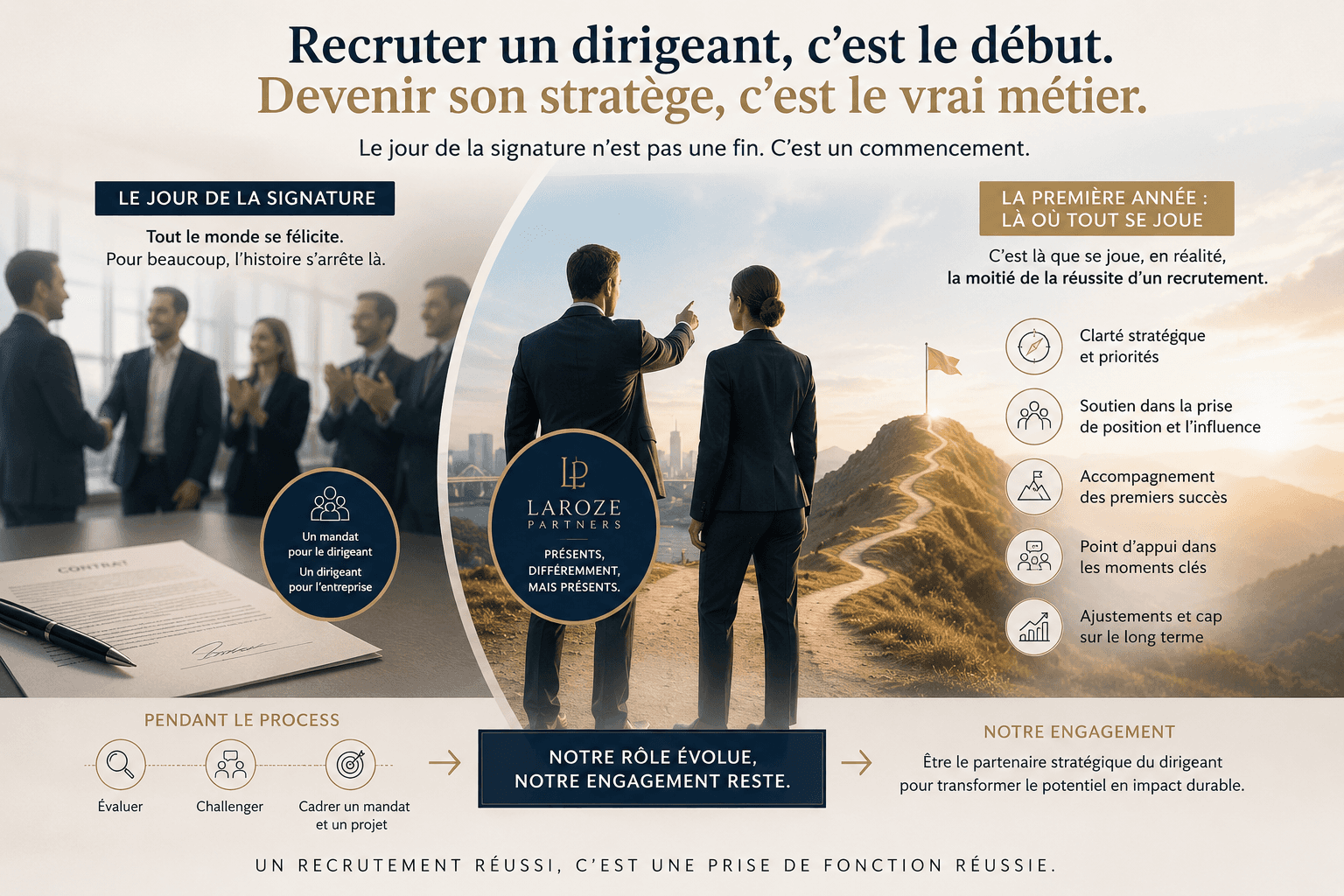
Accompanying a recruited executive: the key to their first year
Accompanying a recruited executive: the key to their first year

Executive Performance: The Errors That Destroy Value
Executive Performance: The Errors That Destroy Value

Executive succession: why boards prepare too late
Executive succession: why boards prepare too late

Health: the management and leadership laboratory of tomorrow
Health: the management and leadership laboratory of tomorrow
CONTACT
Let's talk about your next recruitment
Outline your needs in a few lines. Your request will be treated with the strictest confidentiality.
CONTACT
Let's talk about your next recruitment
Outline your needs in a few lines. Your request will be treated with the strictest confidentiality.
CONTACT
Let's talk about your next recruitment
Outline your needs in a few lines. Your request will be treated with the strictest confidentiality.