Share
The first quarter of 2026 was remarkable for French Medtech. 158 million euros raised, which is already 41% of the total for the year 2025. Announcements are piling up, press releases are flying, and founders are breathing a sigh of relief. They have convinced demanding investors. They have the funds. They have the roadmap.
What no one says at the closing press conference is that the fundraising has just changed the rules of the game. Including for the founder holding the microphone.
What the term sheet does not say explicitly, but is written everywhere
When a fund enters a Medtech's capital with 20, 30, or 50% dilution, it does not just buy shares. It buys the right to have a say in the direction of the company. A seat on the board, governance clauses, veto rights on major strategic decisions, including executive appointments.
This is not a threat. It is the normal mechanics of venture capital.
But it has a consequence that few founders truly integrate before signing: the model of "I stay in control as long as I want" no longer holds. It holds as long as results follow, the strategy is validated by the board, and the fund considers the founder to be the best available operator for the next phase. When one of these three conditions falters, the conversation changes in nature.
In 2012, a Harvard Business School study of more than 200 US venture-backed startups showed that in 50% of cases, the founder had left the CEO position before the IPO or acquisition. Not because they had failed. Often because the profile required for the next step was no longer theirs.
When scientists must learn to govern differently
Medtech has a specific characteristic that other sectors do not have to this degree: a large portion of its founders are scientists, clinicians, and researchers. Profiles of rare intellectual rigor, capable of holding a ten-year vision, convincing academic and industrial partners, and navigating complex regulatory environments.
What makes them extraordinary at the seed stage becomes a constraint past a certain size. Not due to a lack of competence, but because the job changes.
Running an 80-person organization with an institutional board, a quarterly performance obligation, and a commercial expansion to build is not the same job as leading a team of 12 researchers toward clinical validation. The tools, reflexes, and priorities are different.
What the board expects after a Series B is not just good clinical data. It is functions. A Chief Financial Officer capable of talking to investors and structuring reporting. A Chief Operating Officer to industrialize what has been proven in the lab. A Chief Commercial Officer to build the go-to-market organization. A HR Director to structure future hiring and preserve the culture during growth.
These functions did not exist at the seed stage. They did not need to exist. After the fundraising, their absence becomes a risk that the board documents. And that is where tension arises in the existing organization. The scientific and technical teams who built everything suddenly find themselves surrounded by new profiles who speak another language, challenge processes, and ask questions about deadlines, margins, and commercial priorities. Two cultures coexist, sometimes without understanding each other.
A well-managed transition is one where the scientific founder accepts a redefinition of their role toward what they do best: Chief Scientific Officer, Medical Director, Chairman of the Scientific Committee. A role of anchoring and legitimacy, not of day-to-day operations. And where new executive functions are recruited not to replace the company's DNA, but to give it a structure that-allows it to scale.
A poorly managed transition is one where the founder resists this redefinition, where new hires arrive without a clear mandate, and where the organization spends eighteen months fighting against itself rather than against the market.
Yesterday's organization will not be tomorrow's
A significant fundraising round does not just change the leader. It changes the organization deeply, often brutally. Team members assembled at the seed stage—those who held on during difficult moments, those who operated through proximity and direct trust in the founder—suddenly find themselves in a fast-growing structure, with new managers hired above them, new processes, and new priorities.
Some adapt. Others no longer find their place. A few leave. And this silent disintegration of the founding core is often the first loss of value post-fundraising, even before revenue disappoints.
A composite example, representative of several situations observed in the ecosystem: a French specialized diagnostic Medtech, after an €18 million Series B, urgently recruits an experienced CEO under pressure from the lead investor. The profile is solid on paper. He comes from a large pharmaceutical group. He knows how to structure. But he does not know the company's DNA, lacks technical legitimacy with the R&D teams, and applies reporting methods suited to organizations ten times larger. Within eighteen months, three key directors have left the company. The founder, now non-executive Chairman, watches his creation change its face without having the means to stop it.
This scenario is not exceptional. It is frequent.
Three phases, three profiles: what the founder must anticipate before signing
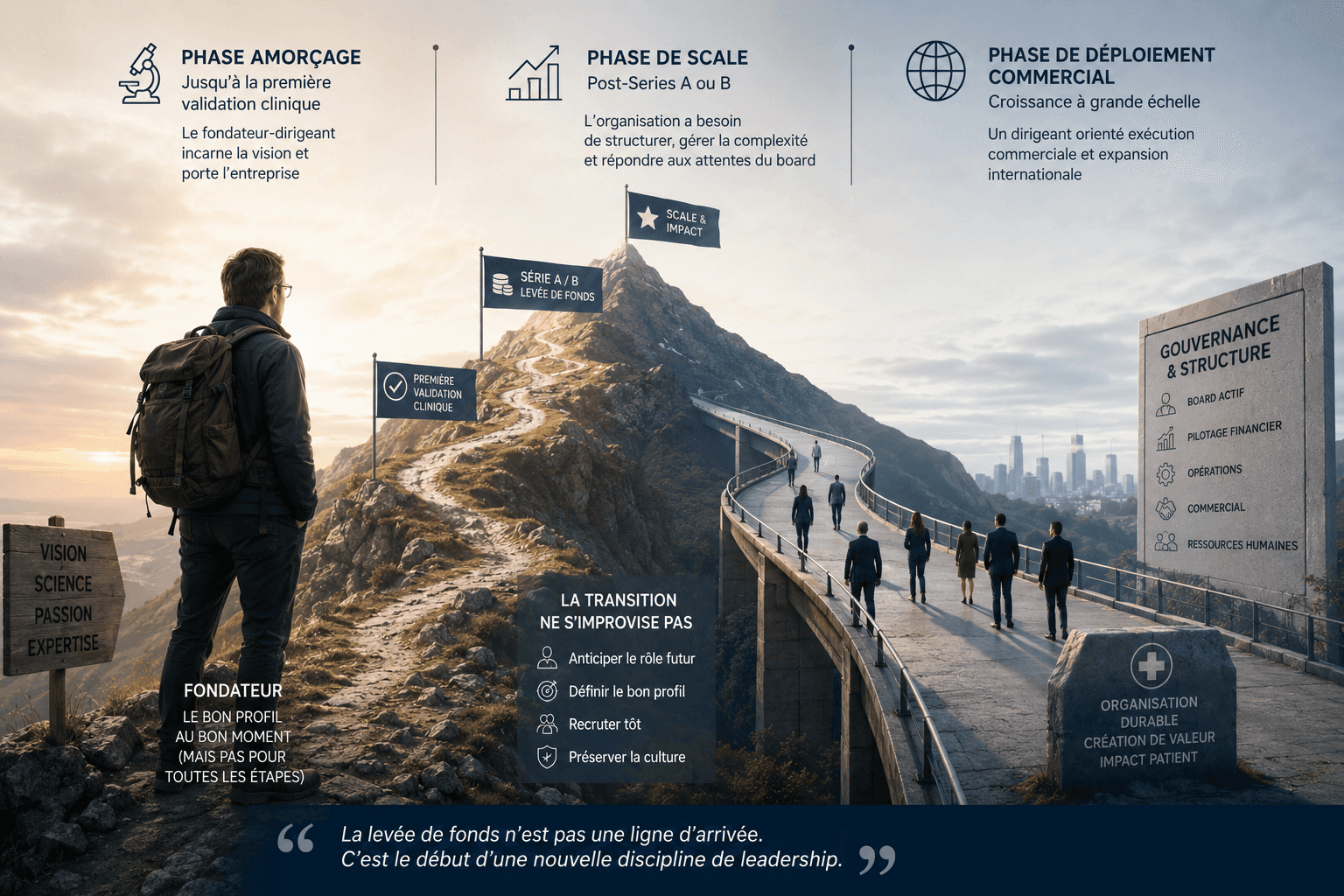
The life cycle of a growing Medtech goes through distinct phases, each requiring a different management profile. The question is not whether the transition will take place. It will. The question is who drives it, how, and within what timeframe.
Seed phase, up to the first clinical validation: the founder-CEO is often the right answer. They embody the vision, convince the first partners, and hold the organization together through the strength of their commitment. This profile is irreplaceable in this specific context.
Scale phase, post-Series A or B: this is where tension appears. The organization needs a leader capable of structuring without bureaucratizing, of simultaneously managing regulatory requirements, industrial partnerships, and the expectations of a now-active board. This profile is more demanding. And it is rarely the founder themselves, except when they have had the lucidity to prepare for it. Founders who navigate this phase well are those who agreed, before closing, to honestly define their own limits and build the leadership team around those limits, not around their ego.
Large-scale commercial deployment phase: yet a third profile. This time, a leader whose strength is building commercial organizations in regulated environments, often internationally. The founder can remain relevant at this stage, but in a redefined role: Chairman, Chief Scientific Officer, Ambassador. Not necessarily continuing in their role as CEO.
The right decision is made beforehand, when you are still free to choose
The window to anticipate this transition exists. It is short, and it closes fast.
The ideal moment is not after the closing, under pressure from the board. It is during negotiations, when the founder still has full latitude to define their future role, negotiate their potential departure terms, and especially to design the profile of the leader who will succeed or complement them.
The profile that needs to be recruited is not found in two weeks. They are in office, they do not respond to ads, and convincing them to change their trajectory takes time and methodology. Medtechs that manage this transition well started working on the subject six to nine months before the need was imposed from the outside.
Those who wait for the board to raise the question are no longer negotiating. They are complying.
What the founder who knows how to read their term sheet does differently
They do not endure the transition. They design it. They negotiate their post-closing role before the dilution is finalized. They define the criteria of the profile that will succeed or complement them, rather than letting the fund define them in their place. They build their network of qualified executive profiles before needing them. And they build an organization capable of riding out the change without losing its soul.
This work is not natural for a founder. It requires self-lucidity that few situations encourage. This is precisely the role of an external advisor: to bring this conversation to the table at the right time, with the right level of frankness.
Laroze Partners accompanies founders, executives, and investors on C-level recruitment and governance transitions in the Medtech, Healthcare, and Tech sectors.