Retail of tomorrow: which leaders should be recruited to transform the sector?
Retail of tomorrow: which leaders should be recruited to transform the sector?
Retail of tomorrow: which leaders should be recruited to transform the sector?
Share
The era of the retail king, who rose slowly from the ground up to operate a stable model, is drawing to a close. To transform, boards of directors are now betting on other profiles: turnaround specialists, leaders from other industries, and a younger generation elevated to executive roles.
These bets can revive a brand or fracture it. What distinguishes them is not the quality of the selected profile, but the clarity of the diagnosis made before the search begins.
Figures to Know
Indicator | Value | Source |
|---|---|---|
Commercial surface area that disappeared from French mass retail in 2024 | around 200,000 m² | Républik Retail |
Commercial vacancy rate | around 11% | Républik Retail |
Retail executives who believe the balance of power is shifting in favor of retailers | 79% | Deloitte Retail Industry Global Outlook 2026 |
Revenue growth generated by Leroy Merlin's influencer program, October 2024 to May 2025 | multiplied by 9 | timeskipper |
Return on investment for the same program, first five months of 2025 | multiplied by 21 | timeskipper |
Mandatory contract threshold for an influencer collaboration | 1,000 euros excluding tax, since January 1, 2026 | French legal framework |
Why This Subject Matters Now
Three movements have aligned.
Physical contraction has become structural. Surface areas are shrinking, vacancy rates are rising, and the erosion of margins is no longer offset by network growth.
Consolidation has shifted from an option to a condition for survival. In fashion, the Beaumanoir group quickly absorbed Jennyfer and Naf Naf, the Amoniss group assembled a consortium around Pimkie, Christine Laure, and Chevignon, and Celio revived Camaïeu. Integrating acquired brands, merging cultures, and rationalizing without destroying brand value requires a very different profile than the traditional operator.
Artificial intelligence has moved from experimentation to operational deployment. Power is shifting to those who own the data and the customer relationship.
In this context, operating well is no longer enough. Boards want to transform, and to transform they are betting on other leaders.
The Three Bets Boards Are Making Today
The Turnaround Specialist
For brands in distress, boards are appointing turnaround and restructuring profiles, with an explicit mandate to reposition. Hanane Ennassiri, at the head of Saint-Maclou, has initiated a strategic repositioning to revive the brand.
The wave of consolidation amplifies this need. A post-acquisition integration mandate is not an operations mandate.
The Profile from Elsewhere
Thirteen years after launching ManoMano, its founders stepped down from operational roles in favor of Loïc Derrien, an executive with experience at Vinci and Hilti, who was appointed CEO to accelerate B2B development. The logic is to import a capacity for transformation from industry, tech, or consulting that the retail sector does not always produce internally.
Carrefour followed the same path by creating an executive division for e-commerce, data, and digital transformation, with an open ambition to become a digital retail company.
The Rising Generation
In 2023, the Adeo group appointed Agathe Monpays, 28, as CEO of Leroy Merlin France, overseeing 144 stores and nearly 10 billion euros in revenue. A few months earlier, Kiabi entrusted its leadership to Ouarda Ech-Chykry, an executive from the same generation.
The detail matters. Agathe Monpays is not an outsider who was parachuted in: she climbed the ranks from sector manager to store director, where she made her point of sale a pioneer in omnichannel transformations, before taking on an international general management role.
Renewal is therefore not just about importing external profiles. It is also about elevating younger leaders who possess a transformational DNA.
Chronology of Recent Appointments in French Retail
Brand or Group | Movement | Type of Bet |
|---|---|---|
Saint-Maclou | Hanane Ennassiri to leadership, strategic repositioning initiated | Turnaround |
ManoMano | Loïc Derrien, formerly of Vinci and Hilti, appointed CEO | Profile from outside the sector |
Carrefour | Creation of an e-commerce, data, and digital transformation executive division | Digital Transformation |
Adeo, Leroy Merlin France | Agathe Monpays appointed CEO at 28, following a complete internal career path | Rising generation, internal path |
Kiabi | Ouarda Ech-Chykry appointed as head of leadership | Rising generation |
Beaumanoir | Absorption of Jennyfer, then Naf Naf | Consolidation |
Amoniss | Consortium around Pimkie, Christine Laure, and Chevignon | Consolidation |
Celio | Revival of Camaïeu | Consolidation |
The Levers These Leaders Deploy
These profiles leverage tools that retail kings rarely used: new concepts, pop-up stores, and commercial collaborations with creators capable of reaching communities that were long out of reach for traditional retailers.
Leroy Merlin offers the most accomplished illustration of this. Under the drive of Anna Faure, who previously worked at La Redoute, the brand transformed influencer marketing into a performance channel. The program attracted 840 applications as of May 30, 2025, multiplied the revenue generated between October 2024 and May 2025 by 9, and achieved a 21-fold return on investment over the first five months of 2025.
The takeaway is counterintuitive: the best results do not come from the largest audiences. One of the top contributors generated 52,000 euros in commissions in six months with a 14.8% conversion rate, without a massive audience, but with a loyal and responsive community. Picard, on its end, established a collaboration with Léna Situations after the creator spontaneously mentioned the brand.
What this says about the leader is essential. These levers require someone who understands community, content, and data, not just merchandising and square footage. And they are professionalizing fast: since January 1, 2026, a written contract has been mandatory as soon as a collaboration exceeds 1,000 euros excluding tax.
The Tension No One Names
Two forces are colliding.
On one side is the omnichannel logic—the strategic banner of the previous decade—now mature and widely deployed. On the other side is the wave of artificial intelligence and new technologies, which is reshaping operations, pricing, supply chain, and customer relations.
Boards are updating their governance to absorb this shock: generational renewal, more agile systems, and the integration of social and environmental responsibility as a component of the business model rather than a separate department.
These appointments are bets, and the bet is rarely on competence alone. Boards want someone capable of embodying a dynamic and carrying a vision, while delivering performance under margin pressure.
The bet fails when the vision does not hold up against the reality of retail execution, or when the individual fails to quickly build legitimacy with teams shaped by a ground-up culture. It succeeds when vision, ground credibility, and transformational capacity coexist in the same person. This combination is rare.
The Three Mistakes Boards Make
Believing that legitimacy can be decreed. A profile coming from another industry, or a very young executive, must quickly earn credibility with field teams. Without an internal sponsor and a deliberate plan for building legitimacy, even the best profile will fail.
Allowing themselves to be won over by a narrative. What matters is not the quality of the vision presented to the selection committee, but the ability to translate it into concepts, formats, and a profit and loss statement, in a sector where execution is ruthless.
Treating social responsibility as an optional extra. The leader must champion environmental and social commitments as an integral part of the model. Evaluating this means looking beyond the rhetoric to the actual trade-offs made.
How to Evaluate a Retail Transformation Profile
Five points establish the strength of a candidacy.
Have they already transformed an organization under margin constraints? Transforming during growth and transforming during contraction are two different exercises.
How did they build their legitimacy in an environment that wasn't expecting them? Ask for a real case study, detailing the resistance encountered and how it was handled.
Do they know how to read a store P&L statement? Ground credibility is verified through operational details, not intentions.
What trade-offs have they made between immediate performance and long-term transformation? The two are structurally at odds in retail.
What is their relationship with customer data? The shift of power to those who hold the data is the defining fact of this period.
What the Board Must Decide Before Opening the Search
The preliminary question is not which profile to recruit, but what type of mandate it is.
A turnaround mandate requires an ability to make quick cuts and accept conflict. A digital transformation mandate requires an understanding of data and platforms. A consolidation mandate requires a capacity for cultural integration that few executives have practiced.
Confusing these three mandates produces a poorly calibrated recruitment, regardless of the quality of the selected individual.
Frequently Asked Questions
Should we recruit a leader from the retail sector or from another industry? Both approaches coexist and address different mandates. An internal profile or one from the sector brings ground-level credibility and knowledge of operating mechanisms. An external profile brings a capacity for transformation that the industry does not always produce. The choice is derived from the diagnosis made for that period, not from a matter of principle.
Can a very young leader manage a multi-billion euro brand? Recent appointments show that they can, under one documented condition in the cases observed: a complete internal career path that builds operational credibility before taking office. Youth is not the factor, the career path is.
How long does it take to judge a retail transformation leader? The effects of a repositioning are measured over three to five years, based on revenue, culture, and brand value. However, the first twelve months indicate whether legitimacy has been established, and this is the best leading indicator.
What skills have become essential in a retail executive committee? Customer data, understanding communities and content, and post-acquisition integration capability. These three skills were marginal ten years ago; today they are structural.
Is commercial influencer marketing a sustainable lever for a brand? The results observed at Leroy Merlin show a measurable performance channel, with a documented return on investment. The lever is professionalizing rapidly, with a written contract requirement for collaborations over 1,000 euros excluding tax since January 2026. It requires management skills that are not found in traditional marketing roles.
How to avoid the failure of a disruptive appointment? By building a legitimacy plan before arrival: identified internal sponsor, mandate clarified to the teams, and visible early operational milestones within six months. Failure rarely comes from lack of competence; it comes from isolation.
Key Takeaways
The retail leader of the next decade will not be the best operator of yesterday's model.
Boards are making three distinct bets: the turnaround, the profile from elsewhere, and the rising generation. Each addresses a different mandate.
Consolidation creates a new need—post-acquisition cultural integration—which few leaders have practiced.
The levers of growth have changed. Commercial influencer marketing has become a measurable performance channel, with a documented return on investment and a legal framework in place since January 2026.
Legitimacy cannot be decreed. Without a deliberate plan, the best profile will fail within the first twelve months.
Laroze Partners' Perspective
Recruiting these leaders is not a traditional hiring process. It is a strategic bet whose consequences are measured over three to five years, on revenue, culture, and brand.
What we observe during missions is consistent: the bet succeeds when vision, ground credibility, and transformational capacity coexist in the same person, and when the board has created the internal conditions for this success. Identifying the profile is half the work. The other half is preparing the organization to receive them.
Boards that treat the appointment as a PR stunt discover the true cost by the second year.
The era of the retail king, who rose slowly from the ground up to operate a stable model, is drawing to a close. To transform, boards of directors are now betting on other profiles: turnaround specialists, leaders from other industries, and a younger generation elevated to executive roles.
These bets can revive a brand or fracture it. What distinguishes them is not the quality of the selected profile, but the clarity of the diagnosis made before the search begins.
Figures to Know
Indicator | Value | Source |
|---|---|---|
Commercial surface area that disappeared from French mass retail in 2024 | around 200,000 m² | Républik Retail |
Commercial vacancy rate | around 11% | Républik Retail |
Retail executives who believe the balance of power is shifting in favor of retailers | 79% | Deloitte Retail Industry Global Outlook 2026 |
Revenue growth generated by Leroy Merlin's influencer program, October 2024 to May 2025 | multiplied by 9 | timeskipper |
Return on investment for the same program, first five months of 2025 | multiplied by 21 | timeskipper |
Mandatory contract threshold for an influencer collaboration | 1,000 euros excluding tax, since January 1, 2026 | French legal framework |
Why This Subject Matters Now
Three movements have aligned.
Physical contraction has become structural. Surface areas are shrinking, vacancy rates are rising, and the erosion of margins is no longer offset by network growth.
Consolidation has shifted from an option to a condition for survival. In fashion, the Beaumanoir group quickly absorbed Jennyfer and Naf Naf, the Amoniss group assembled a consortium around Pimkie, Christine Laure, and Chevignon, and Celio revived Camaïeu. Integrating acquired brands, merging cultures, and rationalizing without destroying brand value requires a very different profile than the traditional operator.
Artificial intelligence has moved from experimentation to operational deployment. Power is shifting to those who own the data and the customer relationship.
In this context, operating well is no longer enough. Boards want to transform, and to transform they are betting on other leaders.
The Three Bets Boards Are Making Today
The Turnaround Specialist
For brands in distress, boards are appointing turnaround and restructuring profiles, with an explicit mandate to reposition. Hanane Ennassiri, at the head of Saint-Maclou, has initiated a strategic repositioning to revive the brand.
The wave of consolidation amplifies this need. A post-acquisition integration mandate is not an operations mandate.
The Profile from Elsewhere
Thirteen years after launching ManoMano, its founders stepped down from operational roles in favor of Loïc Derrien, an executive with experience at Vinci and Hilti, who was appointed CEO to accelerate B2B development. The logic is to import a capacity for transformation from industry, tech, or consulting that the retail sector does not always produce internally.
Carrefour followed the same path by creating an executive division for e-commerce, data, and digital transformation, with an open ambition to become a digital retail company.
The Rising Generation
In 2023, the Adeo group appointed Agathe Monpays, 28, as CEO of Leroy Merlin France, overseeing 144 stores and nearly 10 billion euros in revenue. A few months earlier, Kiabi entrusted its leadership to Ouarda Ech-Chykry, an executive from the same generation.
The detail matters. Agathe Monpays is not an outsider who was parachuted in: she climbed the ranks from sector manager to store director, where she made her point of sale a pioneer in omnichannel transformations, before taking on an international general management role.
Renewal is therefore not just about importing external profiles. It is also about elevating younger leaders who possess a transformational DNA.
Chronology of Recent Appointments in French Retail
Brand or Group | Movement | Type of Bet |
|---|---|---|
Saint-Maclou | Hanane Ennassiri to leadership, strategic repositioning initiated | Turnaround |
ManoMano | Loïc Derrien, formerly of Vinci and Hilti, appointed CEO | Profile from outside the sector |
Carrefour | Creation of an e-commerce, data, and digital transformation executive division | Digital Transformation |
Adeo, Leroy Merlin France | Agathe Monpays appointed CEO at 28, following a complete internal career path | Rising generation, internal path |
Kiabi | Ouarda Ech-Chykry appointed as head of leadership | Rising generation |
Beaumanoir | Absorption of Jennyfer, then Naf Naf | Consolidation |
Amoniss | Consortium around Pimkie, Christine Laure, and Chevignon | Consolidation |
Celio | Revival of Camaïeu | Consolidation |
The Levers These Leaders Deploy
These profiles leverage tools that retail kings rarely used: new concepts, pop-up stores, and commercial collaborations with creators capable of reaching communities that were long out of reach for traditional retailers.
Leroy Merlin offers the most accomplished illustration of this. Under the drive of Anna Faure, who previously worked at La Redoute, the brand transformed influencer marketing into a performance channel. The program attracted 840 applications as of May 30, 2025, multiplied the revenue generated between October 2024 and May 2025 by 9, and achieved a 21-fold return on investment over the first five months of 2025.
The takeaway is counterintuitive: the best results do not come from the largest audiences. One of the top contributors generated 52,000 euros in commissions in six months with a 14.8% conversion rate, without a massive audience, but with a loyal and responsive community. Picard, on its end, established a collaboration with Léna Situations after the creator spontaneously mentioned the brand.
What this says about the leader is essential. These levers require someone who understands community, content, and data, not just merchandising and square footage. And they are professionalizing fast: since January 1, 2026, a written contract has been mandatory as soon as a collaboration exceeds 1,000 euros excluding tax.
The Tension No One Names
Two forces are colliding.
On one side is the omnichannel logic—the strategic banner of the previous decade—now mature and widely deployed. On the other side is the wave of artificial intelligence and new technologies, which is reshaping operations, pricing, supply chain, and customer relations.
Boards are updating their governance to absorb this shock: generational renewal, more agile systems, and the integration of social and environmental responsibility as a component of the business model rather than a separate department.
These appointments are bets, and the bet is rarely on competence alone. Boards want someone capable of embodying a dynamic and carrying a vision, while delivering performance under margin pressure.
The bet fails when the vision does not hold up against the reality of retail execution, or when the individual fails to quickly build legitimacy with teams shaped by a ground-up culture. It succeeds when vision, ground credibility, and transformational capacity coexist in the same person. This combination is rare.
The Three Mistakes Boards Make
Believing that legitimacy can be decreed. A profile coming from another industry, or a very young executive, must quickly earn credibility with field teams. Without an internal sponsor and a deliberate plan for building legitimacy, even the best profile will fail.
Allowing themselves to be won over by a narrative. What matters is not the quality of the vision presented to the selection committee, but the ability to translate it into concepts, formats, and a profit and loss statement, in a sector where execution is ruthless.
Treating social responsibility as an optional extra. The leader must champion environmental and social commitments as an integral part of the model. Evaluating this means looking beyond the rhetoric to the actual trade-offs made.
How to Evaluate a Retail Transformation Profile
Five points establish the strength of a candidacy.
Have they already transformed an organization under margin constraints? Transforming during growth and transforming during contraction are two different exercises.
How did they build their legitimacy in an environment that wasn't expecting them? Ask for a real case study, detailing the resistance encountered and how it was handled.
Do they know how to read a store P&L statement? Ground credibility is verified through operational details, not intentions.
What trade-offs have they made between immediate performance and long-term transformation? The two are structurally at odds in retail.
What is their relationship with customer data? The shift of power to those who hold the data is the defining fact of this period.
What the Board Must Decide Before Opening the Search
The preliminary question is not which profile to recruit, but what type of mandate it is.
A turnaround mandate requires an ability to make quick cuts and accept conflict. A digital transformation mandate requires an understanding of data and platforms. A consolidation mandate requires a capacity for cultural integration that few executives have practiced.
Confusing these three mandates produces a poorly calibrated recruitment, regardless of the quality of the selected individual.
Frequently Asked Questions
Should we recruit a leader from the retail sector or from another industry? Both approaches coexist and address different mandates. An internal profile or one from the sector brings ground-level credibility and knowledge of operating mechanisms. An external profile brings a capacity for transformation that the industry does not always produce. The choice is derived from the diagnosis made for that period, not from a matter of principle.
Can a very young leader manage a multi-billion euro brand? Recent appointments show that they can, under one documented condition in the cases observed: a complete internal career path that builds operational credibility before taking office. Youth is not the factor, the career path is.
How long does it take to judge a retail transformation leader? The effects of a repositioning are measured over three to five years, based on revenue, culture, and brand value. However, the first twelve months indicate whether legitimacy has been established, and this is the best leading indicator.
What skills have become essential in a retail executive committee? Customer data, understanding communities and content, and post-acquisition integration capability. These three skills were marginal ten years ago; today they are structural.
Is commercial influencer marketing a sustainable lever for a brand? The results observed at Leroy Merlin show a measurable performance channel, with a documented return on investment. The lever is professionalizing rapidly, with a written contract requirement for collaborations over 1,000 euros excluding tax since January 2026. It requires management skills that are not found in traditional marketing roles.
How to avoid the failure of a disruptive appointment? By building a legitimacy plan before arrival: identified internal sponsor, mandate clarified to the teams, and visible early operational milestones within six months. Failure rarely comes from lack of competence; it comes from isolation.
Key Takeaways
The retail leader of the next decade will not be the best operator of yesterday's model.
Boards are making three distinct bets: the turnaround, the profile from elsewhere, and the rising generation. Each addresses a different mandate.
Consolidation creates a new need—post-acquisition cultural integration—which few leaders have practiced.
The levers of growth have changed. Commercial influencer marketing has become a measurable performance channel, with a documented return on investment and a legal framework in place since January 2026.
Legitimacy cannot be decreed. Without a deliberate plan, the best profile will fail within the first twelve months.
Laroze Partners' Perspective
Recruiting these leaders is not a traditional hiring process. It is a strategic bet whose consequences are measured over three to five years, on revenue, culture, and brand.
What we observe during missions is consistent: the bet succeeds when vision, ground credibility, and transformational capacity coexist in the same person, and when the board has created the internal conditions for this success. Identifying the profile is half the work. The other half is preparing the organization to receive them.
Boards that treat the appointment as a PR stunt discover the true cost by the second year.
The era of the retail king, who rose slowly from the ground up to operate a stable model, is drawing to a close. To transform, boards of directors are now betting on other profiles: turnaround specialists, leaders from other industries, and a younger generation elevated to executive roles.
These bets can revive a brand or fracture it. What distinguishes them is not the quality of the selected profile, but the clarity of the diagnosis made before the search begins.
Figures to Know
Indicator | Value | Source |
|---|---|---|
Commercial surface area that disappeared from French mass retail in 2024 | around 200,000 m² | Républik Retail |
Commercial vacancy rate | around 11% | Républik Retail |
Retail executives who believe the balance of power is shifting in favor of retailers | 79% | Deloitte Retail Industry Global Outlook 2026 |
Revenue growth generated by Leroy Merlin's influencer program, October 2024 to May 2025 | multiplied by 9 | timeskipper |
Return on investment for the same program, first five months of 2025 | multiplied by 21 | timeskipper |
Mandatory contract threshold for an influencer collaboration | 1,000 euros excluding tax, since January 1, 2026 | French legal framework |
Why This Subject Matters Now
Three movements have aligned.
Physical contraction has become structural. Surface areas are shrinking, vacancy rates are rising, and the erosion of margins is no longer offset by network growth.
Consolidation has shifted from an option to a condition for survival. In fashion, the Beaumanoir group quickly absorbed Jennyfer and Naf Naf, the Amoniss group assembled a consortium around Pimkie, Christine Laure, and Chevignon, and Celio revived Camaïeu. Integrating acquired brands, merging cultures, and rationalizing without destroying brand value requires a very different profile than the traditional operator.
Artificial intelligence has moved from experimentation to operational deployment. Power is shifting to those who own the data and the customer relationship.
In this context, operating well is no longer enough. Boards want to transform, and to transform they are betting on other leaders.
The Three Bets Boards Are Making Today
The Turnaround Specialist
For brands in distress, boards are appointing turnaround and restructuring profiles, with an explicit mandate to reposition. Hanane Ennassiri, at the head of Saint-Maclou, has initiated a strategic repositioning to revive the brand.
The wave of consolidation amplifies this need. A post-acquisition integration mandate is not an operations mandate.
The Profile from Elsewhere
Thirteen years after launching ManoMano, its founders stepped down from operational roles in favor of Loïc Derrien, an executive with experience at Vinci and Hilti, who was appointed CEO to accelerate B2B development. The logic is to import a capacity for transformation from industry, tech, or consulting that the retail sector does not always produce internally.
Carrefour followed the same path by creating an executive division for e-commerce, data, and digital transformation, with an open ambition to become a digital retail company.
The Rising Generation
In 2023, the Adeo group appointed Agathe Monpays, 28, as CEO of Leroy Merlin France, overseeing 144 stores and nearly 10 billion euros in revenue. A few months earlier, Kiabi entrusted its leadership to Ouarda Ech-Chykry, an executive from the same generation.
The detail matters. Agathe Monpays is not an outsider who was parachuted in: she climbed the ranks from sector manager to store director, where she made her point of sale a pioneer in omnichannel transformations, before taking on an international general management role.
Renewal is therefore not just about importing external profiles. It is also about elevating younger leaders who possess a transformational DNA.
Chronology of Recent Appointments in French Retail
Brand or Group | Movement | Type of Bet |
|---|---|---|
Saint-Maclou | Hanane Ennassiri to leadership, strategic repositioning initiated | Turnaround |
ManoMano | Loïc Derrien, formerly of Vinci and Hilti, appointed CEO | Profile from outside the sector |
Carrefour | Creation of an e-commerce, data, and digital transformation executive division | Digital Transformation |
Adeo, Leroy Merlin France | Agathe Monpays appointed CEO at 28, following a complete internal career path | Rising generation, internal path |
Kiabi | Ouarda Ech-Chykry appointed as head of leadership | Rising generation |
Beaumanoir | Absorption of Jennyfer, then Naf Naf | Consolidation |
Amoniss | Consortium around Pimkie, Christine Laure, and Chevignon | Consolidation |
Celio | Revival of Camaïeu | Consolidation |
The Levers These Leaders Deploy
These profiles leverage tools that retail kings rarely used: new concepts, pop-up stores, and commercial collaborations with creators capable of reaching communities that were long out of reach for traditional retailers.
Leroy Merlin offers the most accomplished illustration of this. Under the drive of Anna Faure, who previously worked at La Redoute, the brand transformed influencer marketing into a performance channel. The program attracted 840 applications as of May 30, 2025, multiplied the revenue generated between October 2024 and May 2025 by 9, and achieved a 21-fold return on investment over the first five months of 2025.
The takeaway is counterintuitive: the best results do not come from the largest audiences. One of the top contributors generated 52,000 euros in commissions in six months with a 14.8% conversion rate, without a massive audience, but with a loyal and responsive community. Picard, on its end, established a collaboration with Léna Situations after the creator spontaneously mentioned the brand.
What this says about the leader is essential. These levers require someone who understands community, content, and data, not just merchandising and square footage. And they are professionalizing fast: since January 1, 2026, a written contract has been mandatory as soon as a collaboration exceeds 1,000 euros excluding tax.
The Tension No One Names
Two forces are colliding.
On one side is the omnichannel logic—the strategic banner of the previous decade—now mature and widely deployed. On the other side is the wave of artificial intelligence and new technologies, which is reshaping operations, pricing, supply chain, and customer relations.
Boards are updating their governance to absorb this shock: generational renewal, more agile systems, and the integration of social and environmental responsibility as a component of the business model rather than a separate department.
These appointments are bets, and the bet is rarely on competence alone. Boards want someone capable of embodying a dynamic and carrying a vision, while delivering performance under margin pressure.
The bet fails when the vision does not hold up against the reality of retail execution, or when the individual fails to quickly build legitimacy with teams shaped by a ground-up culture. It succeeds when vision, ground credibility, and transformational capacity coexist in the same person. This combination is rare.
The Three Mistakes Boards Make
Believing that legitimacy can be decreed. A profile coming from another industry, or a very young executive, must quickly earn credibility with field teams. Without an internal sponsor and a deliberate plan for building legitimacy, even the best profile will fail.
Allowing themselves to be won over by a narrative. What matters is not the quality of the vision presented to the selection committee, but the ability to translate it into concepts, formats, and a profit and loss statement, in a sector where execution is ruthless.
Treating social responsibility as an optional extra. The leader must champion environmental and social commitments as an integral part of the model. Evaluating this means looking beyond the rhetoric to the actual trade-offs made.
How to Evaluate a Retail Transformation Profile
Five points establish the strength of a candidacy.
Have they already transformed an organization under margin constraints? Transforming during growth and transforming during contraction are two different exercises.
How did they build their legitimacy in an environment that wasn't expecting them? Ask for a real case study, detailing the resistance encountered and how it was handled.
Do they know how to read a store P&L statement? Ground credibility is verified through operational details, not intentions.
What trade-offs have they made between immediate performance and long-term transformation? The two are structurally at odds in retail.
What is their relationship with customer data? The shift of power to those who hold the data is the defining fact of this period.
What the Board Must Decide Before Opening the Search
The preliminary question is not which profile to recruit, but what type of mandate it is.
A turnaround mandate requires an ability to make quick cuts and accept conflict. A digital transformation mandate requires an understanding of data and platforms. A consolidation mandate requires a capacity for cultural integration that few executives have practiced.
Confusing these three mandates produces a poorly calibrated recruitment, regardless of the quality of the selected individual.
Frequently Asked Questions
Should we recruit a leader from the retail sector or from another industry? Both approaches coexist and address different mandates. An internal profile or one from the sector brings ground-level credibility and knowledge of operating mechanisms. An external profile brings a capacity for transformation that the industry does not always produce. The choice is derived from the diagnosis made for that period, not from a matter of principle.
Can a very young leader manage a multi-billion euro brand? Recent appointments show that they can, under one documented condition in the cases observed: a complete internal career path that builds operational credibility before taking office. Youth is not the factor, the career path is.
How long does it take to judge a retail transformation leader? The effects of a repositioning are measured over three to five years, based on revenue, culture, and brand value. However, the first twelve months indicate whether legitimacy has been established, and this is the best leading indicator.
What skills have become essential in a retail executive committee? Customer data, understanding communities and content, and post-acquisition integration capability. These three skills were marginal ten years ago; today they are structural.
Is commercial influencer marketing a sustainable lever for a brand? The results observed at Leroy Merlin show a measurable performance channel, with a documented return on investment. The lever is professionalizing rapidly, with a written contract requirement for collaborations over 1,000 euros excluding tax since January 2026. It requires management skills that are not found in traditional marketing roles.
How to avoid the failure of a disruptive appointment? By building a legitimacy plan before arrival: identified internal sponsor, mandate clarified to the teams, and visible early operational milestones within six months. Failure rarely comes from lack of competence; it comes from isolation.
Key Takeaways
The retail leader of the next decade will not be the best operator of yesterday's model.
Boards are making three distinct bets: the turnaround, the profile from elsewhere, and the rising generation. Each addresses a different mandate.
Consolidation creates a new need—post-acquisition cultural integration—which few leaders have practiced.
The levers of growth have changed. Commercial influencer marketing has become a measurable performance channel, with a documented return on investment and a legal framework in place since January 2026.
Legitimacy cannot be decreed. Without a deliberate plan, the best profile will fail within the first twelve months.
Laroze Partners' Perspective
Recruiting these leaders is not a traditional hiring process. It is a strategic bet whose consequences are measured over three to five years, on revenue, culture, and brand.
What we observe during missions is consistent: the bet succeeds when vision, ground credibility, and transformational capacity coexist in the same person, and when the board has created the internal conditions for this success. Identifying the profile is half the work. The other half is preparing the organization to receive them.
Boards that treat the appointment as a PR stunt discover the true cost by the second year.
See more
See more

Executive appointments in luxury in 2026: what do boards actually decide?
Executive appointments in luxury in 2026: what do boards actually decide?
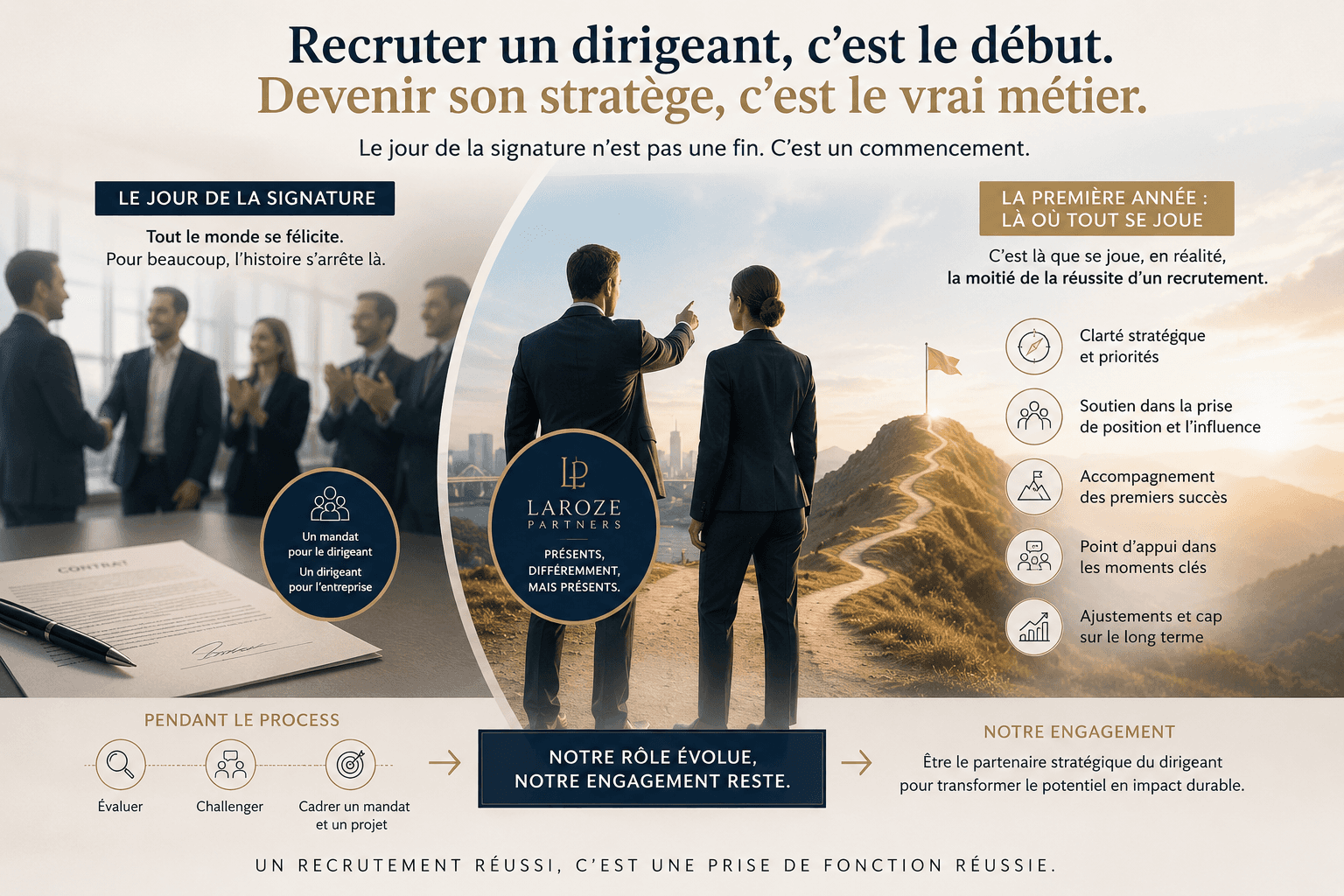
Accompanying a recruited executive: the key to their first year
Accompanying a recruited executive: the key to their first year

Executive Performance: The Errors That Destroy Value
Executive Performance: The Errors That Destroy Value

Executive succession: why boards prepare too late
Executive succession: why boards prepare too late
CONTACT
Let's talk about your next recruitment
Outline your needs in a few lines. Your request will be treated with the strictest confidentiality.
CONTACT
Let's talk about your next recruitment
Outline your needs in a few lines. Your request will be treated with the strictest confidentiality.
CONTACT
Let's talk about your next recruitment
Outline your needs in a few lines. Your request will be treated with the strictest confidentiality.