
Tech executive compensation: base salaries haven't budged, but what the board is buying has changed
Tech executive compensation: base salaries haven't budged, but what the board is buying has changed
Tech executive compensation: base salaries haven't budged, but what the board is buying has changed
Share
On August 28, 2026, C3.ai filed its annual executive compensation document. It states that its founder, Thomas Siebel, requested to no longer receive a salary starting February 1, 2026. It also states that Stephen Ehikian, who joined during the fiscal year and is presented as president and former CEO, declared $36.2 million, including $35 million in stock and options. One fiscal year, two opposite signals on what the fixed portion of executive compensation is worth.
Four months earlier, on April 24, Palantir had published theirs. Its Chief Financial Officer declared $28.0 million for 2025, compared to $0.47 million two years earlier. Its CEO declared $8.6 million, without any new stock awards that year.
These two documents tell the story of what AI compensation narratives do not. Compared to the SaaS era in constant dollars, the compensation of listed AI executives is not out of the norm. What has changed is what a board buys with it. For an executive, a board, or a private equity fund in tech, the question is no longer how much the market pays, but what they are trying to achieve by paying.
Key Figures to Know
All values are in US dollars for companies listed in the United States. "Constant" amounts are converted to 2025 dollars using the US Consumer Price Index. "Total" compensation is what the documents publish: cash paid plus the value of stock and options awarded on the grant date. This is not what the executive actually pocketed.
Indicator | Value | Source |
|---|---|---|
CEO of Salesforce, fiscal year ended January 2012 | $17.7M nominal, or $25.3M constant | Salesforce, 2012 proxy |
CEO of C3.ai, fiscal year ended April 2025 | $25.5M nominal, or $26.0M constant, 2.7% above the previous one | C3.ai, 2026 proxy |
Co-CEO of Workday, fiscal year ended January 2014 | $9.8M nominal, or $13.5M constant | Workday, 2014 proxy |
CEO of Palantir, 2025 | $8.6M, including $7.5M other compensation and no stock awards | Palantir, 2026 proxy |
CFO of Palantir, 2023, 2024, 2025 | $0.47M, then $11.8M, then $28.0M | Palantir, 2026 proxy |
CFOs, fiscal years 2012 to 2014 (Salesforce, Workday) | $5.0M and $8.8M constant | Salesforce, Workday |
CFO of C3.ai, fiscal year ended April 2025 | $10.0M nominal, or $10.2M constant | C3.ai, 2026 proxy |
Base salary of a CFO, 2025 constant dollars | $685,000 (Salesforce), $368,000 (Workday), $404,000 (C3.ai), $450,200 (Palantir) | Proxies |
Equity share of total, seven out of eight executives in the chart | From 76% to 100% | Laroze Partners calculations on proxies |
Salesforce directors, fiscal year ended January 2012 | $666,303 to $723,803, or approximately $1M constant, including $612,553 in stock | Salesforce, 2012 proxy |
C3.ai directors, fiscal year ended April 2026 | $349,989 to $394,990 in options, no cash, $899,991 for one of them | C3.ai, 2026 proxy |
New executive hire at C3.ai, fiscal year ended April 2026 | $36.2M, including $35.0M in stock and options | C3.ai, 2026 proxy |
First AI executive role of a company, United States, 2025 | Median of the total at $1.6M | Equilar, Top 50 Survey 2025 |
AI and data executives, United States, summer 2025 | Approximately $878,000, including $380,000 in cash (press report) | Heidrick & Struggles, via AI Magazine |
US inflation, 2011 to 2025 | Approximately 43% (1.43 multiplier on Salesforce 2012) | BLS, CPI-U series |
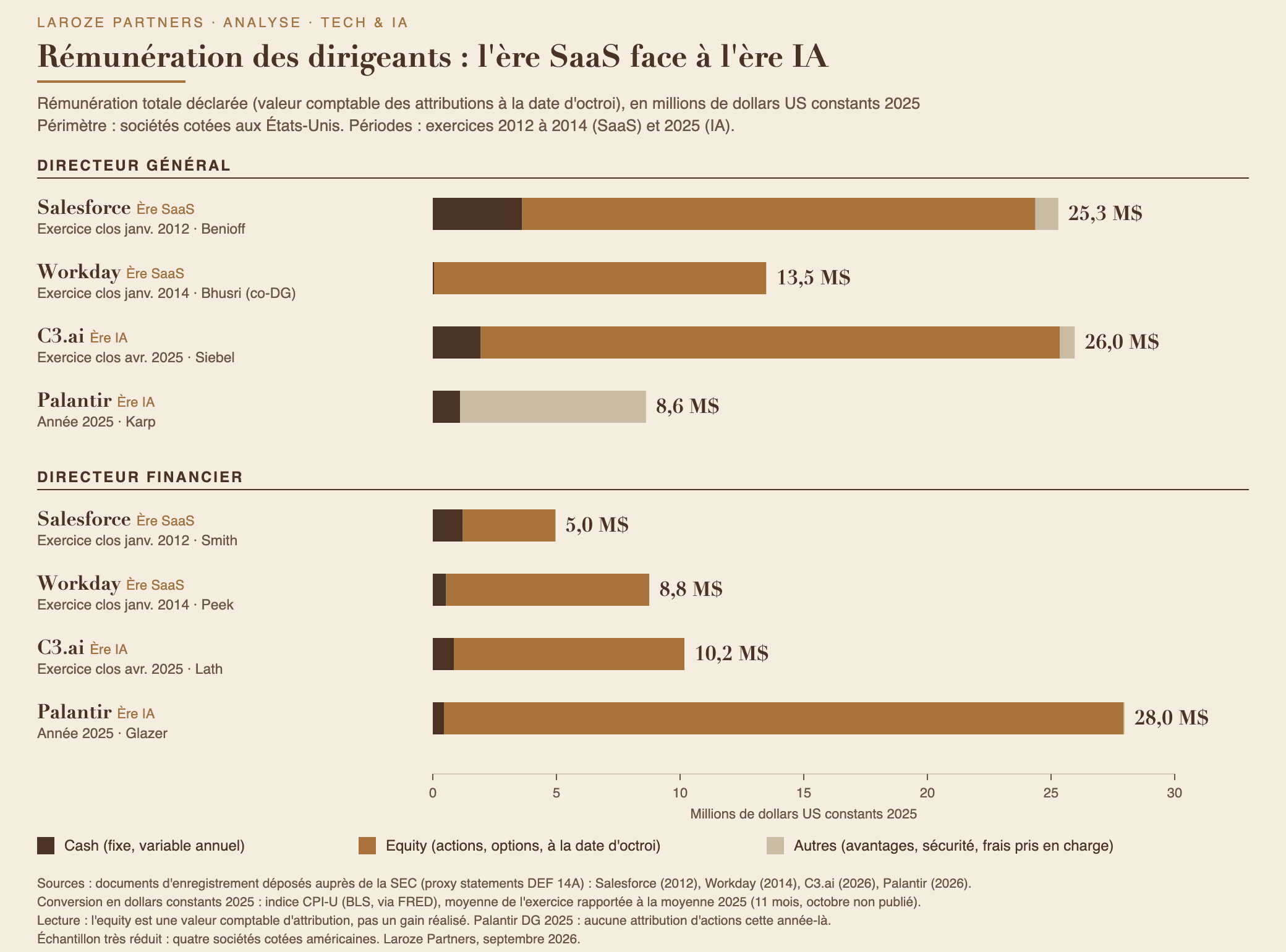
Sources: proxy statements filed with the SEC by Salesforce (2012), Workday (2014), C3.ai (2026), and Palantir (2026). Conversion to constant 2025 dollars: CPI-U, BLS via FRED. Four US listed companies: small sample size.
Chart data, in US dollars:
Role, Company | Period | Nominal Cash | Nominal Equity | Nominal Other | Nominal Total | Total in Constant 2025 Dollars |
|---|---|---|---|---|---|---|
CEO, Salesforce (Benioff) | FY ended Jan. 2012 | 2,530,000 | 14,535,850 | 648,456 | 17,714,306 | 25.29 M |
Co-CEO, Workday (Bhusri) | FY ended Jan. 2014 | 35,420 | 9,730,842 | 3,335 | 9,769,597 | 13.48 M |
CEO, C3.ai (Siebel) | FY ended Apr. 2025 | 1,900,000 | 23,012,029 | 604,847 | 25,516,876 | 25.96 M |
CEO, Palantir (Karp) | 2025 | 1,101,637 | 0 | 7,521,363 | 8,623,000 | 8.62 M |
CFO, Salesforce (Smith) | FY ended Jan. 2012 | 847,200 | 2,625,087 | 0 | 3,472,287 | 4.96 M |
CFO, Workday (Peek) | FY ended Jan. 2014 | 392,205 | 5,946,662 | 7,525 | 6,346,392 | 8.76 M |
CFO, C3.ai (Lath) | FY ended Apr. 2025 | 834,750 | 9,164,000 | 1,156 | 9,999,906 | 10.18 M |
CFO, Palantir (Glazer) | 2025 | 450,200 | 27,485,141 | 36,535 | 27,971,876 | 27.97 M |
Why This Subject Matters Now
Three sets of facts have overlapped over the past year, and it is their combination that makes the issue urgent.
The 2026 documents are out, and they are readable. Palantir published its document on April 24, C3.ai on August 28. They detail, for each executive, what was paid in cash and what was awarded in stock over three fiscal years. We now have data on two listed AI companies over several years, to compare with software companies whose identical documents date back to 2012 and 2014. The gap is twelve to fourteen years, and US inflation has added about 40% to it.
The role of AI executive now has a price, or rather two. On September 11, 2025, Equilar published a median of $1.6 million for the first AI role of companies that declared one. In the summer of 2025, Heidrick & Struggles conducted a survey of 318 AI and data leaders, with a press report indicating a total of about $878,000 for the US. The two figures have coexisted for a year without anyone comparing them.
Boards are rediscovering that compensation is an act of governance. A founder who reduces his salary to zero, a CFO whose compensation is multiplied by nearly sixty in two years, a newly hired executive with $36 million in awards: these decisions involve strategy, ownership, and organization.
Two false interpretations are circulating. The first claims that AI has caused executive compensation to explode. For the CEO, the difference between Salesforce in 2012 and C3.ai in 2025 is 2.7% in constant dollars. The second claims that nothing has changed. Yet the hierarchy of compensation, the role of the board, and the cost of hiring have shifted. It is neither an explosion nor a status quo. It is a shift in what compensation buys.
Base Salary Has Not Budged
Fixed salary is the most stable and comparable part of compensation. Adjusted to constant 2025 dollars, it shows no surge between the two periods.
Executive | Period | Nominal Salary | Salary in Constant 2025 Dollars |
|---|---|---|---|
CEO, Salesforce (Benioff) | FY ended Jan. 2012 | $1,000,000 | $1,427,837 |
CEO, ServiceNow (Slootman) | 2012 | $300,000 | $420,668 |
CEO, C3.ai (Siebel) | FY ended Apr. 2025 | $1,000,000 | $1,017,467 |
CEO, Palantir (Karp) | 2025 | $1,101,637 | $1,101,637 |
CFO, Salesforce (Smith) | FY ended Jan. 2012 | $480,000 | $685,361 |
CFO, ServiceNow (Scarpelli) | 2012 | $275,000 | $385,612 |
CFO, Workday (Peek) | FY ended Jan. 2014 | $266,667 | $368,050 |
CFO, C3.ai (Lath) | FY ended Apr. 2025 and 2026 | $397,500 and $500,000 | $404,443 and $494,701 |
CFO, Palantir (Glazer) | 2025 | $450,200 | $450,200 |
Three takeaways are clear.
The fixed portion for a CFO fluctuates between $370,000 and $685,000 in today's dollars across both periods. Salesforce, the largest company in the SaaS era, is at the top of the range. Workday and ServiceNow, then young on the stock market, are at the bottom. AI companies lie in between. There is no indication from this sample that the AI market pays more for the fixed portion.
The fixed portion for a CEO centers around one million. $1.43 million for Salesforce in 2012 in today's dollars, $1.02 million for C3.ai, $1.10 million for Palantir. Company size matters more than the era: ServiceNow, at $300,000, was then at a very different stage.
The fixed portion can be a choice, not a market price. Thomas Siebel had his reduced from $1,000,000 to zero starting February 1, 2026, at his request, according to the C3.ai filing. A base salary can be negotiated, reduced, or eliminated depending on what the executive wants to signal to the organization. Its value is as much symbolic as it is economic.
Equity Drives the Total, and It Arrives in Spikes
In seven of the eight compensation packages in the chart, equity represents 76% to 100% of the total: 82% for the CEO of Salesforce, 90% for the CEO of C3.ai, 76% and 98% for the CFOs of Salesforce and Palantir. Only the CEO of Palantir is an exception, with no new awards in 2025. The structure is the same in both periods. The total, however, is hard to read from one year to the next.
Executive | Year 1 | Year 2 | Year 3 |
|---|---|---|---|
CEO, ServiceNow (Slootman) | $8.6M (six months ended Dec. 2011) | $0.57M (2012) | |
Chief Product Officer, ServiceNow (Luddy) | $0.27M (six months ended Dec. 2011) | $10.96M (2012) | |
CFO, Palantir (Glazer) | $0.47M (2023) | $11.8M (2024) | $28.0M (2025) |
CTO, C3.ai (Abbo) | $29.9M (FY 2023) | $1.1M (FY 2024) | $4.1M (FY 2025) |
CFO, C3.ai (Lath) | $5.4M (FY 2024) | $10.0M (FY 2025) | $5.5M (FY 2026) |
These series call for a methodological note. The CEO of ServiceNow shows $8.6 million for the second half of 2011, including $8.5 million in options, then $0.57 million for 2012, with no new awards. His product chief shows the opposite: $0.27 million in the second half of 2011, then $10.96 million in 2012, including a $10.35 million stock retention grant, vesting over four years. The 2011 line of this document covers six months, as the company changed its closing date in February 2012.
Comparing one year to another, or one executive to another, based on a single fiscal year, amounts to comparing board decisions. The Chief Technology Officer of C3.ai goes from $29.9 million to $1.1 million, without his role changing. What changed was the year the board decided to grant. Any comparison of "levels" of tech compensation looking at only one fiscal year is fragile, in both eras.
Equity is a grant-date value, not a realized gain. The filings themselves point this out: the reported amounts are accounting values on the grant date, which do not correspond to what the executive actually pockets. What they receive depends on the stock price years later, and nothing in these tables reveals that.
What the Board Buys: A Hire, Retention, a Result
What these figures show best is the logic behind each grant. The filings do not always state it explicitly, but they allow us to read it.
What Compensation Bought in 2012 to 2014 | What It Buys in 2025 and 2026 |
|---|---|
A modest fixed portion and limited annual variable: $1.53M for the CEO of Salesforce, $273,548 for the CEO of ServiceNow | A base salary that can fall to zero at the executive's request (Siebel), and variable pay distributed in stock rather than cash at C3.ai |
Option grants at the time of the IPO, or during the executive's first year | Stock and option awards upon hiring, which can reach $35M (Ehikian, FY 2026) |
Retention in a technical or product role (Luddy, $10.35M in stock in 2012) | Broader retention, affecting the CFO and Chief Commercial and Legal Officer (Palantir, $21.2M in stock each in 2025) |
A CFO between 20% and 65% of the CEO's compensation | A CFO at 39% of the CEO (C3.ai), or three times their level (Palantir) |
A board paid about $1M constant, mostly in stock | A board paid about $350,000 in options only (C3.ai) |
Three insights emerge. They represent our interpretation, not a published data point.
A new hire is paid primarily in stock, at a price that reflects the board's uncertainty. The C3.ai filing shows $35.0 million in awards out of $36.2 million total for an executive whose offer is dated August 29, 2025, covering only a portion of the fiscal year. A board that accepts this price is not just paying an executive: it is paying to mitigate a risk it doesn't know how to reduce otherwise.
Retention is paid in spikes, at the moment the board fears a departure. The grants of $10.35 million at ServiceNow in 2012, $21.2 million at Palantir in 2025, and $28.8 million at C3.ai in fiscal year 2023 share the same structure: a single amount, granted once, with multi-year vesting. They reveal more about the board's anxiety than the market value of the position.
Results are rarely paid in cash. Annual variable pay remained limited in both periods, and it is paid in stock at C3.ai. The highest compensation packages are those that place a bet on future value, not on the performance of the past year.
At Palantir, the CFO Earns Three Times More Than the CEO
The ratio of CFO compensation to CEO compensation has a history in this sample. It is 20% at Salesforce in 2012, 65% at Workday in 2014, and 39% at C3.ai in 2025. At Palantir in 2025, it is 324%: $28.0 million for the CFO, $27.96 million for the Chief Commercial and Legal Officer, and $8.6 million for the CEO, with $7.5 million of that falling under other compensation.
This is a unique case in our sample, and we are not framing it as a trend. The CEO of Palantir received no equity awards in 2025, and there is no indication that this situation is permanent. But this case demonstrates one thing: compensation no longer follows rank. It follows the contribution that the board deems critical at a given moment.
Part of the "other compensation" of the Palantir CEO relates to protection and compliance: about $2.5 million in personal security, $2.4 million in regulatory filing fees covered by the company. At C3.ai, Thomas Siebel's personal security represents about $600,000 for fiscal year 2025, or 99% of his other compensation. These amounts are legitimate, and their disclosure is mandatory. They treat the executive and the company as a single exposure, which is managed at the board level.
The C3.ai Board is Paid Nearly Three Times Less Than Salesforce's in 2012, and Solely in Options
Salesforce directors declared, for the fiscal year ended January 2012, between $666,303 and $723,803 each, including $612,553 in stock granted on the same day to all, and $53,750 to $111,250 in cash. In today's dollars, this represents about $950,000 to $1,030,000.
C3.ai directors declare, for the fiscal year ended April 2026, between $349,989 and $394,990, entirely in options, with no cash, with one exception: $899,991 for one of them. Two directors have no declared compensation. In today's dollars, the most common amounts are around $350,000 to $390,000.
We do not draw a general rule from this single example: C3.ai's policy is atypical, and Salesforce was a much larger company in 2012. But the gap raises a question that few compensation committees ask: what should a director be paid in a company whose technology changes in twelve months? A director paid solely in options, whose vesting is suspended if they miss a meeting, is aligned with the stock. They are not necessarily available for governance.
An AI Executive Position Has No Set Price, Due to a Lack of Definition
The Equilar study of companies that declared a first AI role shows, for 2025, a median total compensation of $1.6 million. The median salary is $439,375, median annual bonuses are $191,307, and median time-vesting stock is $242,997. These medians are calculated component by component: they do not add up to reconstruct the total. The 10th percentile of the total is at $567,235, the 90th at $3.5 million.
The Heidrick & Struggles survey, conducted in the summer of 2025 among 318 AI and data leaders, shows, according to a press report, about $380,000 in cash and $498,000 in equity for the US, totaling around $878,000. For the UK, 217,000 pounds in cash and 249,000 pounds in equity. We were unable to verify these figures in the source report itself, and the press report does not specify whether these are averages or medians.
These two series do not contradict each other. They probably do not measure the same thing: one focuses on the top AI role of companies disclosing it among their highest-paid executives, the other on a broader group of AI and data leaders. The title is the same, the function is not. We found no comparable public data for continental Europe.
This is the real issue. A position for which no one has written a definition cannot be priced, measured, or defended before a board. Paying $1.6 million or $878,000 to an executive who has no recognized scope of responsibility amounts to paying for a title.
What This Demands of Leadership Roles
A stable fixed salary, equity that comes in spikes, a board paid differently, and an AI role without a definition shift the responsibilities of six roles.
Role | What They Used to Do | What is Now Demanded of Them |
|---|---|---|
Chief Executive Officer | Negotiate an onboarding package and a periodic award plan | Justify to the board what their equity aims to achieve (milestone, retention, or result), and accept that their base salary is a signal as much as a price |
Chief Financial Officer | Manage cash flow, fundraising, and reporting | Be the recipient of a potential massive equity grant themselves, and model equity cost as a long-term personnel expense |
Engineering & Product Leadership | Deliver a product roadmap | Position themselves in a market where retention grants can exceed ten million dollars in a single year |
AI Leadership | Define use cases and risks | Secure a written mandate before discussing a price that, without it, varies by almost double depending on the study |
Compensation Committee & Board of Directors | Approve market benchmarks | Decide what they are buying (hiring, retention, or result) before making comparisons, and revise director compensation in light of the sector's pace |
Human Resources | Document pay scales | Build transparency across functions, especially regarding gaps between the CEO, CFO, and Commercial leadership |
Two of these roles merit further discussion.
The compensation committee becomes a strategic body. In both periods, the bulk of compensation consists of equity granted at selected times. These times represent governance decisions: a hire, a flight risk, a bet on growth. A committee that merely compares levels to benchmarks misses what it is funding. The useful analysis lies in the timeline: when was it granted, to whom, for what horizon, and what risk does this grant cover?
The finance function has become a role that negotiates for itself as much as it negotiates for others. At Palantir and C3.ai, CFOs are compensated in ranges that rank alone does not explain: $28.0 million in 2025 for one, $10.0 million then $5.5 million over two fiscal years for the other. The CFO who models the executive committee's equity cost also models their own. The board has every interest in making this position clear.
The Case of C3.ai: One Fiscal Year, Three Compensation Packages, $66 Million
The C3.ai filing for the fiscal year ended April 2026 brings together, in a single table, three different configurations. Thomas Siebel, founder, presented as CEO and Chairman of the Board, declared $24.3 million, including $23.0 million in stock and options, and a salary falling to zero at his request on February 1, 2026. Hitesh Lath, CFO and Chief Administration Officer, declared $5.5 million, compared to $10.0 million the previous year. Stephen Ehikian, whose offer is dated August 29, 2025, declared $36.2 million, including a salary of $666,667, a $500,000 bonus, $20.0 million in stock, and $15.0 million in options. In total, $65.9 million nominal for three executives.
We only know of this situation what the document discloses, and we make no judgment on the individuals. Two facts are useful for a board.
First: the three compensation packages do not follow the same logic. A founder removing his base salary to align with the stock price, a CFO whose grant drops after a year of retention, and an executive whose hiring is paid primarily in equity. Comparing these three amounts as market benchmarks makes no sense.
Second: what we do not know. No reliable public data allows for this exercise to be repeated for France or continental Europe. We found no comparable documents for the first French SaaS companies from 2008 to 2015, nor for French AI players, and major unlisted AI labs do not publish executive compensation. For a European fund, this means that an executive's price is constructed without public benchmarks, and one must know how to explain to their board what cannot be measured.
Common Errors
Comparing one fiscal year to another. Equity comes in spikes. Palantir's CFO goes from $0.47M to $28.0M in two years, without his role expanding sixty-fold. You must look at a minimum of three fiscal years.
Reading a grant-date value as a realized gain. Filings specify that the amounts do not reflect what the executive actually pockets. The gain depends on the stock price years later.
Comparing in nominal dollars. US inflation between 2011 and 2025 is approximately 43%. A million dollars at Salesforce in 2012 is worth about $1.43 million today. Without this correction, you will perceive a surge that does not exist.
Aligning an executive with the stock price when you expect a five-year vision from them. A massive grant upon hiring covers the board's risk, not the executive's performance. It says nothing about the tenure expected of them.
Paying for a role before writing its definition. Between $878,000 and $1.6 million, depending on the study, the AI executive role has no set price because it has no defined scope. The board must write what this executive decides, not just what they cost.
Treating personal benefits as a detail. Security, regulatory filing fees, insurance: $7.5 million for one executive at Palantir, $600,000 for another at C3.ai. The line is published, and regulators, shareholders, and employees read it.
How to Evaluate a Tech and AI Executive for This Cycle
Do they distinguish, in their own compensation, what is granted from what is vested, and then from what is realized? The answer reveals whether they have managed a multi-year equity plan, or merely received an offer.
What did they request, and what did they turn down, upon hiring? An executive who negotiated a lower base salary in exchange for higher exposure to equity value, or vice versa, knows what they want to signal. One who accepted everything may not have measured what they were committing to.
Over what horizon do they accept their equity to vest? A four-year vesting schedule, like the retention grant at ServiceNow in 2012, does not convey the same message as a grant with no clear timeline. What they say about it reveals their view of the duration of their mission.
How do they describe compensation disparities within their executive committee? A leader who presents these gaps as an external constraint is not in control of them. One who can explain them as board-driven choices knows how to defend them.
Have they ever defined the scope of a role before discussing its price? For a role like AI leader, where the price varies by almost double depending on the study, the answer distinguishes someone who wrote a mandate from someone who inherited a title.
Frequently Asked Questions
Is an AI CEO paid more than a SaaS CEO?
Not in this sample. In constant 2025 dollars, the CEO of Salesforce (FY ended January 2012) declared $25.3 million and the CEO of C3.ai (FY ended April 2025) $26.0 million, a 2.7% difference. Palantir's CEO declared $8.6 million in 2025, with no stock awards that year. The sample consists of four US listed companies and proves nothing beyond them.
How much does a CFO of a listed AI company make?
At C3.ai, $10.0 million for the fiscal year ended April 2025, then $5.5 million for the following year. At Palantir, $27.97 million in 2025, compared to $11.8 million in 2024 and $0.47 million in 2023. The base salary remains between $397,500 and $500,000. All the rest is equity, granted in spikes.
How much does a Chief AI Officer earn?
It depends on the definition of the role. According to Equilar, the median total is $1.6 million for the first AI role of companies disclosing one, with a median salary of $439,375. According to a press report of the Heidrick & Struggles survey, about $878,000 in the US. The two likely do not measure the same population, and we were unable to verify the second in the source report.
Why convert amounts to constant dollars?
US inflation between 2011 and 2025 is approximately 43%. Without conversion, $17.7 million in 2012 appears far below $25.5 million in 2025. In constant dollars, it is worth $25.3 million.
How much are directors of a listed tech company paid?
At Salesforce, $666,303 to $723,803 for the fiscal year ended January 2012, or about one million constant dollars, mostly in stock. At C3.ai, $349,989 to $394,990 for the fiscal year ended April 2026, in options only, no cash. Two companies do not make a market, and C3.ai's policy is atypical.
Are there public data available for France?
We found no reliable data, neither for the first French SaaS companies from 2008 to 2015, nor for French AI players. The main ones are unlisted and do not publish executive compensation. Any estimate would be an assumption, and this article makes none.
Summary
In constant dollars, the compensation of a listed AI CEO ($26.0M, C3.ai 2025) is within 2.7% of that of a software CEO from the SaaS era ($25.3M, Salesforce 2012).
Base salary is stable across both periods: a CFO between $368,000 and $685,000 constant dollars, a CEO around one million.
Equity represents 76% to 100% of the total for seven out of eight executives, and it arrives in spikes: Palantir's CFO goes from $0.47M to $28.0M in two years.
The C3.ai board is paid nearly three times less than Salesforce's in 2012, and in options only: about $350,000 compared to about one million constant.
The AI executive role has no set price ($1.6M or $878,000 depending on the study) because it has no set definition. Writing the mandate precedes discussing the price.
The Laroze Partners Perspective
AI executive compensation draws a lot of commentary regarding its level. Public documents show that the level is not the issue. A listed software CEO was worth $25 million in 2012; a listed AI CEO is worth $26 million in 2025, in constant dollars. The fixed portion has not moved. What is shifting is the timing of when the board decides to grant equity, and the reason why they do so.
A board that awards $36 million upon hiring an executive, or $28 million to its CFO in a year when the CEO receives nothing, is communicating what it intends to buy before declaring what the market is worth: a hire, retention, or a result. These three logic sets demand different structures, timelines, and safeguards. The challenge is not finding the amount. It is knowing, before searching for a leader, what is expected of them over five years, and translating that into compensation that can be defended before one's own board. The Laroze Pattern®, our method for the strategic interpretation of trajectories, leadership behaviors, and performance dynamics, serves precisely to distinguish, within a career path, what proves the capacity to maintain a course from what merely suggests it.
The companies that survive the decade will not be those that paid the most. They will be those whose boards knew what they were buying before setting a figure.
Sources
Salesforce, Definitive Proxy Statement (DEF 14A), 2012 · ServiceNow, Definitive Proxy Statement (DEF 14A), 2013 · Workday, Definitive Proxy Statement (DEF 14A), April 18, 2014 · C3.ai, Definitive Proxy Statements (DEF 14A), August 21, 2025, and August 28, 2026 · Palantir Technologies, Definitive Proxy Statement (DEF 14A), April 24, 2026 · Equilar, "Compensation for AI Executives Nears $2 Million", September 11, 2025 (2025 Top 50 Survey) · Heidrick & Struggles, 2025 Data, Analytics, and Artificial Intelligence Officers Compensation Survey, and AI Magazine · U.S. Bureau of Labor Statistics, CPI-U (CPIAUCNS series), via FRED, Federal Reserve Bank of St. Louis.
On August 28, 2026, C3.ai filed its annual executive compensation document. It states that its founder, Thomas Siebel, requested to no longer receive a salary starting February 1, 2026. It also states that Stephen Ehikian, who joined during the fiscal year and is presented as president and former CEO, declared $36.2 million, including $35 million in stock and options. One fiscal year, two opposite signals on what the fixed portion of executive compensation is worth.
Four months earlier, on April 24, Palantir had published theirs. Its Chief Financial Officer declared $28.0 million for 2025, compared to $0.47 million two years earlier. Its CEO declared $8.6 million, without any new stock awards that year.
These two documents tell the story of what AI compensation narratives do not. Compared to the SaaS era in constant dollars, the compensation of listed AI executives is not out of the norm. What has changed is what a board buys with it. For an executive, a board, or a private equity fund in tech, the question is no longer how much the market pays, but what they are trying to achieve by paying.
Key Figures to Know
All values are in US dollars for companies listed in the United States. "Constant" amounts are converted to 2025 dollars using the US Consumer Price Index. "Total" compensation is what the documents publish: cash paid plus the value of stock and options awarded on the grant date. This is not what the executive actually pocketed.
Indicator | Value | Source |
|---|---|---|
CEO of Salesforce, fiscal year ended January 2012 | $17.7M nominal, or $25.3M constant | Salesforce, 2012 proxy |
CEO of C3.ai, fiscal year ended April 2025 | $25.5M nominal, or $26.0M constant, 2.7% above the previous one | C3.ai, 2026 proxy |
Co-CEO of Workday, fiscal year ended January 2014 | $9.8M nominal, or $13.5M constant | Workday, 2014 proxy |
CEO of Palantir, 2025 | $8.6M, including $7.5M other compensation and no stock awards | Palantir, 2026 proxy |
CFO of Palantir, 2023, 2024, 2025 | $0.47M, then $11.8M, then $28.0M | Palantir, 2026 proxy |
CFOs, fiscal years 2012 to 2014 (Salesforce, Workday) | $5.0M and $8.8M constant | Salesforce, Workday |
CFO of C3.ai, fiscal year ended April 2025 | $10.0M nominal, or $10.2M constant | C3.ai, 2026 proxy |
Base salary of a CFO, 2025 constant dollars | $685,000 (Salesforce), $368,000 (Workday), $404,000 (C3.ai), $450,200 (Palantir) | Proxies |
Equity share of total, seven out of eight executives in the chart | From 76% to 100% | Laroze Partners calculations on proxies |
Salesforce directors, fiscal year ended January 2012 | $666,303 to $723,803, or approximately $1M constant, including $612,553 in stock | Salesforce, 2012 proxy |
C3.ai directors, fiscal year ended April 2026 | $349,989 to $394,990 in options, no cash, $899,991 for one of them | C3.ai, 2026 proxy |
New executive hire at C3.ai, fiscal year ended April 2026 | $36.2M, including $35.0M in stock and options | C3.ai, 2026 proxy |
First AI executive role of a company, United States, 2025 | Median of the total at $1.6M | Equilar, Top 50 Survey 2025 |
AI and data executives, United States, summer 2025 | Approximately $878,000, including $380,000 in cash (press report) | Heidrick & Struggles, via AI Magazine |
US inflation, 2011 to 2025 | Approximately 43% (1.43 multiplier on Salesforce 2012) | BLS, CPI-U series |
Sources: proxy statements filed with the SEC by Salesforce (2012), Workday (2014), C3.ai (2026), and Palantir (2026). Conversion to constant 2025 dollars: CPI-U, BLS via FRED. Four US listed companies: small sample size.
Chart data, in US dollars:
Role, Company | Period | Nominal Cash | Nominal Equity | Nominal Other | Nominal Total | Total in Constant 2025 Dollars |
|---|---|---|---|---|---|---|
CEO, Salesforce (Benioff) | FY ended Jan. 2012 | 2,530,000 | 14,535,850 | 648,456 | 17,714,306 | 25.29 M |
Co-CEO, Workday (Bhusri) | FY ended Jan. 2014 | 35,420 | 9,730,842 | 3,335 | 9,769,597 | 13.48 M |
CEO, C3.ai (Siebel) | FY ended Apr. 2025 | 1,900,000 | 23,012,029 | 604,847 | 25,516,876 | 25.96 M |
CEO, Palantir (Karp) | 2025 | 1,101,637 | 0 | 7,521,363 | 8,623,000 | 8.62 M |
CFO, Salesforce (Smith) | FY ended Jan. 2012 | 847,200 | 2,625,087 | 0 | 3,472,287 | 4.96 M |
CFO, Workday (Peek) | FY ended Jan. 2014 | 392,205 | 5,946,662 | 7,525 | 6,346,392 | 8.76 M |
CFO, C3.ai (Lath) | FY ended Apr. 2025 | 834,750 | 9,164,000 | 1,156 | 9,999,906 | 10.18 M |
CFO, Palantir (Glazer) | 2025 | 450,200 | 27,485,141 | 36,535 | 27,971,876 | 27.97 M |
Why This Subject Matters Now
Three sets of facts have overlapped over the past year, and it is their combination that makes the issue urgent.
The 2026 documents are out, and they are readable. Palantir published its document on April 24, C3.ai on August 28. They detail, for each executive, what was paid in cash and what was awarded in stock over three fiscal years. We now have data on two listed AI companies over several years, to compare with software companies whose identical documents date back to 2012 and 2014. The gap is twelve to fourteen years, and US inflation has added about 40% to it.
The role of AI executive now has a price, or rather two. On September 11, 2025, Equilar published a median of $1.6 million for the first AI role of companies that declared one. In the summer of 2025, Heidrick & Struggles conducted a survey of 318 AI and data leaders, with a press report indicating a total of about $878,000 for the US. The two figures have coexisted for a year without anyone comparing them.
Boards are rediscovering that compensation is an act of governance. A founder who reduces his salary to zero, a CFO whose compensation is multiplied by nearly sixty in two years, a newly hired executive with $36 million in awards: these decisions involve strategy, ownership, and organization.
Two false interpretations are circulating. The first claims that AI has caused executive compensation to explode. For the CEO, the difference between Salesforce in 2012 and C3.ai in 2025 is 2.7% in constant dollars. The second claims that nothing has changed. Yet the hierarchy of compensation, the role of the board, and the cost of hiring have shifted. It is neither an explosion nor a status quo. It is a shift in what compensation buys.
Base Salary Has Not Budged
Fixed salary is the most stable and comparable part of compensation. Adjusted to constant 2025 dollars, it shows no surge between the two periods.
Executive | Period | Nominal Salary | Salary in Constant 2025 Dollars |
|---|---|---|---|
CEO, Salesforce (Benioff) | FY ended Jan. 2012 | $1,000,000 | $1,427,837 |
CEO, ServiceNow (Slootman) | 2012 | $300,000 | $420,668 |
CEO, C3.ai (Siebel) | FY ended Apr. 2025 | $1,000,000 | $1,017,467 |
CEO, Palantir (Karp) | 2025 | $1,101,637 | $1,101,637 |
CFO, Salesforce (Smith) | FY ended Jan. 2012 | $480,000 | $685,361 |
CFO, ServiceNow (Scarpelli) | 2012 | $275,000 | $385,612 |
CFO, Workday (Peek) | FY ended Jan. 2014 | $266,667 | $368,050 |
CFO, C3.ai (Lath) | FY ended Apr. 2025 and 2026 | $397,500 and $500,000 | $404,443 and $494,701 |
CFO, Palantir (Glazer) | 2025 | $450,200 | $450,200 |
Three takeaways are clear.
The fixed portion for a CFO fluctuates between $370,000 and $685,000 in today's dollars across both periods. Salesforce, the largest company in the SaaS era, is at the top of the range. Workday and ServiceNow, then young on the stock market, are at the bottom. AI companies lie in between. There is no indication from this sample that the AI market pays more for the fixed portion.
The fixed portion for a CEO centers around one million. $1.43 million for Salesforce in 2012 in today's dollars, $1.02 million for C3.ai, $1.10 million for Palantir. Company size matters more than the era: ServiceNow, at $300,000, was then at a very different stage.
The fixed portion can be a choice, not a market price. Thomas Siebel had his reduced from $1,000,000 to zero starting February 1, 2026, at his request, according to the C3.ai filing. A base salary can be negotiated, reduced, or eliminated depending on what the executive wants to signal to the organization. Its value is as much symbolic as it is economic.
Equity Drives the Total, and It Arrives in Spikes
In seven of the eight compensation packages in the chart, equity represents 76% to 100% of the total: 82% for the CEO of Salesforce, 90% for the CEO of C3.ai, 76% and 98% for the CFOs of Salesforce and Palantir. Only the CEO of Palantir is an exception, with no new awards in 2025. The structure is the same in both periods. The total, however, is hard to read from one year to the next.
Executive | Year 1 | Year 2 | Year 3 |
|---|---|---|---|
CEO, ServiceNow (Slootman) | $8.6M (six months ended Dec. 2011) | $0.57M (2012) | |
Chief Product Officer, ServiceNow (Luddy) | $0.27M (six months ended Dec. 2011) | $10.96M (2012) | |
CFO, Palantir (Glazer) | $0.47M (2023) | $11.8M (2024) | $28.0M (2025) |
CTO, C3.ai (Abbo) | $29.9M (FY 2023) | $1.1M (FY 2024) | $4.1M (FY 2025) |
CFO, C3.ai (Lath) | $5.4M (FY 2024) | $10.0M (FY 2025) | $5.5M (FY 2026) |
These series call for a methodological note. The CEO of ServiceNow shows $8.6 million for the second half of 2011, including $8.5 million in options, then $0.57 million for 2012, with no new awards. His product chief shows the opposite: $0.27 million in the second half of 2011, then $10.96 million in 2012, including a $10.35 million stock retention grant, vesting over four years. The 2011 line of this document covers six months, as the company changed its closing date in February 2012.
Comparing one year to another, or one executive to another, based on a single fiscal year, amounts to comparing board decisions. The Chief Technology Officer of C3.ai goes from $29.9 million to $1.1 million, without his role changing. What changed was the year the board decided to grant. Any comparison of "levels" of tech compensation looking at only one fiscal year is fragile, in both eras.
Equity is a grant-date value, not a realized gain. The filings themselves point this out: the reported amounts are accounting values on the grant date, which do not correspond to what the executive actually pockets. What they receive depends on the stock price years later, and nothing in these tables reveals that.
What the Board Buys: A Hire, Retention, a Result
What these figures show best is the logic behind each grant. The filings do not always state it explicitly, but they allow us to read it.
What Compensation Bought in 2012 to 2014 | What It Buys in 2025 and 2026 |
|---|---|
A modest fixed portion and limited annual variable: $1.53M for the CEO of Salesforce, $273,548 for the CEO of ServiceNow | A base salary that can fall to zero at the executive's request (Siebel), and variable pay distributed in stock rather than cash at C3.ai |
Option grants at the time of the IPO, or during the executive's first year | Stock and option awards upon hiring, which can reach $35M (Ehikian, FY 2026) |
Retention in a technical or product role (Luddy, $10.35M in stock in 2012) | Broader retention, affecting the CFO and Chief Commercial and Legal Officer (Palantir, $21.2M in stock each in 2025) |
A CFO between 20% and 65% of the CEO's compensation | A CFO at 39% of the CEO (C3.ai), or three times their level (Palantir) |
A board paid about $1M constant, mostly in stock | A board paid about $350,000 in options only (C3.ai) |
Three insights emerge. They represent our interpretation, not a published data point.
A new hire is paid primarily in stock, at a price that reflects the board's uncertainty. The C3.ai filing shows $35.0 million in awards out of $36.2 million total for an executive whose offer is dated August 29, 2025, covering only a portion of the fiscal year. A board that accepts this price is not just paying an executive: it is paying to mitigate a risk it doesn't know how to reduce otherwise.
Retention is paid in spikes, at the moment the board fears a departure. The grants of $10.35 million at ServiceNow in 2012, $21.2 million at Palantir in 2025, and $28.8 million at C3.ai in fiscal year 2023 share the same structure: a single amount, granted once, with multi-year vesting. They reveal more about the board's anxiety than the market value of the position.
Results are rarely paid in cash. Annual variable pay remained limited in both periods, and it is paid in stock at C3.ai. The highest compensation packages are those that place a bet on future value, not on the performance of the past year.
At Palantir, the CFO Earns Three Times More Than the CEO
The ratio of CFO compensation to CEO compensation has a history in this sample. It is 20% at Salesforce in 2012, 65% at Workday in 2014, and 39% at C3.ai in 2025. At Palantir in 2025, it is 324%: $28.0 million for the CFO, $27.96 million for the Chief Commercial and Legal Officer, and $8.6 million for the CEO, with $7.5 million of that falling under other compensation.
This is a unique case in our sample, and we are not framing it as a trend. The CEO of Palantir received no equity awards in 2025, and there is no indication that this situation is permanent. But this case demonstrates one thing: compensation no longer follows rank. It follows the contribution that the board deems critical at a given moment.
Part of the "other compensation" of the Palantir CEO relates to protection and compliance: about $2.5 million in personal security, $2.4 million in regulatory filing fees covered by the company. At C3.ai, Thomas Siebel's personal security represents about $600,000 for fiscal year 2025, or 99% of his other compensation. These amounts are legitimate, and their disclosure is mandatory. They treat the executive and the company as a single exposure, which is managed at the board level.
The C3.ai Board is Paid Nearly Three Times Less Than Salesforce's in 2012, and Solely in Options
Salesforce directors declared, for the fiscal year ended January 2012, between $666,303 and $723,803 each, including $612,553 in stock granted on the same day to all, and $53,750 to $111,250 in cash. In today's dollars, this represents about $950,000 to $1,030,000.
C3.ai directors declare, for the fiscal year ended April 2026, between $349,989 and $394,990, entirely in options, with no cash, with one exception: $899,991 for one of them. Two directors have no declared compensation. In today's dollars, the most common amounts are around $350,000 to $390,000.
We do not draw a general rule from this single example: C3.ai's policy is atypical, and Salesforce was a much larger company in 2012. But the gap raises a question that few compensation committees ask: what should a director be paid in a company whose technology changes in twelve months? A director paid solely in options, whose vesting is suspended if they miss a meeting, is aligned with the stock. They are not necessarily available for governance.
An AI Executive Position Has No Set Price, Due to a Lack of Definition
The Equilar study of companies that declared a first AI role shows, for 2025, a median total compensation of $1.6 million. The median salary is $439,375, median annual bonuses are $191,307, and median time-vesting stock is $242,997. These medians are calculated component by component: they do not add up to reconstruct the total. The 10th percentile of the total is at $567,235, the 90th at $3.5 million.
The Heidrick & Struggles survey, conducted in the summer of 2025 among 318 AI and data leaders, shows, according to a press report, about $380,000 in cash and $498,000 in equity for the US, totaling around $878,000. For the UK, 217,000 pounds in cash and 249,000 pounds in equity. We were unable to verify these figures in the source report itself, and the press report does not specify whether these are averages or medians.
These two series do not contradict each other. They probably do not measure the same thing: one focuses on the top AI role of companies disclosing it among their highest-paid executives, the other on a broader group of AI and data leaders. The title is the same, the function is not. We found no comparable public data for continental Europe.
This is the real issue. A position for which no one has written a definition cannot be priced, measured, or defended before a board. Paying $1.6 million or $878,000 to an executive who has no recognized scope of responsibility amounts to paying for a title.
What This Demands of Leadership Roles
A stable fixed salary, equity that comes in spikes, a board paid differently, and an AI role without a definition shift the responsibilities of six roles.
Role | What They Used to Do | What is Now Demanded of Them |
|---|---|---|
Chief Executive Officer | Negotiate an onboarding package and a periodic award plan | Justify to the board what their equity aims to achieve (milestone, retention, or result), and accept that their base salary is a signal as much as a price |
Chief Financial Officer | Manage cash flow, fundraising, and reporting | Be the recipient of a potential massive equity grant themselves, and model equity cost as a long-term personnel expense |
Engineering & Product Leadership | Deliver a product roadmap | Position themselves in a market where retention grants can exceed ten million dollars in a single year |
AI Leadership | Define use cases and risks | Secure a written mandate before discussing a price that, without it, varies by almost double depending on the study |
Compensation Committee & Board of Directors | Approve market benchmarks | Decide what they are buying (hiring, retention, or result) before making comparisons, and revise director compensation in light of the sector's pace |
Human Resources | Document pay scales | Build transparency across functions, especially regarding gaps between the CEO, CFO, and Commercial leadership |
Two of these roles merit further discussion.
The compensation committee becomes a strategic body. In both periods, the bulk of compensation consists of equity granted at selected times. These times represent governance decisions: a hire, a flight risk, a bet on growth. A committee that merely compares levels to benchmarks misses what it is funding. The useful analysis lies in the timeline: when was it granted, to whom, for what horizon, and what risk does this grant cover?
The finance function has become a role that negotiates for itself as much as it negotiates for others. At Palantir and C3.ai, CFOs are compensated in ranges that rank alone does not explain: $28.0 million in 2025 for one, $10.0 million then $5.5 million over two fiscal years for the other. The CFO who models the executive committee's equity cost also models their own. The board has every interest in making this position clear.
The Case of C3.ai: One Fiscal Year, Three Compensation Packages, $66 Million
The C3.ai filing for the fiscal year ended April 2026 brings together, in a single table, three different configurations. Thomas Siebel, founder, presented as CEO and Chairman of the Board, declared $24.3 million, including $23.0 million in stock and options, and a salary falling to zero at his request on February 1, 2026. Hitesh Lath, CFO and Chief Administration Officer, declared $5.5 million, compared to $10.0 million the previous year. Stephen Ehikian, whose offer is dated August 29, 2025, declared $36.2 million, including a salary of $666,667, a $500,000 bonus, $20.0 million in stock, and $15.0 million in options. In total, $65.9 million nominal for three executives.
We only know of this situation what the document discloses, and we make no judgment on the individuals. Two facts are useful for a board.
First: the three compensation packages do not follow the same logic. A founder removing his base salary to align with the stock price, a CFO whose grant drops after a year of retention, and an executive whose hiring is paid primarily in equity. Comparing these three amounts as market benchmarks makes no sense.
Second: what we do not know. No reliable public data allows for this exercise to be repeated for France or continental Europe. We found no comparable documents for the first French SaaS companies from 2008 to 2015, nor for French AI players, and major unlisted AI labs do not publish executive compensation. For a European fund, this means that an executive's price is constructed without public benchmarks, and one must know how to explain to their board what cannot be measured.
Common Errors
Comparing one fiscal year to another. Equity comes in spikes. Palantir's CFO goes from $0.47M to $28.0M in two years, without his role expanding sixty-fold. You must look at a minimum of three fiscal years.
Reading a grant-date value as a realized gain. Filings specify that the amounts do not reflect what the executive actually pockets. The gain depends on the stock price years later.
Comparing in nominal dollars. US inflation between 2011 and 2025 is approximately 43%. A million dollars at Salesforce in 2012 is worth about $1.43 million today. Without this correction, you will perceive a surge that does not exist.
Aligning an executive with the stock price when you expect a five-year vision from them. A massive grant upon hiring covers the board's risk, not the executive's performance. It says nothing about the tenure expected of them.
Paying for a role before writing its definition. Between $878,000 and $1.6 million, depending on the study, the AI executive role has no set price because it has no defined scope. The board must write what this executive decides, not just what they cost.
Treating personal benefits as a detail. Security, regulatory filing fees, insurance: $7.5 million for one executive at Palantir, $600,000 for another at C3.ai. The line is published, and regulators, shareholders, and employees read it.
How to Evaluate a Tech and AI Executive for This Cycle
Do they distinguish, in their own compensation, what is granted from what is vested, and then from what is realized? The answer reveals whether they have managed a multi-year equity plan, or merely received an offer.
What did they request, and what did they turn down, upon hiring? An executive who negotiated a lower base salary in exchange for higher exposure to equity value, or vice versa, knows what they want to signal. One who accepted everything may not have measured what they were committing to.
Over what horizon do they accept their equity to vest? A four-year vesting schedule, like the retention grant at ServiceNow in 2012, does not convey the same message as a grant with no clear timeline. What they say about it reveals their view of the duration of their mission.
How do they describe compensation disparities within their executive committee? A leader who presents these gaps as an external constraint is not in control of them. One who can explain them as board-driven choices knows how to defend them.
Have they ever defined the scope of a role before discussing its price? For a role like AI leader, where the price varies by almost double depending on the study, the answer distinguishes someone who wrote a mandate from someone who inherited a title.
Frequently Asked Questions
Is an AI CEO paid more than a SaaS CEO?
Not in this sample. In constant 2025 dollars, the CEO of Salesforce (FY ended January 2012) declared $25.3 million and the CEO of C3.ai (FY ended April 2025) $26.0 million, a 2.7% difference. Palantir's CEO declared $8.6 million in 2025, with no stock awards that year. The sample consists of four US listed companies and proves nothing beyond them.
How much does a CFO of a listed AI company make?
At C3.ai, $10.0 million for the fiscal year ended April 2025, then $5.5 million for the following year. At Palantir, $27.97 million in 2025, compared to $11.8 million in 2024 and $0.47 million in 2023. The base salary remains between $397,500 and $500,000. All the rest is equity, granted in spikes.
How much does a Chief AI Officer earn?
It depends on the definition of the role. According to Equilar, the median total is $1.6 million for the first AI role of companies disclosing one, with a median salary of $439,375. According to a press report of the Heidrick & Struggles survey, about $878,000 in the US. The two likely do not measure the same population, and we were unable to verify the second in the source report.
Why convert amounts to constant dollars?
US inflation between 2011 and 2025 is approximately 43%. Without conversion, $17.7 million in 2012 appears far below $25.5 million in 2025. In constant dollars, it is worth $25.3 million.
How much are directors of a listed tech company paid?
At Salesforce, $666,303 to $723,803 for the fiscal year ended January 2012, or about one million constant dollars, mostly in stock. At C3.ai, $349,989 to $394,990 for the fiscal year ended April 2026, in options only, no cash. Two companies do not make a market, and C3.ai's policy is atypical.
Are there public data available for France?
We found no reliable data, neither for the first French SaaS companies from 2008 to 2015, nor for French AI players. The main ones are unlisted and do not publish executive compensation. Any estimate would be an assumption, and this article makes none.
Summary
In constant dollars, the compensation of a listed AI CEO ($26.0M, C3.ai 2025) is within 2.7% of that of a software CEO from the SaaS era ($25.3M, Salesforce 2012).
Base salary is stable across both periods: a CFO between $368,000 and $685,000 constant dollars, a CEO around one million.
Equity represents 76% to 100% of the total for seven out of eight executives, and it arrives in spikes: Palantir's CFO goes from $0.47M to $28.0M in two years.
The C3.ai board is paid nearly three times less than Salesforce's in 2012, and in options only: about $350,000 compared to about one million constant.
The AI executive role has no set price ($1.6M or $878,000 depending on the study) because it has no set definition. Writing the mandate precedes discussing the price.
The Laroze Partners Perspective
AI executive compensation draws a lot of commentary regarding its level. Public documents show that the level is not the issue. A listed software CEO was worth $25 million in 2012; a listed AI CEO is worth $26 million in 2025, in constant dollars. The fixed portion has not moved. What is shifting is the timing of when the board decides to grant equity, and the reason why they do so.
A board that awards $36 million upon hiring an executive, or $28 million to its CFO in a year when the CEO receives nothing, is communicating what it intends to buy before declaring what the market is worth: a hire, retention, or a result. These three logic sets demand different structures, timelines, and safeguards. The challenge is not finding the amount. It is knowing, before searching for a leader, what is expected of them over five years, and translating that into compensation that can be defended before one's own board. The Laroze Pattern®, our method for the strategic interpretation of trajectories, leadership behaviors, and performance dynamics, serves precisely to distinguish, within a career path, what proves the capacity to maintain a course from what merely suggests it.
The companies that survive the decade will not be those that paid the most. They will be those whose boards knew what they were buying before setting a figure.
Sources
Salesforce, Definitive Proxy Statement (DEF 14A), 2012 · ServiceNow, Definitive Proxy Statement (DEF 14A), 2013 · Workday, Definitive Proxy Statement (DEF 14A), April 18, 2014 · C3.ai, Definitive Proxy Statements (DEF 14A), August 21, 2025, and August 28, 2026 · Palantir Technologies, Definitive Proxy Statement (DEF 14A), April 24, 2026 · Equilar, "Compensation for AI Executives Nears $2 Million", September 11, 2025 (2025 Top 50 Survey) · Heidrick & Struggles, 2025 Data, Analytics, and Artificial Intelligence Officers Compensation Survey, and AI Magazine · U.S. Bureau of Labor Statistics, CPI-U (CPIAUCNS series), via FRED, Federal Reserve Bank of St. Louis.
On August 28, 2026, C3.ai filed its annual executive compensation document. It states that its founder, Thomas Siebel, requested to no longer receive a salary starting February 1, 2026. It also states that Stephen Ehikian, who joined during the fiscal year and is presented as president and former CEO, declared $36.2 million, including $35 million in stock and options. One fiscal year, two opposite signals on what the fixed portion of executive compensation is worth.
Four months earlier, on April 24, Palantir had published theirs. Its Chief Financial Officer declared $28.0 million for 2025, compared to $0.47 million two years earlier. Its CEO declared $8.6 million, without any new stock awards that year.
These two documents tell the story of what AI compensation narratives do not. Compared to the SaaS era in constant dollars, the compensation of listed AI executives is not out of the norm. What has changed is what a board buys with it. For an executive, a board, or a private equity fund in tech, the question is no longer how much the market pays, but what they are trying to achieve by paying.
Key Figures to Know
All values are in US dollars for companies listed in the United States. "Constant" amounts are converted to 2025 dollars using the US Consumer Price Index. "Total" compensation is what the documents publish: cash paid plus the value of stock and options awarded on the grant date. This is not what the executive actually pocketed.
Indicator | Value | Source |
|---|---|---|
CEO of Salesforce, fiscal year ended January 2012 | $17.7M nominal, or $25.3M constant | Salesforce, 2012 proxy |
CEO of C3.ai, fiscal year ended April 2025 | $25.5M nominal, or $26.0M constant, 2.7% above the previous one | C3.ai, 2026 proxy |
Co-CEO of Workday, fiscal year ended January 2014 | $9.8M nominal, or $13.5M constant | Workday, 2014 proxy |
CEO of Palantir, 2025 | $8.6M, including $7.5M other compensation and no stock awards | Palantir, 2026 proxy |
CFO of Palantir, 2023, 2024, 2025 | $0.47M, then $11.8M, then $28.0M | Palantir, 2026 proxy |
CFOs, fiscal years 2012 to 2014 (Salesforce, Workday) | $5.0M and $8.8M constant | Salesforce, Workday |
CFO of C3.ai, fiscal year ended April 2025 | $10.0M nominal, or $10.2M constant | C3.ai, 2026 proxy |
Base salary of a CFO, 2025 constant dollars | $685,000 (Salesforce), $368,000 (Workday), $404,000 (C3.ai), $450,200 (Palantir) | Proxies |
Equity share of total, seven out of eight executives in the chart | From 76% to 100% | Laroze Partners calculations on proxies |
Salesforce directors, fiscal year ended January 2012 | $666,303 to $723,803, or approximately $1M constant, including $612,553 in stock | Salesforce, 2012 proxy |
C3.ai directors, fiscal year ended April 2026 | $349,989 to $394,990 in options, no cash, $899,991 for one of them | C3.ai, 2026 proxy |
New executive hire at C3.ai, fiscal year ended April 2026 | $36.2M, including $35.0M in stock and options | C3.ai, 2026 proxy |
First AI executive role of a company, United States, 2025 | Median of the total at $1.6M | Equilar, Top 50 Survey 2025 |
AI and data executives, United States, summer 2025 | Approximately $878,000, including $380,000 in cash (press report) | Heidrick & Struggles, via AI Magazine |
US inflation, 2011 to 2025 | Approximately 43% (1.43 multiplier on Salesforce 2012) | BLS, CPI-U series |
Sources: proxy statements filed with the SEC by Salesforce (2012), Workday (2014), C3.ai (2026), and Palantir (2026). Conversion to constant 2025 dollars: CPI-U, BLS via FRED. Four US listed companies: small sample size.
Chart data, in US dollars:
Role, Company | Period | Nominal Cash | Nominal Equity | Nominal Other | Nominal Total | Total in Constant 2025 Dollars |
|---|---|---|---|---|---|---|
CEO, Salesforce (Benioff) | FY ended Jan. 2012 | 2,530,000 | 14,535,850 | 648,456 | 17,714,306 | 25.29 M |
Co-CEO, Workday (Bhusri) | FY ended Jan. 2014 | 35,420 | 9,730,842 | 3,335 | 9,769,597 | 13.48 M |
CEO, C3.ai (Siebel) | FY ended Apr. 2025 | 1,900,000 | 23,012,029 | 604,847 | 25,516,876 | 25.96 M |
CEO, Palantir (Karp) | 2025 | 1,101,637 | 0 | 7,521,363 | 8,623,000 | 8.62 M |
CFO, Salesforce (Smith) | FY ended Jan. 2012 | 847,200 | 2,625,087 | 0 | 3,472,287 | 4.96 M |
CFO, Workday (Peek) | FY ended Jan. 2014 | 392,205 | 5,946,662 | 7,525 | 6,346,392 | 8.76 M |
CFO, C3.ai (Lath) | FY ended Apr. 2025 | 834,750 | 9,164,000 | 1,156 | 9,999,906 | 10.18 M |
CFO, Palantir (Glazer) | 2025 | 450,200 | 27,485,141 | 36,535 | 27,971,876 | 27.97 M |
Why This Subject Matters Now
Three sets of facts have overlapped over the past year, and it is their combination that makes the issue urgent.
The 2026 documents are out, and they are readable. Palantir published its document on April 24, C3.ai on August 28. They detail, for each executive, what was paid in cash and what was awarded in stock over three fiscal years. We now have data on two listed AI companies over several years, to compare with software companies whose identical documents date back to 2012 and 2014. The gap is twelve to fourteen years, and US inflation has added about 40% to it.
The role of AI executive now has a price, or rather two. On September 11, 2025, Equilar published a median of $1.6 million for the first AI role of companies that declared one. In the summer of 2025, Heidrick & Struggles conducted a survey of 318 AI and data leaders, with a press report indicating a total of about $878,000 for the US. The two figures have coexisted for a year without anyone comparing them.
Boards are rediscovering that compensation is an act of governance. A founder who reduces his salary to zero, a CFO whose compensation is multiplied by nearly sixty in two years, a newly hired executive with $36 million in awards: these decisions involve strategy, ownership, and organization.
Two false interpretations are circulating. The first claims that AI has caused executive compensation to explode. For the CEO, the difference between Salesforce in 2012 and C3.ai in 2025 is 2.7% in constant dollars. The second claims that nothing has changed. Yet the hierarchy of compensation, the role of the board, and the cost of hiring have shifted. It is neither an explosion nor a status quo. It is a shift in what compensation buys.
Base Salary Has Not Budged
Fixed salary is the most stable and comparable part of compensation. Adjusted to constant 2025 dollars, it shows no surge between the two periods.
Executive | Period | Nominal Salary | Salary in Constant 2025 Dollars |
|---|---|---|---|
CEO, Salesforce (Benioff) | FY ended Jan. 2012 | $1,000,000 | $1,427,837 |
CEO, ServiceNow (Slootman) | 2012 | $300,000 | $420,668 |
CEO, C3.ai (Siebel) | FY ended Apr. 2025 | $1,000,000 | $1,017,467 |
CEO, Palantir (Karp) | 2025 | $1,101,637 | $1,101,637 |
CFO, Salesforce (Smith) | FY ended Jan. 2012 | $480,000 | $685,361 |
CFO, ServiceNow (Scarpelli) | 2012 | $275,000 | $385,612 |
CFO, Workday (Peek) | FY ended Jan. 2014 | $266,667 | $368,050 |
CFO, C3.ai (Lath) | FY ended Apr. 2025 and 2026 | $397,500 and $500,000 | $404,443 and $494,701 |
CFO, Palantir (Glazer) | 2025 | $450,200 | $450,200 |
Three takeaways are clear.
The fixed portion for a CFO fluctuates between $370,000 and $685,000 in today's dollars across both periods. Salesforce, the largest company in the SaaS era, is at the top of the range. Workday and ServiceNow, then young on the stock market, are at the bottom. AI companies lie in between. There is no indication from this sample that the AI market pays more for the fixed portion.
The fixed portion for a CEO centers around one million. $1.43 million for Salesforce in 2012 in today's dollars, $1.02 million for C3.ai, $1.10 million for Palantir. Company size matters more than the era: ServiceNow, at $300,000, was then at a very different stage.
The fixed portion can be a choice, not a market price. Thomas Siebel had his reduced from $1,000,000 to zero starting February 1, 2026, at his request, according to the C3.ai filing. A base salary can be negotiated, reduced, or eliminated depending on what the executive wants to signal to the organization. Its value is as much symbolic as it is economic.
Equity Drives the Total, and It Arrives in Spikes
In seven of the eight compensation packages in the chart, equity represents 76% to 100% of the total: 82% for the CEO of Salesforce, 90% for the CEO of C3.ai, 76% and 98% for the CFOs of Salesforce and Palantir. Only the CEO of Palantir is an exception, with no new awards in 2025. The structure is the same in both periods. The total, however, is hard to read from one year to the next.
Executive | Year 1 | Year 2 | Year 3 |
|---|---|---|---|
CEO, ServiceNow (Slootman) | $8.6M (six months ended Dec. 2011) | $0.57M (2012) | |
Chief Product Officer, ServiceNow (Luddy) | $0.27M (six months ended Dec. 2011) | $10.96M (2012) | |
CFO, Palantir (Glazer) | $0.47M (2023) | $11.8M (2024) | $28.0M (2025) |
CTO, C3.ai (Abbo) | $29.9M (FY 2023) | $1.1M (FY 2024) | $4.1M (FY 2025) |
CFO, C3.ai (Lath) | $5.4M (FY 2024) | $10.0M (FY 2025) | $5.5M (FY 2026) |
These series call for a methodological note. The CEO of ServiceNow shows $8.6 million for the second half of 2011, including $8.5 million in options, then $0.57 million for 2012, with no new awards. His product chief shows the opposite: $0.27 million in the second half of 2011, then $10.96 million in 2012, including a $10.35 million stock retention grant, vesting over four years. The 2011 line of this document covers six months, as the company changed its closing date in February 2012.
Comparing one year to another, or one executive to another, based on a single fiscal year, amounts to comparing board decisions. The Chief Technology Officer of C3.ai goes from $29.9 million to $1.1 million, without his role changing. What changed was the year the board decided to grant. Any comparison of "levels" of tech compensation looking at only one fiscal year is fragile, in both eras.
Equity is a grant-date value, not a realized gain. The filings themselves point this out: the reported amounts are accounting values on the grant date, which do not correspond to what the executive actually pockets. What they receive depends on the stock price years later, and nothing in these tables reveals that.
What the Board Buys: A Hire, Retention, a Result
What these figures show best is the logic behind each grant. The filings do not always state it explicitly, but they allow us to read it.
What Compensation Bought in 2012 to 2014 | What It Buys in 2025 and 2026 |
|---|---|
A modest fixed portion and limited annual variable: $1.53M for the CEO of Salesforce, $273,548 for the CEO of ServiceNow | A base salary that can fall to zero at the executive's request (Siebel), and variable pay distributed in stock rather than cash at C3.ai |
Option grants at the time of the IPO, or during the executive's first year | Stock and option awards upon hiring, which can reach $35M (Ehikian, FY 2026) |
Retention in a technical or product role (Luddy, $10.35M in stock in 2012) | Broader retention, affecting the CFO and Chief Commercial and Legal Officer (Palantir, $21.2M in stock each in 2025) |
A CFO between 20% and 65% of the CEO's compensation | A CFO at 39% of the CEO (C3.ai), or three times their level (Palantir) |
A board paid about $1M constant, mostly in stock | A board paid about $350,000 in options only (C3.ai) |
Three insights emerge. They represent our interpretation, not a published data point.
A new hire is paid primarily in stock, at a price that reflects the board's uncertainty. The C3.ai filing shows $35.0 million in awards out of $36.2 million total for an executive whose offer is dated August 29, 2025, covering only a portion of the fiscal year. A board that accepts this price is not just paying an executive: it is paying to mitigate a risk it doesn't know how to reduce otherwise.
Retention is paid in spikes, at the moment the board fears a departure. The grants of $10.35 million at ServiceNow in 2012, $21.2 million at Palantir in 2025, and $28.8 million at C3.ai in fiscal year 2023 share the same structure: a single amount, granted once, with multi-year vesting. They reveal more about the board's anxiety than the market value of the position.
Results are rarely paid in cash. Annual variable pay remained limited in both periods, and it is paid in stock at C3.ai. The highest compensation packages are those that place a bet on future value, not on the performance of the past year.
At Palantir, the CFO Earns Three Times More Than the CEO
The ratio of CFO compensation to CEO compensation has a history in this sample. It is 20% at Salesforce in 2012, 65% at Workday in 2014, and 39% at C3.ai in 2025. At Palantir in 2025, it is 324%: $28.0 million for the CFO, $27.96 million for the Chief Commercial and Legal Officer, and $8.6 million for the CEO, with $7.5 million of that falling under other compensation.
This is a unique case in our sample, and we are not framing it as a trend. The CEO of Palantir received no equity awards in 2025, and there is no indication that this situation is permanent. But this case demonstrates one thing: compensation no longer follows rank. It follows the contribution that the board deems critical at a given moment.
Part of the "other compensation" of the Palantir CEO relates to protection and compliance: about $2.5 million in personal security, $2.4 million in regulatory filing fees covered by the company. At C3.ai, Thomas Siebel's personal security represents about $600,000 for fiscal year 2025, or 99% of his other compensation. These amounts are legitimate, and their disclosure is mandatory. They treat the executive and the company as a single exposure, which is managed at the board level.
The C3.ai Board is Paid Nearly Three Times Less Than Salesforce's in 2012, and Solely in Options
Salesforce directors declared, for the fiscal year ended January 2012, between $666,303 and $723,803 each, including $612,553 in stock granted on the same day to all, and $53,750 to $111,250 in cash. In today's dollars, this represents about $950,000 to $1,030,000.
C3.ai directors declare, for the fiscal year ended April 2026, between $349,989 and $394,990, entirely in options, with no cash, with one exception: $899,991 for one of them. Two directors have no declared compensation. In today's dollars, the most common amounts are around $350,000 to $390,000.
We do not draw a general rule from this single example: C3.ai's policy is atypical, and Salesforce was a much larger company in 2012. But the gap raises a question that few compensation committees ask: what should a director be paid in a company whose technology changes in twelve months? A director paid solely in options, whose vesting is suspended if they miss a meeting, is aligned with the stock. They are not necessarily available for governance.
An AI Executive Position Has No Set Price, Due to a Lack of Definition
The Equilar study of companies that declared a first AI role shows, for 2025, a median total compensation of $1.6 million. The median salary is $439,375, median annual bonuses are $191,307, and median time-vesting stock is $242,997. These medians are calculated component by component: they do not add up to reconstruct the total. The 10th percentile of the total is at $567,235, the 90th at $3.5 million.
The Heidrick & Struggles survey, conducted in the summer of 2025 among 318 AI and data leaders, shows, according to a press report, about $380,000 in cash and $498,000 in equity for the US, totaling around $878,000. For the UK, 217,000 pounds in cash and 249,000 pounds in equity. We were unable to verify these figures in the source report itself, and the press report does not specify whether these are averages or medians.
These two series do not contradict each other. They probably do not measure the same thing: one focuses on the top AI role of companies disclosing it among their highest-paid executives, the other on a broader group of AI and data leaders. The title is the same, the function is not. We found no comparable public data for continental Europe.
This is the real issue. A position for which no one has written a definition cannot be priced, measured, or defended before a board. Paying $1.6 million or $878,000 to an executive who has no recognized scope of responsibility amounts to paying for a title.
What This Demands of Leadership Roles
A stable fixed salary, equity that comes in spikes, a board paid differently, and an AI role without a definition shift the responsibilities of six roles.
Role | What They Used to Do | What is Now Demanded of Them |
|---|---|---|
Chief Executive Officer | Negotiate an onboarding package and a periodic award plan | Justify to the board what their equity aims to achieve (milestone, retention, or result), and accept that their base salary is a signal as much as a price |
Chief Financial Officer | Manage cash flow, fundraising, and reporting | Be the recipient of a potential massive equity grant themselves, and model equity cost as a long-term personnel expense |
Engineering & Product Leadership | Deliver a product roadmap | Position themselves in a market where retention grants can exceed ten million dollars in a single year |
AI Leadership | Define use cases and risks | Secure a written mandate before discussing a price that, without it, varies by almost double depending on the study |
Compensation Committee & Board of Directors | Approve market benchmarks | Decide what they are buying (hiring, retention, or result) before making comparisons, and revise director compensation in light of the sector's pace |
Human Resources | Document pay scales | Build transparency across functions, especially regarding gaps between the CEO, CFO, and Commercial leadership |
Two of these roles merit further discussion.
The compensation committee becomes a strategic body. In both periods, the bulk of compensation consists of equity granted at selected times. These times represent governance decisions: a hire, a flight risk, a bet on growth. A committee that merely compares levels to benchmarks misses what it is funding. The useful analysis lies in the timeline: when was it granted, to whom, for what horizon, and what risk does this grant cover?
The finance function has become a role that negotiates for itself as much as it negotiates for others. At Palantir and C3.ai, CFOs are compensated in ranges that rank alone does not explain: $28.0 million in 2025 for one, $10.0 million then $5.5 million over two fiscal years for the other. The CFO who models the executive committee's equity cost also models their own. The board has every interest in making this position clear.
The Case of C3.ai: One Fiscal Year, Three Compensation Packages, $66 Million
The C3.ai filing for the fiscal year ended April 2026 brings together, in a single table, three different configurations. Thomas Siebel, founder, presented as CEO and Chairman of the Board, declared $24.3 million, including $23.0 million in stock and options, and a salary falling to zero at his request on February 1, 2026. Hitesh Lath, CFO and Chief Administration Officer, declared $5.5 million, compared to $10.0 million the previous year. Stephen Ehikian, whose offer is dated August 29, 2025, declared $36.2 million, including a salary of $666,667, a $500,000 bonus, $20.0 million in stock, and $15.0 million in options. In total, $65.9 million nominal for three executives.
We only know of this situation what the document discloses, and we make no judgment on the individuals. Two facts are useful for a board.
First: the three compensation packages do not follow the same logic. A founder removing his base salary to align with the stock price, a CFO whose grant drops after a year of retention, and an executive whose hiring is paid primarily in equity. Comparing these three amounts as market benchmarks makes no sense.
Second: what we do not know. No reliable public data allows for this exercise to be repeated for France or continental Europe. We found no comparable documents for the first French SaaS companies from 2008 to 2015, nor for French AI players, and major unlisted AI labs do not publish executive compensation. For a European fund, this means that an executive's price is constructed without public benchmarks, and one must know how to explain to their board what cannot be measured.
Common Errors
Comparing one fiscal year to another. Equity comes in spikes. Palantir's CFO goes from $0.47M to $28.0M in two years, without his role expanding sixty-fold. You must look at a minimum of three fiscal years.
Reading a grant-date value as a realized gain. Filings specify that the amounts do not reflect what the executive actually pockets. The gain depends on the stock price years later.
Comparing in nominal dollars. US inflation between 2011 and 2025 is approximately 43%. A million dollars at Salesforce in 2012 is worth about $1.43 million today. Without this correction, you will perceive a surge that does not exist.
Aligning an executive with the stock price when you expect a five-year vision from them. A massive grant upon hiring covers the board's risk, not the executive's performance. It says nothing about the tenure expected of them.
Paying for a role before writing its definition. Between $878,000 and $1.6 million, depending on the study, the AI executive role has no set price because it has no defined scope. The board must write what this executive decides, not just what they cost.
Treating personal benefits as a detail. Security, regulatory filing fees, insurance: $7.5 million for one executive at Palantir, $600,000 for another at C3.ai. The line is published, and regulators, shareholders, and employees read it.
How to Evaluate a Tech and AI Executive for This Cycle
Do they distinguish, in their own compensation, what is granted from what is vested, and then from what is realized? The answer reveals whether they have managed a multi-year equity plan, or merely received an offer.
What did they request, and what did they turn down, upon hiring? An executive who negotiated a lower base salary in exchange for higher exposure to equity value, or vice versa, knows what they want to signal. One who accepted everything may not have measured what they were committing to.
Over what horizon do they accept their equity to vest? A four-year vesting schedule, like the retention grant at ServiceNow in 2012, does not convey the same message as a grant with no clear timeline. What they say about it reveals their view of the duration of their mission.
How do they describe compensation disparities within their executive committee? A leader who presents these gaps as an external constraint is not in control of them. One who can explain them as board-driven choices knows how to defend them.
Have they ever defined the scope of a role before discussing its price? For a role like AI leader, where the price varies by almost double depending on the study, the answer distinguishes someone who wrote a mandate from someone who inherited a title.
Frequently Asked Questions
Is an AI CEO paid more than a SaaS CEO?
Not in this sample. In constant 2025 dollars, the CEO of Salesforce (FY ended January 2012) declared $25.3 million and the CEO of C3.ai (FY ended April 2025) $26.0 million, a 2.7% difference. Palantir's CEO declared $8.6 million in 2025, with no stock awards that year. The sample consists of four US listed companies and proves nothing beyond them.
How much does a CFO of a listed AI company make?
At C3.ai, $10.0 million for the fiscal year ended April 2025, then $5.5 million for the following year. At Palantir, $27.97 million in 2025, compared to $11.8 million in 2024 and $0.47 million in 2023. The base salary remains between $397,500 and $500,000. All the rest is equity, granted in spikes.
How much does a Chief AI Officer earn?
It depends on the definition of the role. According to Equilar, the median total is $1.6 million for the first AI role of companies disclosing one, with a median salary of $439,375. According to a press report of the Heidrick & Struggles survey, about $878,000 in the US. The two likely do not measure the same population, and we were unable to verify the second in the source report.
Why convert amounts to constant dollars?
US inflation between 2011 and 2025 is approximately 43%. Without conversion, $17.7 million in 2012 appears far below $25.5 million in 2025. In constant dollars, it is worth $25.3 million.
How much are directors of a listed tech company paid?
At Salesforce, $666,303 to $723,803 for the fiscal year ended January 2012, or about one million constant dollars, mostly in stock. At C3.ai, $349,989 to $394,990 for the fiscal year ended April 2026, in options only, no cash. Two companies do not make a market, and C3.ai's policy is atypical.
Are there public data available for France?
We found no reliable data, neither for the first French SaaS companies from 2008 to 2015, nor for French AI players. The main ones are unlisted and do not publish executive compensation. Any estimate would be an assumption, and this article makes none.
Summary
In constant dollars, the compensation of a listed AI CEO ($26.0M, C3.ai 2025) is within 2.7% of that of a software CEO from the SaaS era ($25.3M, Salesforce 2012).
Base salary is stable across both periods: a CFO between $368,000 and $685,000 constant dollars, a CEO around one million.
Equity represents 76% to 100% of the total for seven out of eight executives, and it arrives in spikes: Palantir's CFO goes from $0.47M to $28.0M in two years.
The C3.ai board is paid nearly three times less than Salesforce's in 2012, and in options only: about $350,000 compared to about one million constant.
The AI executive role has no set price ($1.6M or $878,000 depending on the study) because it has no set definition. Writing the mandate precedes discussing the price.
The Laroze Partners Perspective
AI executive compensation draws a lot of commentary regarding its level. Public documents show that the level is not the issue. A listed software CEO was worth $25 million in 2012; a listed AI CEO is worth $26 million in 2025, in constant dollars. The fixed portion has not moved. What is shifting is the timing of when the board decides to grant equity, and the reason why they do so.
A board that awards $36 million upon hiring an executive, or $28 million to its CFO in a year when the CEO receives nothing, is communicating what it intends to buy before declaring what the market is worth: a hire, retention, or a result. These three logic sets demand different structures, timelines, and safeguards. The challenge is not finding the amount. It is knowing, before searching for a leader, what is expected of them over five years, and translating that into compensation that can be defended before one's own board. The Laroze Pattern®, our method for the strategic interpretation of trajectories, leadership behaviors, and performance dynamics, serves precisely to distinguish, within a career path, what proves the capacity to maintain a course from what merely suggests it.
The companies that survive the decade will not be those that paid the most. They will be those whose boards knew what they were buying before setting a figure.
Sources
Salesforce, Definitive Proxy Statement (DEF 14A), 2012 · ServiceNow, Definitive Proxy Statement (DEF 14A), 2013 · Workday, Definitive Proxy Statement (DEF 14A), April 18, 2014 · C3.ai, Definitive Proxy Statements (DEF 14A), August 21, 2025, and August 28, 2026 · Palantir Technologies, Definitive Proxy Statement (DEF 14A), April 24, 2026 · Equilar, "Compensation for AI Executives Nears $2 Million", September 11, 2025 (2025 Top 50 Survey) · Heidrick & Struggles, 2025 Data, Analytics, and Artificial Intelligence Officers Compensation Survey, and AI Magazine · U.S. Bureau of Labor Statistics, CPI-U (CPIAUCNS series), via FRED, Federal Reserve Bank of St. Louis.
See more
See more

AI Valuations in 2026: What 2015 SaaS Has Already Taught Us, and What It Cannot Teach Us
AI Valuations in 2026: What 2015 SaaS Has Already Taught Us, and What It Cannot Teach Us
SaaS Vendors: What Kind of Leader is Needed to Move Away from Per-User Licensing?
SaaS Vendors: What Kind of Leader is Needed to Move Away from Per-User Licensing?

Chief GenIA Officer: The leader of transformation through generative AI
Chief GenIA Officer: The leader of transformation through generative AI

Edtech: capital has returned, but it is no longer buying the same thing
Edtech: capital has returned, but it is no longer buying the same thing

AI and Consulting: Avoiding Groupthink in Executive Teams
AI and Consulting: Avoiding Groupthink in Executive Teams
CONTACT
Let's talk about your next recruitment
Outline your needs in a few lines. Your request will be treated with the strictest confidentiality.
CONTACT
Let's talk about your next recruitment
Outline your needs in a few lines. Your request will be treated with the strictest confidentiality.
CONTACT
Let's talk about your next recruitment
Outline your needs in a few lines. Your request will be treated with the strictest confidentiality.