Medtech in France: recruiting leaders of regulated innovation
Medtech in France: recruiting leaders of regulated innovation
Medtech in France: recruiting leaders of regulated innovation
Share
Laroze Partners · Sector Analysis · Medtech & Medical Device · May 2026
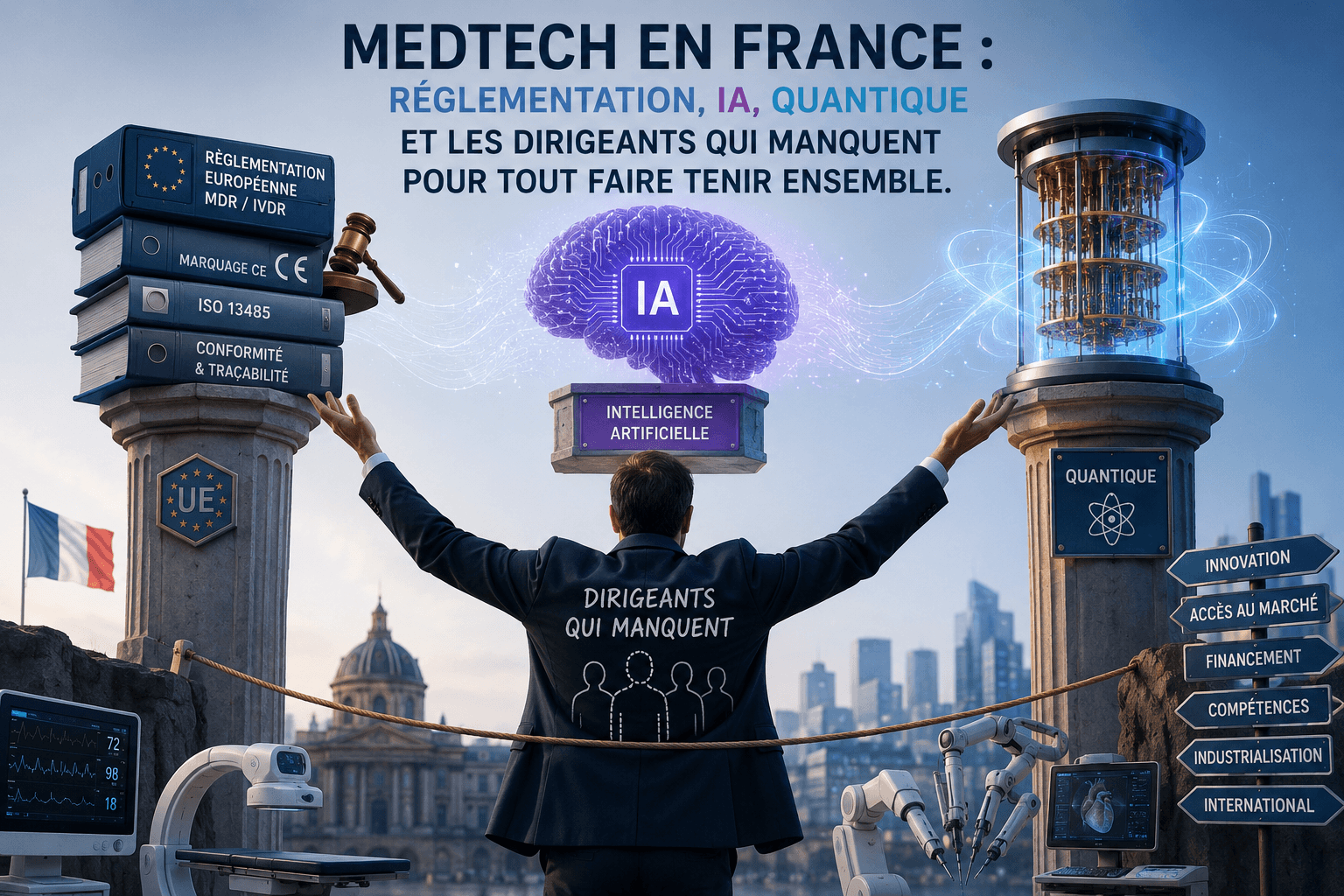
The medical device sector is undergoing a triple simultaneous transformation. European companies targeting the French market in 2026 do not face a commercial challenge. They face a leadership challenge.
The Sector in Figures
€28 Bn | ×2 | 7% | 1,300 |
|---|---|---|---|
turnover of the medical device sector in France | approval times since the MDR entered into force | of global turnover, the maximum penalty provided by the AI Act in case of non-compliance | medtech companies in France, of which 92% are SMEs |
(Bpifrance / SNITEM 2023) | (National Council of Industry, 2023) | (EU Regulation 2024/1689) | (Bpifrance 2025) |
A Sector in Permanent Compliance and Continuous Movement
The European Medical Device Regulation, known as MDR (EU 2017/745), has been fully in force since May 27, 2025. It is now mandatory for all devices marketed in Europe, without exception or additional delay. Companies that have not finalized their compliance expose themselves to the outright withdrawal of their products from the European market.
This regulation imposes substantially stricter requirements than the MDD directive it replaces: strengthening technical documentation, enhanced end-to-end traceability, structured post-market surveillance, and continuous clinical evaluation. For manufacturers, subcontractors, and distributors, the compliance burden has multiplied. Approval times have doubled for some players according to the National Council of Industry.
To this is added an ongoing revision. On December 16, 2025, the European Commission published proposal COM(2025) 1023, initiating a new iteration of the MDR and IVDR framework. Organizations must therefore comply with a regulatory architecture that is simultaneously applicable and in the process of being rewritten, representing unprecedented steering complexity.
The Regulatory Framework in Force
ISO 13485:2025 — Ongoing revision of the international quality management standard. Enhanced harmonization with MDR and IVDR, new requirements in cybersecurity and traceability. Mandatory common language between manufacturers and subcontractors.
MDR EU 2017/745 — Fully applicable since May 2025. Requires a documented quality management system, continuous clinical evaluation, and structured post-market surveillance. Certification by a notified body is mandatory.
AI Act EU 2024/1689 — In force since August 2024, applicable progressively until 2027. Classifies medical devices integrating AI as high-risk systems. Double compliance required with the MDR. ANSM and DGCCRF on the front line in France.
COM(2025) 1023 — Commission revision proposal of December 16, 2025. Among the directions: digitalization of audits, relief for low-risk devices, unified European governance.
This regulatory layering is not just another administrative constraint. It is a structural transformation that requires, within organizations, profiles capable of steering it over the long term — with the rigor of a regulatory expert and the vision of a strategic leader.
AI and Quantum: Powerful Accelerators Under High Ethical Scrutiny
Artificial intelligence is already transforming the medical device sector in depth. Medical image analysis software, early detection algorithms, and clinical decision support tools constitute a new category of devices that European regulations call "Software as a Medical Device". These systems are now subject to a double compliance obligation: MDR for their qualification as a medical device, and the AI Act for their qualification as a high-risk AI system.
The AI Act adopted in June 2024 entered into force on August 1, 2024. It will apply in a staggered manner until 2027 and will be as binding as the GDPR. In France, the ANSM and the DGCCRF have been designated as the competent supervisory authorities for medical devices integrating AI. The requirements are strict: traceability of training data, transparency of algorithms, documented cybersecurity and, above all, mandatory human supervision at every decision-making step.
Regulation does not stifle AI in healthcare. It sets a non-negotiable condition for its deployment: the permanent presence of human judgment to guide the algorithmic decision.
It is precisely on this point that the concept of ethics becomes operational. In a sector where the device directly affects the patient's life, human supervision is not a regulatory formality. It is a managerial responsibility that commits leaders at every level of the organization.
On a more distant horizon, quantum computing outlines a disruption of another scale. In October 2025, Google presented a quantum chip capable of calculating the structure of a molecule, opening the way to concrete applications in molecular simulation and drug discovery. R&D cycles that today take ten to fifteen years and cost billions could be considerably compressed. For medical imaging, quantum algorithms also open up prospects for unprecedented diagnostic precision.
These technologies are not yet in the hands of the majority of medtech players. But they are getting closer. And organizations that train their leaders today to understand these tools, without being their engineers but their enlightened pilots, will take a decisive lead.
The French Market: One of the Greatest Opportunities in Europe, and One of the Most Complex to Seize
With 28 billion euros in turnover, 1,300 active companies, and 88,000 direct jobs, France is the second largest European medtech ecosystem. For Nordic, German, or Dutch players looking to grow beyond their domestic market, it is naturally one of the first destinations.
But the French medical device market is not an ordinary market. It operates according to a double-entry logic that most foreign companies discover too late. First, regulatory access: obtaining CE marking and MDR compliance is a necessary condition, but it is not enough to market. Second, economic access: any listing on the list of reimbursable products and services (LPPR) requires an evaluation by the French National Authority for Health (HAS) and tariff negotiation with the Economic Committee for Health Products (CEPS). This second lock is often the longest, most expensive, and least anticipated.
To this are added the specificities of the hospital purchasing system: complex bidding processes, purchasing groups that centralize decisions for dozens of establishments, and regional logics meaning that what works in Paris is not mechanically replicated in Lyon or Bordeaux.
Field Observation — Laroze Partners
I am currently supporting a European company in the medical device sector that wishes to enter the French market. Like many mid-sized players carrying a differentiating technology, it faces the same equation: a solid product, MDR compliance in order, real commercial ambition. And a market that does not open simply because you knock on the door.
The mission entrusted to me is the recruitment of its Country Manager France. This position is foundational. The recruited person will have to build the go-to-market strategy over three years, identify and engage the right Key Opinion Leaders as the first clinical ambassadors, and lay the foundations for a commercial organization consistent with the constraints of the French healthcare system.
What this mission reveals above all: the first recruitment of a foreign company in the French medical device market is not a pure commercial recruitment. It is a strategic recruitment, with high stakes of medical credibility, regulatory navigation, and institutional building that bring it closer to a general management recruitment.
Companies that treat this position as a sales director recruitment generally reap the consequences of this poor calibration from the second year.
The Role of Key Opinion Leaders: An Influence Strategy Before a Commercial Strategy
In the medical device industry, the decision to adopt a new product is not made in a purchasing office. It is made in clinical departments, operating rooms, and hospital medical commissions. Key Opinion Leaders (KOLs) — surgeons, medical specialists, or department heads recognized in their discipline — are the primary drivers of this adoption.
Engaging the right KOLs does not mean buying medical endorsement. It means identifying practitioners whose clinical practice is consistent with the value of the device, building a relationship of trust with them over the long term, and supporting them so that they become true ambassadors to their peers and institutions.
This strategy takes time. It requires a detailed knowledge of the French medical landscape, personal legitimacy with medical teams, and an ability to navigate between the regulatory requirements governing industry-physician relations and the need to build lasting partnerships. It is a rare skill, and it is at the heart of the profile sought.
The Profile That Holds It All Together
This profile is not a regulatory expert. Nor will they be a pure salesperson, nor a transition manager. It is what I call a market architect: someone who understands the French healthcare system as a political environment as much as a commercial one, who knows how to build internal and external coalitions, and who steers a transformation with the rigor required by such a regulated sector.
Three skills never appear in standard job descriptions, yet they are the ones that determine the success or failure of these missions.
Understanding of the French healthcare system. Understanding how Social Security, complementary insurance, the CEPS, and the HAS interact is not a skill acquired in a few months. It is a systemic reading that takes years to build and radically changes how one approaches a hospital, institutional, or medical interlocutor.
The ability to engage KOLs over the long term. This is not a sales skill. It is a relationship and scientific skill, which implies speaking the language of clinicians, understanding their practice constraints, and convincing them of the medical value of the device before convincing them of the economic value.
The ability to steer a nascent organization in a context of regulatory ambiguity. The Country Manager of a foreign company entering France works without local history, without an established network, and in a permanently evolving regulatory framework. This is a profile that must be both founder and executor, strategist and operational: a combination that classic assessment processes do not know how to detect.
Recruiting a Country Manager in medtech is not a commercial recruitment. It is a strategic recruitment whose consequences are measured over three to five years.
What This Context Demands of Organizations
The companies that successfully enter the French medical device market will not necessarily be those with the best product. They will be those that understood from the start that MDR compliance is the ticket to entry, and that building a sustainable position requires a leadership profile capable of handling the complexity of the system.
MDR, the AI Act, ISO 13485 revision, CEPS logic, and KOL strategy are not parallel projects to be delegated to siloed specialists. They form a whole that demands an integrated vision and consistent steering.
Finding the leader capable of carrying this vision: that is where entry into the French market really begins.
Laroze Partners — Executive Search Firm
Healthcare & Pharma · Medtech · Tech · CSR
Sources: MDR EU 2017/745 · AI Act EU 2024/1689 · COM(2025) 1023, European Commission · Bpifrance / SNITEM 2023 · National Council of Industry 2023 · Annales des Mines, Feb. 2025 · Google Quantum Computing, Oct. 2025
Laroze Partners · Sector Analysis · Medtech & Medical Device · May 2026
The medical device sector is undergoing a triple simultaneous transformation. European companies targeting the French market in 2026 do not face a commercial challenge. They face a leadership challenge.
The Sector in Figures
€28 Bn | ×2 | 7% | 1,300 |
|---|---|---|---|
turnover of the medical device sector in France | approval times since the MDR entered into force | of global turnover, the maximum penalty provided by the AI Act in case of non-compliance | medtech companies in France, of which 92% are SMEs |
(Bpifrance / SNITEM 2023) | (National Council of Industry, 2023) | (EU Regulation 2024/1689) | (Bpifrance 2025) |
A Sector in Permanent Compliance and Continuous Movement
The European Medical Device Regulation, known as MDR (EU 2017/745), has been fully in force since May 27, 2025. It is now mandatory for all devices marketed in Europe, without exception or additional delay. Companies that have not finalized their compliance expose themselves to the outright withdrawal of their products from the European market.
This regulation imposes substantially stricter requirements than the MDD directive it replaces: strengthening technical documentation, enhanced end-to-end traceability, structured post-market surveillance, and continuous clinical evaluation. For manufacturers, subcontractors, and distributors, the compliance burden has multiplied. Approval times have doubled for some players according to the National Council of Industry.
To this is added an ongoing revision. On December 16, 2025, the European Commission published proposal COM(2025) 1023, initiating a new iteration of the MDR and IVDR framework. Organizations must therefore comply with a regulatory architecture that is simultaneously applicable and in the process of being rewritten, representing unprecedented steering complexity.
The Regulatory Framework in Force
ISO 13485:2025 — Ongoing revision of the international quality management standard. Enhanced harmonization with MDR and IVDR, new requirements in cybersecurity and traceability. Mandatory common language between manufacturers and subcontractors.
MDR EU 2017/745 — Fully applicable since May 2025. Requires a documented quality management system, continuous clinical evaluation, and structured post-market surveillance. Certification by a notified body is mandatory.
AI Act EU 2024/1689 — In force since August 2024, applicable progressively until 2027. Classifies medical devices integrating AI as high-risk systems. Double compliance required with the MDR. ANSM and DGCCRF on the front line in France.
COM(2025) 1023 — Commission revision proposal of December 16, 2025. Among the directions: digitalization of audits, relief for low-risk devices, unified European governance.
This regulatory layering is not just another administrative constraint. It is a structural transformation that requires, within organizations, profiles capable of steering it over the long term — with the rigor of a regulatory expert and the vision of a strategic leader.
AI and Quantum: Powerful Accelerators Under High Ethical Scrutiny
Artificial intelligence is already transforming the medical device sector in depth. Medical image analysis software, early detection algorithms, and clinical decision support tools constitute a new category of devices that European regulations call "Software as a Medical Device". These systems are now subject to a double compliance obligation: MDR for their qualification as a medical device, and the AI Act for their qualification as a high-risk AI system.
The AI Act adopted in June 2024 entered into force on August 1, 2024. It will apply in a staggered manner until 2027 and will be as binding as the GDPR. In France, the ANSM and the DGCCRF have been designated as the competent supervisory authorities for medical devices integrating AI. The requirements are strict: traceability of training data, transparency of algorithms, documented cybersecurity and, above all, mandatory human supervision at every decision-making step.
Regulation does not stifle AI in healthcare. It sets a non-negotiable condition for its deployment: the permanent presence of human judgment to guide the algorithmic decision.
It is precisely on this point that the concept of ethics becomes operational. In a sector where the device directly affects the patient's life, human supervision is not a regulatory formality. It is a managerial responsibility that commits leaders at every level of the organization.
On a more distant horizon, quantum computing outlines a disruption of another scale. In October 2025, Google presented a quantum chip capable of calculating the structure of a molecule, opening the way to concrete applications in molecular simulation and drug discovery. R&D cycles that today take ten to fifteen years and cost billions could be considerably compressed. For medical imaging, quantum algorithms also open up prospects for unprecedented diagnostic precision.
These technologies are not yet in the hands of the majority of medtech players. But they are getting closer. And organizations that train their leaders today to understand these tools, without being their engineers but their enlightened pilots, will take a decisive lead.
The French Market: One of the Greatest Opportunities in Europe, and One of the Most Complex to Seize
With 28 billion euros in turnover, 1,300 active companies, and 88,000 direct jobs, France is the second largest European medtech ecosystem. For Nordic, German, or Dutch players looking to grow beyond their domestic market, it is naturally one of the first destinations.
But the French medical device market is not an ordinary market. It operates according to a double-entry logic that most foreign companies discover too late. First, regulatory access: obtaining CE marking and MDR compliance is a necessary condition, but it is not enough to market. Second, economic access: any listing on the list of reimbursable products and services (LPPR) requires an evaluation by the French National Authority for Health (HAS) and tariff negotiation with the Economic Committee for Health Products (CEPS). This second lock is often the longest, most expensive, and least anticipated.
To this are added the specificities of the hospital purchasing system: complex bidding processes, purchasing groups that centralize decisions for dozens of establishments, and regional logics meaning that what works in Paris is not mechanically replicated in Lyon or Bordeaux.
Field Observation — Laroze Partners
I am currently supporting a European company in the medical device sector that wishes to enter the French market. Like many mid-sized players carrying a differentiating technology, it faces the same equation: a solid product, MDR compliance in order, real commercial ambition. And a market that does not open simply because you knock on the door.
The mission entrusted to me is the recruitment of its Country Manager France. This position is foundational. The recruited person will have to build the go-to-market strategy over three years, identify and engage the right Key Opinion Leaders as the first clinical ambassadors, and lay the foundations for a commercial organization consistent with the constraints of the French healthcare system.
What this mission reveals above all: the first recruitment of a foreign company in the French medical device market is not a pure commercial recruitment. It is a strategic recruitment, with high stakes of medical credibility, regulatory navigation, and institutional building that bring it closer to a general management recruitment.
Companies that treat this position as a sales director recruitment generally reap the consequences of this poor calibration from the second year.
The Role of Key Opinion Leaders: An Influence Strategy Before a Commercial Strategy
In the medical device industry, the decision to adopt a new product is not made in a purchasing office. It is made in clinical departments, operating rooms, and hospital medical commissions. Key Opinion Leaders (KOLs) — surgeons, medical specialists, or department heads recognized in their discipline — are the primary drivers of this adoption.
Engaging the right KOLs does not mean buying medical endorsement. It means identifying practitioners whose clinical practice is consistent with the value of the device, building a relationship of trust with them over the long term, and supporting them so that they become true ambassadors to their peers and institutions.
This strategy takes time. It requires a detailed knowledge of the French medical landscape, personal legitimacy with medical teams, and an ability to navigate between the regulatory requirements governing industry-physician relations and the need to build lasting partnerships. It is a rare skill, and it is at the heart of the profile sought.
The Profile That Holds It All Together
This profile is not a regulatory expert. Nor will they be a pure salesperson, nor a transition manager. It is what I call a market architect: someone who understands the French healthcare system as a political environment as much as a commercial one, who knows how to build internal and external coalitions, and who steers a transformation with the rigor required by such a regulated sector.
Three skills never appear in standard job descriptions, yet they are the ones that determine the success or failure of these missions.
Understanding of the French healthcare system. Understanding how Social Security, complementary insurance, the CEPS, and the HAS interact is not a skill acquired in a few months. It is a systemic reading that takes years to build and radically changes how one approaches a hospital, institutional, or medical interlocutor.
The ability to engage KOLs over the long term. This is not a sales skill. It is a relationship and scientific skill, which implies speaking the language of clinicians, understanding their practice constraints, and convincing them of the medical value of the device before convincing them of the economic value.
The ability to steer a nascent organization in a context of regulatory ambiguity. The Country Manager of a foreign company entering France works without local history, without an established network, and in a permanently evolving regulatory framework. This is a profile that must be both founder and executor, strategist and operational: a combination that classic assessment processes do not know how to detect.
Recruiting a Country Manager in medtech is not a commercial recruitment. It is a strategic recruitment whose consequences are measured over three to five years.
What This Context Demands of Organizations
The companies that successfully enter the French medical device market will not necessarily be those with the best product. They will be those that understood from the start that MDR compliance is the ticket to entry, and that building a sustainable position requires a leadership profile capable of handling the complexity of the system.
MDR, the AI Act, ISO 13485 revision, CEPS logic, and KOL strategy are not parallel projects to be delegated to siloed specialists. They form a whole that demands an integrated vision and consistent steering.
Finding the leader capable of carrying this vision: that is where entry into the French market really begins.
Laroze Partners — Executive Search Firm
Healthcare & Pharma · Medtech · Tech · CSR
Sources: MDR EU 2017/745 · AI Act EU 2024/1689 · COM(2025) 1023, European Commission · Bpifrance / SNITEM 2023 · National Council of Industry 2023 · Annales des Mines, Feb. 2025 · Google Quantum Computing, Oct. 2025
Laroze Partners · Sector Analysis · Medtech & Medical Device · May 2026
The medical device sector is undergoing a triple simultaneous transformation. European companies targeting the French market in 2026 do not face a commercial challenge. They face a leadership challenge.
The Sector in Figures
€28 Bn | ×2 | 7% | 1,300 |
|---|---|---|---|
turnover of the medical device sector in France | approval times since the MDR entered into force | of global turnover, the maximum penalty provided by the AI Act in case of non-compliance | medtech companies in France, of which 92% are SMEs |
(Bpifrance / SNITEM 2023) | (National Council of Industry, 2023) | (EU Regulation 2024/1689) | (Bpifrance 2025) |
A Sector in Permanent Compliance and Continuous Movement
The European Medical Device Regulation, known as MDR (EU 2017/745), has been fully in force since May 27, 2025. It is now mandatory for all devices marketed in Europe, without exception or additional delay. Companies that have not finalized their compliance expose themselves to the outright withdrawal of their products from the European market.
This regulation imposes substantially stricter requirements than the MDD directive it replaces: strengthening technical documentation, enhanced end-to-end traceability, structured post-market surveillance, and continuous clinical evaluation. For manufacturers, subcontractors, and distributors, the compliance burden has multiplied. Approval times have doubled for some players according to the National Council of Industry.
To this is added an ongoing revision. On December 16, 2025, the European Commission published proposal COM(2025) 1023, initiating a new iteration of the MDR and IVDR framework. Organizations must therefore comply with a regulatory architecture that is simultaneously applicable and in the process of being rewritten, representing unprecedented steering complexity.
The Regulatory Framework in Force
ISO 13485:2025 — Ongoing revision of the international quality management standard. Enhanced harmonization with MDR and IVDR, new requirements in cybersecurity and traceability. Mandatory common language between manufacturers and subcontractors.
MDR EU 2017/745 — Fully applicable since May 2025. Requires a documented quality management system, continuous clinical evaluation, and structured post-market surveillance. Certification by a notified body is mandatory.
AI Act EU 2024/1689 — In force since August 2024, applicable progressively until 2027. Classifies medical devices integrating AI as high-risk systems. Double compliance required with the MDR. ANSM and DGCCRF on the front line in France.
COM(2025) 1023 — Commission revision proposal of December 16, 2025. Among the directions: digitalization of audits, relief for low-risk devices, unified European governance.
This regulatory layering is not just another administrative constraint. It is a structural transformation that requires, within organizations, profiles capable of steering it over the long term — with the rigor of a regulatory expert and the vision of a strategic leader.
AI and Quantum: Powerful Accelerators Under High Ethical Scrutiny
Artificial intelligence is already transforming the medical device sector in depth. Medical image analysis software, early detection algorithms, and clinical decision support tools constitute a new category of devices that European regulations call "Software as a Medical Device". These systems are now subject to a double compliance obligation: MDR for their qualification as a medical device, and the AI Act for their qualification as a high-risk AI system.
The AI Act adopted in June 2024 entered into force on August 1, 2024. It will apply in a staggered manner until 2027 and will be as binding as the GDPR. In France, the ANSM and the DGCCRF have been designated as the competent supervisory authorities for medical devices integrating AI. The requirements are strict: traceability of training data, transparency of algorithms, documented cybersecurity and, above all, mandatory human supervision at every decision-making step.
Regulation does not stifle AI in healthcare. It sets a non-negotiable condition for its deployment: the permanent presence of human judgment to guide the algorithmic decision.
It is precisely on this point that the concept of ethics becomes operational. In a sector where the device directly affects the patient's life, human supervision is not a regulatory formality. It is a managerial responsibility that commits leaders at every level of the organization.
On a more distant horizon, quantum computing outlines a disruption of another scale. In October 2025, Google presented a quantum chip capable of calculating the structure of a molecule, opening the way to concrete applications in molecular simulation and drug discovery. R&D cycles that today take ten to fifteen years and cost billions could be considerably compressed. For medical imaging, quantum algorithms also open up prospects for unprecedented diagnostic precision.
These technologies are not yet in the hands of the majority of medtech players. But they are getting closer. And organizations that train their leaders today to understand these tools, without being their engineers but their enlightened pilots, will take a decisive lead.
The French Market: One of the Greatest Opportunities in Europe, and One of the Most Complex to Seize
With 28 billion euros in turnover, 1,300 active companies, and 88,000 direct jobs, France is the second largest European medtech ecosystem. For Nordic, German, or Dutch players looking to grow beyond their domestic market, it is naturally one of the first destinations.
But the French medical device market is not an ordinary market. It operates according to a double-entry logic that most foreign companies discover too late. First, regulatory access: obtaining CE marking and MDR compliance is a necessary condition, but it is not enough to market. Second, economic access: any listing on the list of reimbursable products and services (LPPR) requires an evaluation by the French National Authority for Health (HAS) and tariff negotiation with the Economic Committee for Health Products (CEPS). This second lock is often the longest, most expensive, and least anticipated.
To this are added the specificities of the hospital purchasing system: complex bidding processes, purchasing groups that centralize decisions for dozens of establishments, and regional logics meaning that what works in Paris is not mechanically replicated in Lyon or Bordeaux.
Field Observation — Laroze Partners
I am currently supporting a European company in the medical device sector that wishes to enter the French market. Like many mid-sized players carrying a differentiating technology, it faces the same equation: a solid product, MDR compliance in order, real commercial ambition. And a market that does not open simply because you knock on the door.
The mission entrusted to me is the recruitment of its Country Manager France. This position is foundational. The recruited person will have to build the go-to-market strategy over three years, identify and engage the right Key Opinion Leaders as the first clinical ambassadors, and lay the foundations for a commercial organization consistent with the constraints of the French healthcare system.
What this mission reveals above all: the first recruitment of a foreign company in the French medical device market is not a pure commercial recruitment. It is a strategic recruitment, with high stakes of medical credibility, regulatory navigation, and institutional building that bring it closer to a general management recruitment.
Companies that treat this position as a sales director recruitment generally reap the consequences of this poor calibration from the second year.
The Role of Key Opinion Leaders: An Influence Strategy Before a Commercial Strategy
In the medical device industry, the decision to adopt a new product is not made in a purchasing office. It is made in clinical departments, operating rooms, and hospital medical commissions. Key Opinion Leaders (KOLs) — surgeons, medical specialists, or department heads recognized in their discipline — are the primary drivers of this adoption.
Engaging the right KOLs does not mean buying medical endorsement. It means identifying practitioners whose clinical practice is consistent with the value of the device, building a relationship of trust with them over the long term, and supporting them so that they become true ambassadors to their peers and institutions.
This strategy takes time. It requires a detailed knowledge of the French medical landscape, personal legitimacy with medical teams, and an ability to navigate between the regulatory requirements governing industry-physician relations and the need to build lasting partnerships. It is a rare skill, and it is at the heart of the profile sought.
The Profile That Holds It All Together
This profile is not a regulatory expert. Nor will they be a pure salesperson, nor a transition manager. It is what I call a market architect: someone who understands the French healthcare system as a political environment as much as a commercial one, who knows how to build internal and external coalitions, and who steers a transformation with the rigor required by such a regulated sector.
Three skills never appear in standard job descriptions, yet they are the ones that determine the success or failure of these missions.
Understanding of the French healthcare system. Understanding how Social Security, complementary insurance, the CEPS, and the HAS interact is not a skill acquired in a few months. It is a systemic reading that takes years to build and radically changes how one approaches a hospital, institutional, or medical interlocutor.
The ability to engage KOLs over the long term. This is not a sales skill. It is a relationship and scientific skill, which implies speaking the language of clinicians, understanding their practice constraints, and convincing them of the medical value of the device before convincing them of the economic value.
The ability to steer a nascent organization in a context of regulatory ambiguity. The Country Manager of a foreign company entering France works without local history, without an established network, and in a permanently evolving regulatory framework. This is a profile that must be both founder and executor, strategist and operational: a combination that classic assessment processes do not know how to detect.
Recruiting a Country Manager in medtech is not a commercial recruitment. It is a strategic recruitment whose consequences are measured over three to five years.
What This Context Demands of Organizations
The companies that successfully enter the French medical device market will not necessarily be those with the best product. They will be those that understood from the start that MDR compliance is the ticket to entry, and that building a sustainable position requires a leadership profile capable of handling the complexity of the system.
MDR, the AI Act, ISO 13485 revision, CEPS logic, and KOL strategy are not parallel projects to be delegated to siloed specialists. They form a whole that demands an integrated vision and consistent steering.
Finding the leader capable of carrying this vision: that is where entry into the French market really begins.
Laroze Partners — Executive Search Firm
Healthcare & Pharma · Medtech · Tech · CSR
Sources: MDR EU 2017/745 · AI Act EU 2024/1689 · COM(2025) 1023, European Commission · Bpifrance / SNITEM 2023 · National Council of Industry 2023 · Annales des Mines, Feb. 2025 · Google Quantum Computing, Oct. 2025
See more
See more

Medtech: after a fundraising round, recruiting the leader who can scale up the company
Medtech: after a fundraising round, recruiting the leader who can scale up the company

Executive search market: analysis of the 2nd quarter of 2026
Executive search market: analysis of the 2nd quarter of 2026

AI Ethics in IT Consulting: Does the AI Act Delay Change the Target Recruitment Profile?
AI Ethics in IT Consulting: Does the AI Act Delay Change the Target Recruitment Profile?

French Pharma: recruiting the right leaders for the new cycle
French Pharma: recruiting the right leaders for the new cycle
CONTACT
Let's talk about your next recruitment
Outline your needs in a few lines. Your request will be treated with the strictest confidentiality.
CONTACT
Let's talk about your next recruitment
Outline your needs in a few lines. Your request will be treated with the strictest confidentiality.
CONTACT
Let's talk about your next recruitment
Outline your needs in a few lines. Your request will be treated with the strictest confidentiality.