Pharma M&A: Why the architect of the deal is almost never the architect of the transformation?
Pharma M&A: Why the architect of the deal is almost never the architect of the transformation?
Pharma M&A: Why the architect of the deal is almost never the architect of the transformation?
Share
In six months, pharmaceutical M&A has surpassed the total for the year 2025. Behind the euphoria of these transactions lies a reality that financial figures do not show: laboratories are buying innovation at a premium, then routinely dispersing those who produced it.
The decisive variable of a ten-billion-dollar acquisition is not the molecule. It is the leadership that successfully integrates it. And this leadership is almost never the one that closed the deal.
Figures to Know
Indicator | Value | Source |
|---|---|---|
Value of pharmaceutical M&A in the first half of 2026 | approximately 134 billion dollars | STAT News, June 22, 2026 |
Acquisitions worth over one billion dollars, first half of 2026 | 33 | STAT News |
Comparison, full year 2025 | 112 billion dollars, 26 transactions over one billion | STAT News |
Share of merger and acquisition transactions that do not meet their objectives | 70% to 75% | Baruch Lev and Feng Gu, analysis of 40,000 transactions over 40 years |
Probability of departure of inventors of an acquired biotech, within three to six years | 20% higher than a control group | Humanities and Social Sciences Communications, 2025 |
Acquisition of Apogee Therapeutics by AbbVie, announced June 22, 2026 | 10.9 billion dollars, 135.11 dollars per share, 53% premium | AbbVie press release, merger document |
Acquisition of Arcellx by Gilead, closed April 28, 2026 | 7.8 billion dollars | BioSpace |
Subsequent staff reductions at Arcellx | 192 positions out of 220, or 87% | BioSpace |
Why This Subject is Urgent Now
Three forces are combining.
The patent cliff. Legacy blockbusters are coming to the end of their protection, and internal growth drivers are not enough to bridge the gap.
Executive confidence at a four-year high. This permits premiums that no one would have paid in 2023.
The string-of-pearls strategy. A succession of biotech acquisitions at advanced clinical stages has become the dominant response. It multiplies the integrations to be conducted in parallel, in organizations that do not have the managerial capacity to handle them.
The recent highlight is AbbVie's acquisition of Apogee Therapeutics, announced on June 22, 2026, for 10.9 billion dollars, at 135.11 dollars per share, representing a 53% premium over the closing price on June 17.
The volume of transactions is therefore spectacular. This is only the first half of the story.
What These Deals Are Actually Buying
A pharmaceutical acquisition does not just buy a molecule or a pipeline of programs. It buys a partially de-risked asset, and above all, the teams that designed it and who must bring it to market.
The tacit knowledge of researchers, the expertise of scientific leaders, the entrepreneurial agility that allowed a small structure to move faster than a large group: this is what the premium compensates.
A 50% premium does not pay for patents. It pays for people. Those who hold the deep knowledge of a program, who know why a certain path was abandoned and another favored, who embody the culture of innovation that the large group is precisely seeking to capture.
This is where the paradox lies.
The Paradox of Integration
Transactions routinely destroy what they paid so dearly for.
The academic literature is harsh. The analysis of 40,000 transactions conducted over forty years by Baruch Lev and Feng Gu concludes that 70% to 75% of them do not achieve their stated objectives. The authors point to a structural cause that is rarely named: executives are compensated for closing, not for succeeding.
The human mechanism is documented separately, and it is precise. A study published in 2025 in Humanities and Social Sciences Communications shows that inventors of an acquired biotech are 20% more likely to leave the company than their counterparts in comparable companies, over a window of three to six years following the transaction. The effect is most pronounced among those whose skills are the most transferable, which means exactly the most sought-after profiles.
In other words, the acquisition acts as a catalyst for departure for the very people the transaction was supposed to capture.
The brutal form of this phenomenon is job cuts through redundancy. Following the closing of Gilead's acquisition of Arcellx for 7.8 billion dollars on April 28, 2026, 192 of the biotech's 220 positions were eliminated, representing 87% of the workforce.
Innovation is bought at a premium, then those who produced it are dispersed, through poorly managed integration or redundancy. The science remains on paper. The people who carried it, however, leave.
Why This is a Leadership Issue and Not a Financial One
The cause of this failure is almost never financial. It is human and organizational.
Analyses converge: acquirers focus their integration efforts on intellectual property, without sufficiently considering the people who carry it. A considerable amount of value is put at risk without anyone having explicitly decided so.
An integration succeeds or fails based on leadership and cultural alignment. A large hierarchical structure absorbing a flat and fast-paced organization creates immediate friction. Management styles clash, communication codes diverge, and reference points become blurred.
The decisive question is not whether the molecule is good. It is, otherwise the transaction would not have occurred. The question is who drives the integration, who is retained, and how the leaders of the acquired company are given a real role rather than being absorbed and then pushed out.
The Architect of the Deal is Not the Architect of the Transformation
This is the point that integration models systematically underestimate.
The person whose relationships, credibility, and history made a merger possible is not always the one who will know how to transform the resulting entity. In fact, this is a common occurrence. Providential at the moment of the transaction, they can become the main obstacle to change once integration begins.
This is not a matter of ill will. Transforming requires different skills than those needed to close a deal. Attachment to the previous model, loss of reference points, and the feeling of no longer mastering the topics to be reformed create a resistance, sometimes unconscious, to any structural change.
The problem crystallizes at the time of succession. When a person is identified and put in place to lead the next phase, they sometimes clash for months with the very person they are supposed to succeed. Constructive decisions are delayed, choices are blocked, and an entire organization slows down.
A transition only succeeds when internal conditions are aligned around a shared vision. If a single link blocks, the whole organization slows down. Collective exhaustion sets in, frustration rises, numbers continue to drop without the bleeding stopping, and ego battles replace decisions.
The Two Architects, Compared
The Architect of the Deal | The Architect of the Transformation | |
|---|---|---|
Core Competency | Negotiation, network, industry credibility | Change management, organizational arbitration |
Horizon | The signing | The twenty-four months that follow |
Relationship to prior model | They embody it and have defended it | They must challenge it |
Type of Authority | Relational and personal | Structural and delegated |
Main Risk | Becomes an obstacle once integration begins | Lacks legitimacy with the acquired teams |
Timing of Appointment | Before the transaction | Ideally decided before closing, established within six months |
These two profiles can coexist in the same person. This is rare, and it is something to be verified rather than assumed.
The Three Mistakes of Acquirers
Addressing retention after closing. Identifying critical scientific and leadership talent, defining a retention period and conditions for maintaining each individual, is as much a part of the deal strategy as valuation. An integration team that discovers the people issue on the day of signing has already lost time and value.
Assuming that the closer can transform. Anticipating succession, evaluating who will lead the transformation phase rather than just celebrating the merger, and securing the internal conditions for this success, is a decision as strategic as the acquisition itself.
Underestimating the cost of poor casting. It is not measured in advisory fees, but in delayed programs, talent departing to competitors, and value evaporating in a window where speed is key.
How to Prepare Retention Before Closing
Four points to establish during the diligence phase, not after.
Mapping critical people. Who holds the tacit knowledge of each program. The answer is found neither in the organizational chart nor in publications.
The required retention period, profile by profile. Some roles are critical for eighteen months, others for five years. Applying the same duration to everyone is expensive and retains the wrong people.
The actual conditions for staying. Financial incentives retain a presence, not engagement. What retains a high-level scientist is the continuity of their program and their decision-making autonomy.
The explicit role of target executives. A real role in the new organization, defined before signing, or an organized departure. Ambiguity produces the worst of both.
How to Evaluate an Integration Leader
Have they already led a post-acquisition integration, and which one failed? Failure teaches more than success in this precise exercise.
Do they know how to distinguish what must be integrated from what must remain separate? The dominant mistake is total integration by default.
How did they handle the issue of the target's founders and executives? Ask for a specific case with the outcome.
What is their relationship with the long term? Effects are measured over twenty-four months, while pressures are felt quarterly.
Are they willing to disagree with the person who championed the deal? This is a prerequisite for executing the role.
Frequently Asked Questions
Why do pharmaceutical acquisitions fail so often? The analysis of 40,000 transactions over forty years led by Baruch Lev and Feng Gu concludes that 70% to 75% do not achieve their stated objectives, with a structural cause: executives are compensated for closing, not for succeeding. Added to this is a human mechanism documented in 2025 in Humanities and Social Sciences Communications: inventors of an acquired biotech are 20% more likely to leave than their counterparts in comparable companies within the following three to six years.
What does the premium paid on a biotech actually compensate? A partially de-risked asset, and the teams that designed it. Tacit knowledge about a program, the understanding of abandoned paths and the reasons for those abandonments, cannot be transferred through documentation. It is transferred through people, or it is lost.
Should integration be entrusted to the person who closed the deal? Rarely. The skills that allow a deal to close—networking, credibility, negotiation—are not the ones that enable transformation. The person who led the deal embodies the previous model and can become an obstacle to the change they themselves made necessary.
When should retention be addressed? During the diligence phase, not after closing. Mapping critical people, the required retention period for each, and the actual conditions for keeping them are part of the transaction strategy, just like valuation.
How do you retain a high-level scientist after an acquisition? Financial incentives retain a presence, not engagement. What retains people over the long term is the continuity of the program they are working on and their decision-making autonomy. Purely financial retention results in departures delayed by eighteen months.
Over what timeframe is the success of an integration judged? The twelve to twenty-four months following the signing. The decisive moment is not closing, it is this window, and it depends on leadership and talent more than finance.
Key Takeaways
Pharmaceutical M&A reached 134 billion dollars in six months, with 33 transactions over one billion, compared to 112 billion and 26 transactions for the entire year of 2025.
These transactions buy people as much as molecules. The premium compensates for tacit knowledge that cannot be transferred through documentation.
Between 70% and 75% of transactions fail to meet their objectives, and inventors of an acquired biotech are 20% more likely to leave within three to six years.
The architect of the deal and the architect of the transformation are rarely the same person. Confusing the two blocks the organization for months.
Retention is prepared during diligence. If discovered at signing, it has already cost value.
Laroze Partners' Perspective
The 2026 pharmaceutical M&A boom will not be judged by the number of deals signed or the premiums paid. It will be judged by the integrations that hold, and those that fail.
The laboratories that transform these acquisitions into real value will not be those that paid the most, but those that knew how to retain the right talent, entrust integration to the right people, and align the organization around a shared vision.
The choices that are truly structural are the hardest to make. These are precisely the ones that make the difference later on.
In six months, pharmaceutical M&A has surpassed the total for the year 2025. Behind the euphoria of these transactions lies a reality that financial figures do not show: laboratories are buying innovation at a premium, then routinely dispersing those who produced it.
The decisive variable of a ten-billion-dollar acquisition is not the molecule. It is the leadership that successfully integrates it. And this leadership is almost never the one that closed the deal.
Figures to Know
Indicator | Value | Source |
|---|---|---|
Value of pharmaceutical M&A in the first half of 2026 | approximately 134 billion dollars | STAT News, June 22, 2026 |
Acquisitions worth over one billion dollars, first half of 2026 | 33 | STAT News |
Comparison, full year 2025 | 112 billion dollars, 26 transactions over one billion | STAT News |
Share of merger and acquisition transactions that do not meet their objectives | 70% to 75% | Baruch Lev and Feng Gu, analysis of 40,000 transactions over 40 years |
Probability of departure of inventors of an acquired biotech, within three to six years | 20% higher than a control group | Humanities and Social Sciences Communications, 2025 |
Acquisition of Apogee Therapeutics by AbbVie, announced June 22, 2026 | 10.9 billion dollars, 135.11 dollars per share, 53% premium | AbbVie press release, merger document |
Acquisition of Arcellx by Gilead, closed April 28, 2026 | 7.8 billion dollars | BioSpace |
Subsequent staff reductions at Arcellx | 192 positions out of 220, or 87% | BioSpace |
Why This Subject is Urgent Now
Three forces are combining.
The patent cliff. Legacy blockbusters are coming to the end of their protection, and internal growth drivers are not enough to bridge the gap.
Executive confidence at a four-year high. This permits premiums that no one would have paid in 2023.
The string-of-pearls strategy. A succession of biotech acquisitions at advanced clinical stages has become the dominant response. It multiplies the integrations to be conducted in parallel, in organizations that do not have the managerial capacity to handle them.
The recent highlight is AbbVie's acquisition of Apogee Therapeutics, announced on June 22, 2026, for 10.9 billion dollars, at 135.11 dollars per share, representing a 53% premium over the closing price on June 17.
The volume of transactions is therefore spectacular. This is only the first half of the story.
What These Deals Are Actually Buying
A pharmaceutical acquisition does not just buy a molecule or a pipeline of programs. It buys a partially de-risked asset, and above all, the teams that designed it and who must bring it to market.
The tacit knowledge of researchers, the expertise of scientific leaders, the entrepreneurial agility that allowed a small structure to move faster than a large group: this is what the premium compensates.
A 50% premium does not pay for patents. It pays for people. Those who hold the deep knowledge of a program, who know why a certain path was abandoned and another favored, who embody the culture of innovation that the large group is precisely seeking to capture.
This is where the paradox lies.
The Paradox of Integration
Transactions routinely destroy what they paid so dearly for.
The academic literature is harsh. The analysis of 40,000 transactions conducted over forty years by Baruch Lev and Feng Gu concludes that 70% to 75% of them do not achieve their stated objectives. The authors point to a structural cause that is rarely named: executives are compensated for closing, not for succeeding.
The human mechanism is documented separately, and it is precise. A study published in 2025 in Humanities and Social Sciences Communications shows that inventors of an acquired biotech are 20% more likely to leave the company than their counterparts in comparable companies, over a window of three to six years following the transaction. The effect is most pronounced among those whose skills are the most transferable, which means exactly the most sought-after profiles.
In other words, the acquisition acts as a catalyst for departure for the very people the transaction was supposed to capture.
The brutal form of this phenomenon is job cuts through redundancy. Following the closing of Gilead's acquisition of Arcellx for 7.8 billion dollars on April 28, 2026, 192 of the biotech's 220 positions were eliminated, representing 87% of the workforce.
Innovation is bought at a premium, then those who produced it are dispersed, through poorly managed integration or redundancy. The science remains on paper. The people who carried it, however, leave.
Why This is a Leadership Issue and Not a Financial One
The cause of this failure is almost never financial. It is human and organizational.
Analyses converge: acquirers focus their integration efforts on intellectual property, without sufficiently considering the people who carry it. A considerable amount of value is put at risk without anyone having explicitly decided so.
An integration succeeds or fails based on leadership and cultural alignment. A large hierarchical structure absorbing a flat and fast-paced organization creates immediate friction. Management styles clash, communication codes diverge, and reference points become blurred.
The decisive question is not whether the molecule is good. It is, otherwise the transaction would not have occurred. The question is who drives the integration, who is retained, and how the leaders of the acquired company are given a real role rather than being absorbed and then pushed out.
The Architect of the Deal is Not the Architect of the Transformation
This is the point that integration models systematically underestimate.
The person whose relationships, credibility, and history made a merger possible is not always the one who will know how to transform the resulting entity. In fact, this is a common occurrence. Providential at the moment of the transaction, they can become the main obstacle to change once integration begins.
This is not a matter of ill will. Transforming requires different skills than those needed to close a deal. Attachment to the previous model, loss of reference points, and the feeling of no longer mastering the topics to be reformed create a resistance, sometimes unconscious, to any structural change.
The problem crystallizes at the time of succession. When a person is identified and put in place to lead the next phase, they sometimes clash for months with the very person they are supposed to succeed. Constructive decisions are delayed, choices are blocked, and an entire organization slows down.
A transition only succeeds when internal conditions are aligned around a shared vision. If a single link blocks, the whole organization slows down. Collective exhaustion sets in, frustration rises, numbers continue to drop without the bleeding stopping, and ego battles replace decisions.
The Two Architects, Compared
The Architect of the Deal | The Architect of the Transformation | |
|---|---|---|
Core Competency | Negotiation, network, industry credibility | Change management, organizational arbitration |
Horizon | The signing | The twenty-four months that follow |
Relationship to prior model | They embody it and have defended it | They must challenge it |
Type of Authority | Relational and personal | Structural and delegated |
Main Risk | Becomes an obstacle once integration begins | Lacks legitimacy with the acquired teams |
Timing of Appointment | Before the transaction | Ideally decided before closing, established within six months |
These two profiles can coexist in the same person. This is rare, and it is something to be verified rather than assumed.
The Three Mistakes of Acquirers
Addressing retention after closing. Identifying critical scientific and leadership talent, defining a retention period and conditions for maintaining each individual, is as much a part of the deal strategy as valuation. An integration team that discovers the people issue on the day of signing has already lost time and value.
Assuming that the closer can transform. Anticipating succession, evaluating who will lead the transformation phase rather than just celebrating the merger, and securing the internal conditions for this success, is a decision as strategic as the acquisition itself.
Underestimating the cost of poor casting. It is not measured in advisory fees, but in delayed programs, talent departing to competitors, and value evaporating in a window where speed is key.
How to Prepare Retention Before Closing
Four points to establish during the diligence phase, not after.
Mapping critical people. Who holds the tacit knowledge of each program. The answer is found neither in the organizational chart nor in publications.
The required retention period, profile by profile. Some roles are critical for eighteen months, others for five years. Applying the same duration to everyone is expensive and retains the wrong people.
The actual conditions for staying. Financial incentives retain a presence, not engagement. What retains a high-level scientist is the continuity of their program and their decision-making autonomy.
The explicit role of target executives. A real role in the new organization, defined before signing, or an organized departure. Ambiguity produces the worst of both.
How to Evaluate an Integration Leader
Have they already led a post-acquisition integration, and which one failed? Failure teaches more than success in this precise exercise.
Do they know how to distinguish what must be integrated from what must remain separate? The dominant mistake is total integration by default.
How did they handle the issue of the target's founders and executives? Ask for a specific case with the outcome.
What is their relationship with the long term? Effects are measured over twenty-four months, while pressures are felt quarterly.
Are they willing to disagree with the person who championed the deal? This is a prerequisite for executing the role.
Frequently Asked Questions
Why do pharmaceutical acquisitions fail so often? The analysis of 40,000 transactions over forty years led by Baruch Lev and Feng Gu concludes that 70% to 75% do not achieve their stated objectives, with a structural cause: executives are compensated for closing, not for succeeding. Added to this is a human mechanism documented in 2025 in Humanities and Social Sciences Communications: inventors of an acquired biotech are 20% more likely to leave than their counterparts in comparable companies within the following three to six years.
What does the premium paid on a biotech actually compensate? A partially de-risked asset, and the teams that designed it. Tacit knowledge about a program, the understanding of abandoned paths and the reasons for those abandonments, cannot be transferred through documentation. It is transferred through people, or it is lost.
Should integration be entrusted to the person who closed the deal? Rarely. The skills that allow a deal to close—networking, credibility, negotiation—are not the ones that enable transformation. The person who led the deal embodies the previous model and can become an obstacle to the change they themselves made necessary.
When should retention be addressed? During the diligence phase, not after closing. Mapping critical people, the required retention period for each, and the actual conditions for keeping them are part of the transaction strategy, just like valuation.
How do you retain a high-level scientist after an acquisition? Financial incentives retain a presence, not engagement. What retains people over the long term is the continuity of the program they are working on and their decision-making autonomy. Purely financial retention results in departures delayed by eighteen months.
Over what timeframe is the success of an integration judged? The twelve to twenty-four months following the signing. The decisive moment is not closing, it is this window, and it depends on leadership and talent more than finance.
Key Takeaways
Pharmaceutical M&A reached 134 billion dollars in six months, with 33 transactions over one billion, compared to 112 billion and 26 transactions for the entire year of 2025.
These transactions buy people as much as molecules. The premium compensates for tacit knowledge that cannot be transferred through documentation.
Between 70% and 75% of transactions fail to meet their objectives, and inventors of an acquired biotech are 20% more likely to leave within three to six years.
The architect of the deal and the architect of the transformation are rarely the same person. Confusing the two blocks the organization for months.
Retention is prepared during diligence. If discovered at signing, it has already cost value.
Laroze Partners' Perspective
The 2026 pharmaceutical M&A boom will not be judged by the number of deals signed or the premiums paid. It will be judged by the integrations that hold, and those that fail.
The laboratories that transform these acquisitions into real value will not be those that paid the most, but those that knew how to retain the right talent, entrust integration to the right people, and align the organization around a shared vision.
The choices that are truly structural are the hardest to make. These are precisely the ones that make the difference later on.
In six months, pharmaceutical M&A has surpassed the total for the year 2025. Behind the euphoria of these transactions lies a reality that financial figures do not show: laboratories are buying innovation at a premium, then routinely dispersing those who produced it.
The decisive variable of a ten-billion-dollar acquisition is not the molecule. It is the leadership that successfully integrates it. And this leadership is almost never the one that closed the deal.
Figures to Know
Indicator | Value | Source |
|---|---|---|
Value of pharmaceutical M&A in the first half of 2026 | approximately 134 billion dollars | STAT News, June 22, 2026 |
Acquisitions worth over one billion dollars, first half of 2026 | 33 | STAT News |
Comparison, full year 2025 | 112 billion dollars, 26 transactions over one billion | STAT News |
Share of merger and acquisition transactions that do not meet their objectives | 70% to 75% | Baruch Lev and Feng Gu, analysis of 40,000 transactions over 40 years |
Probability of departure of inventors of an acquired biotech, within three to six years | 20% higher than a control group | Humanities and Social Sciences Communications, 2025 |
Acquisition of Apogee Therapeutics by AbbVie, announced June 22, 2026 | 10.9 billion dollars, 135.11 dollars per share, 53% premium | AbbVie press release, merger document |
Acquisition of Arcellx by Gilead, closed April 28, 2026 | 7.8 billion dollars | BioSpace |
Subsequent staff reductions at Arcellx | 192 positions out of 220, or 87% | BioSpace |
Why This Subject is Urgent Now
Three forces are combining.
The patent cliff. Legacy blockbusters are coming to the end of their protection, and internal growth drivers are not enough to bridge the gap.
Executive confidence at a four-year high. This permits premiums that no one would have paid in 2023.
The string-of-pearls strategy. A succession of biotech acquisitions at advanced clinical stages has become the dominant response. It multiplies the integrations to be conducted in parallel, in organizations that do not have the managerial capacity to handle them.
The recent highlight is AbbVie's acquisition of Apogee Therapeutics, announced on June 22, 2026, for 10.9 billion dollars, at 135.11 dollars per share, representing a 53% premium over the closing price on June 17.
The volume of transactions is therefore spectacular. This is only the first half of the story.
What These Deals Are Actually Buying
A pharmaceutical acquisition does not just buy a molecule or a pipeline of programs. It buys a partially de-risked asset, and above all, the teams that designed it and who must bring it to market.
The tacit knowledge of researchers, the expertise of scientific leaders, the entrepreneurial agility that allowed a small structure to move faster than a large group: this is what the premium compensates.
A 50% premium does not pay for patents. It pays for people. Those who hold the deep knowledge of a program, who know why a certain path was abandoned and another favored, who embody the culture of innovation that the large group is precisely seeking to capture.
This is where the paradox lies.
The Paradox of Integration
Transactions routinely destroy what they paid so dearly for.
The academic literature is harsh. The analysis of 40,000 transactions conducted over forty years by Baruch Lev and Feng Gu concludes that 70% to 75% of them do not achieve their stated objectives. The authors point to a structural cause that is rarely named: executives are compensated for closing, not for succeeding.
The human mechanism is documented separately, and it is precise. A study published in 2025 in Humanities and Social Sciences Communications shows that inventors of an acquired biotech are 20% more likely to leave the company than their counterparts in comparable companies, over a window of three to six years following the transaction. The effect is most pronounced among those whose skills are the most transferable, which means exactly the most sought-after profiles.
In other words, the acquisition acts as a catalyst for departure for the very people the transaction was supposed to capture.
The brutal form of this phenomenon is job cuts through redundancy. Following the closing of Gilead's acquisition of Arcellx for 7.8 billion dollars on April 28, 2026, 192 of the biotech's 220 positions were eliminated, representing 87% of the workforce.
Innovation is bought at a premium, then those who produced it are dispersed, through poorly managed integration or redundancy. The science remains on paper. The people who carried it, however, leave.
Why This is a Leadership Issue and Not a Financial One
The cause of this failure is almost never financial. It is human and organizational.
Analyses converge: acquirers focus their integration efforts on intellectual property, without sufficiently considering the people who carry it. A considerable amount of value is put at risk without anyone having explicitly decided so.
An integration succeeds or fails based on leadership and cultural alignment. A large hierarchical structure absorbing a flat and fast-paced organization creates immediate friction. Management styles clash, communication codes diverge, and reference points become blurred.
The decisive question is not whether the molecule is good. It is, otherwise the transaction would not have occurred. The question is who drives the integration, who is retained, and how the leaders of the acquired company are given a real role rather than being absorbed and then pushed out.
The Architect of the Deal is Not the Architect of the Transformation
This is the point that integration models systematically underestimate.
The person whose relationships, credibility, and history made a merger possible is not always the one who will know how to transform the resulting entity. In fact, this is a common occurrence. Providential at the moment of the transaction, they can become the main obstacle to change once integration begins.
This is not a matter of ill will. Transforming requires different skills than those needed to close a deal. Attachment to the previous model, loss of reference points, and the feeling of no longer mastering the topics to be reformed create a resistance, sometimes unconscious, to any structural change.
The problem crystallizes at the time of succession. When a person is identified and put in place to lead the next phase, they sometimes clash for months with the very person they are supposed to succeed. Constructive decisions are delayed, choices are blocked, and an entire organization slows down.
A transition only succeeds when internal conditions are aligned around a shared vision. If a single link blocks, the whole organization slows down. Collective exhaustion sets in, frustration rises, numbers continue to drop without the bleeding stopping, and ego battles replace decisions.
The Two Architects, Compared
The Architect of the Deal | The Architect of the Transformation | |
|---|---|---|
Core Competency | Negotiation, network, industry credibility | Change management, organizational arbitration |
Horizon | The signing | The twenty-four months that follow |
Relationship to prior model | They embody it and have defended it | They must challenge it |
Type of Authority | Relational and personal | Structural and delegated |
Main Risk | Becomes an obstacle once integration begins | Lacks legitimacy with the acquired teams |
Timing of Appointment | Before the transaction | Ideally decided before closing, established within six months |
These two profiles can coexist in the same person. This is rare, and it is something to be verified rather than assumed.
The Three Mistakes of Acquirers
Addressing retention after closing. Identifying critical scientific and leadership talent, defining a retention period and conditions for maintaining each individual, is as much a part of the deal strategy as valuation. An integration team that discovers the people issue on the day of signing has already lost time and value.
Assuming that the closer can transform. Anticipating succession, evaluating who will lead the transformation phase rather than just celebrating the merger, and securing the internal conditions for this success, is a decision as strategic as the acquisition itself.
Underestimating the cost of poor casting. It is not measured in advisory fees, but in delayed programs, talent departing to competitors, and value evaporating in a window where speed is key.
How to Prepare Retention Before Closing
Four points to establish during the diligence phase, not after.
Mapping critical people. Who holds the tacit knowledge of each program. The answer is found neither in the organizational chart nor in publications.
The required retention period, profile by profile. Some roles are critical for eighteen months, others for five years. Applying the same duration to everyone is expensive and retains the wrong people.
The actual conditions for staying. Financial incentives retain a presence, not engagement. What retains a high-level scientist is the continuity of their program and their decision-making autonomy.
The explicit role of target executives. A real role in the new organization, defined before signing, or an organized departure. Ambiguity produces the worst of both.
How to Evaluate an Integration Leader
Have they already led a post-acquisition integration, and which one failed? Failure teaches more than success in this precise exercise.
Do they know how to distinguish what must be integrated from what must remain separate? The dominant mistake is total integration by default.
How did they handle the issue of the target's founders and executives? Ask for a specific case with the outcome.
What is their relationship with the long term? Effects are measured over twenty-four months, while pressures are felt quarterly.
Are they willing to disagree with the person who championed the deal? This is a prerequisite for executing the role.
Frequently Asked Questions
Why do pharmaceutical acquisitions fail so often? The analysis of 40,000 transactions over forty years led by Baruch Lev and Feng Gu concludes that 70% to 75% do not achieve their stated objectives, with a structural cause: executives are compensated for closing, not for succeeding. Added to this is a human mechanism documented in 2025 in Humanities and Social Sciences Communications: inventors of an acquired biotech are 20% more likely to leave than their counterparts in comparable companies within the following three to six years.
What does the premium paid on a biotech actually compensate? A partially de-risked asset, and the teams that designed it. Tacit knowledge about a program, the understanding of abandoned paths and the reasons for those abandonments, cannot be transferred through documentation. It is transferred through people, or it is lost.
Should integration be entrusted to the person who closed the deal? Rarely. The skills that allow a deal to close—networking, credibility, negotiation—are not the ones that enable transformation. The person who led the deal embodies the previous model and can become an obstacle to the change they themselves made necessary.
When should retention be addressed? During the diligence phase, not after closing. Mapping critical people, the required retention period for each, and the actual conditions for keeping them are part of the transaction strategy, just like valuation.
How do you retain a high-level scientist after an acquisition? Financial incentives retain a presence, not engagement. What retains people over the long term is the continuity of the program they are working on and their decision-making autonomy. Purely financial retention results in departures delayed by eighteen months.
Over what timeframe is the success of an integration judged? The twelve to twenty-four months following the signing. The decisive moment is not closing, it is this window, and it depends on leadership and talent more than finance.
Key Takeaways
Pharmaceutical M&A reached 134 billion dollars in six months, with 33 transactions over one billion, compared to 112 billion and 26 transactions for the entire year of 2025.
These transactions buy people as much as molecules. The premium compensates for tacit knowledge that cannot be transferred through documentation.
Between 70% and 75% of transactions fail to meet their objectives, and inventors of an acquired biotech are 20% more likely to leave within three to six years.
The architect of the deal and the architect of the transformation are rarely the same person. Confusing the two blocks the organization for months.
Retention is prepared during diligence. If discovered at signing, it has already cost value.
Laroze Partners' Perspective
The 2026 pharmaceutical M&A boom will not be judged by the number of deals signed or the premiums paid. It will be judged by the integrations that hold, and those that fail.
The laboratories that transform these acquisitions into real value will not be those that paid the most, but those that knew how to retain the right talent, entrust integration to the right people, and align the organization around a shared vision.
The choices that are truly structural are the hardest to make. These are precisely the ones that make the difference later on.
See more
See more

The 10 best healthcare executive search firms: overview and selection criteria
The 10 best healthcare executive search firms: overview and selection criteria

Recruiting a General Manager for France in pharma: why this mandate is first and foremost a negotiation with the State?
Recruiting a General Manager for France in pharma: why this mandate is first and foremost a negotiation with the State?
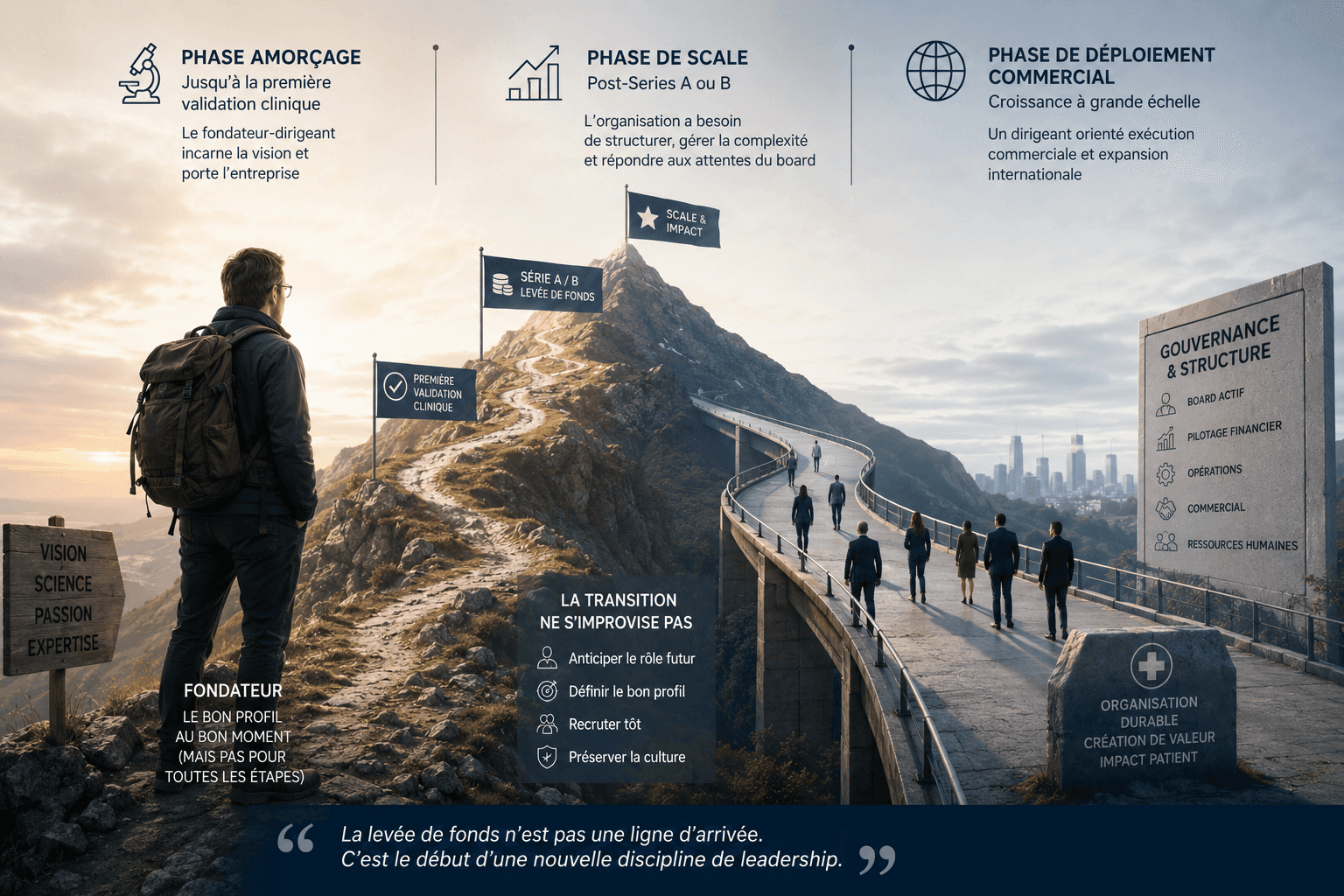
Medtech: after a fundraising round, recruiting the leader who can scale up the company
Medtech: after a fundraising round, recruiting the leader who can scale up the company

Executive succession: why boards prepare too late
Executive succession: why boards prepare too late
CONTACT
Let's talk about your next recruitment
Outline your needs in a few lines. Your request will be treated with the strictest confidentiality.
CONTACT
Let's talk about your next recruitment
Outline your needs in a few lines. Your request will be treated with the strictest confidentiality.
CONTACT
Let's talk about your next recruitment
Outline your needs in a few lines. Your request will be treated with the strictest confidentiality.