European Pharma: Why Board Chairs, Not CEOs, Are Leading the Charge
European Pharma: Why Board Chairs, Not CEOs, Are Leading the Charge
European Pharma: Why Board Chairs, Not CEOs, Are Leading the Charge
Share
On the morning of September 22, 2026, nine board chairs signed an open letter. Sanofi, AstraZeneca, Novartis, Roche, GSK, Novo, Ipsen, Chiesi, Boehringer Ingelheim. The title leaves no room for interpretation: "Europe Is Losing the Pharma Investment Race, But the Comeback Is Within Reach." Europe is losing the pharmaceutical investment race, but a comeback remains possible.
On the same day, Leem, the professional organization for pharmaceutical companies, presented its ten proposals for the 2027 presidential election. A week earlier, Sanofi had announced the divestment of twenty mature medicines and three factories, including one in Brittany. A week later, on September 29, the 100% US customs tariff on patented medicines applied to all importers without an agreement with Washington.
Each of these events was commented on individually. None of them was discussed for what they say, when taken together, about the level at which decisions are now being made within a European pharmaceutical company. Indeed, the most significant detail of this letter lies not in its content, but in its list of signatories: nine board chairs. Not a single chief executive officer.
When an entire industry has its boards of directors speak rather than its executive leaders, it is a signal of where decisions are being made, and therefore of what is expected from the people who carry them out.
Key Figures to Know
Indicator | Value | Source |
|---|---|---|
Pharma investments announced in the US and China over two years | More than $600 billion | Open letter from the nine chairs, September 22, 2026 |
Europe's share of global pharmaceutical R&D | 43% in 1990, 31% today | Open letter, September 22, 2026 |
Europe's share of clinical trials | 9%, halved in ten years | Open letter, September 22, 2026 |
New therapies that never reach European patients | 40% | Open letter, September 22, 2026 |
Average time to access a new medicine in Europe | About 600 days | Open letter, September 22, 2026 |
European Union's pharmaceutical trade surplus | More than €220 billion | Open letter, September 22, 2026 |
US customs tariff on patented medicines | 100%, reduced to 15% for the European Union, generalized on September 29, 2026 | Proclamation Section 232 of April 2, 2026, Crowell & Moring analysis |
Laboratories that have signed a price agreement with the White House | 26, representing 89% of the US brand-name drug market | EU Perspectives, September 1, 2026 |
Industrial investments promised in the US by major groups | Around $480 to $500 billion, including $20 billion for Sanofi by 2030 | Reuters, August 10, 2026 |
Savings on medicine prices proposed for the 2027 PLFSS | €1.3 billion | Cnam, report of July 2, 2026 |
Why This Issue Is Pressing Now
Three major deadlines converged within a ten-day window, and it is this concentration that gives the September 22 letter its significance.
On September 29, the US tariff becomes universal. The proclamation of April 2, 2026, issued under Section 232, established a 100% tariff on patented medicines imported into the US. Since July 31, it had applied to seventeen specifically listed groups. Starting September 29, it applies to all others. The European Union benefits from a reduced rate of 15%. Two paths make it possible to escape this tariff: an industrial relocation agreement with the Department of Commerce, which brings the rate down to 20%, and, when combined with a "most favored nation" price agreement, a zero rate until January 2029.
At the end of September, the French budget cycle begins. The Social Security Financing Bill (PLFSS) for 2027 is expected to be presented to the Council of Ministers at the end of the month, with a vote in the National Assembly around October 27. On July 2, National Health Insurance proposed €3.9 billion in savings, including €1.3 billion on medicine prices, the largest single item. Four decrees issued on August 22 will reduce reimbursement for medicines with low or moderate medical benefit starting January 1, 2027.
On September 14, Sanofi divested. Twenty mature medicines, three production sites, and just over 560 employees were transferred to Germany's Cheplapharm in exchange for 26.4% of its capital. This is the first major industrial action by the new Chief Executive Officer, five months after taking office, and was welcomed by the CGT union as "the first step of the famous refocusing" and by the CFDT as a "dangerous decision" for strategic autonomy.
Two false interpretations are circulating. The first views this as classic lobbying, an industry demanding higher prices on the eve of a budget. This ignores the level of the signatories: board chairs do not sign open letters about prices. The second concludes that Europe has already lost. The trade surplus of over €220 billion, which the letter itself highlights, suggests the opposite. What is at stake is not the present, but the allocation of investment for the next decade.
The Double Constraint: What Washington Imposes, What Europe Imposes
The executive management of a European pharmaceutical company is currently caught between two opposing forces that have intensified at the same time.
What Washington Imposes | What Europe Imposes |
|---|---|
Prices aligned with the cheapest countries: 26 laboratories have signed a "most favored nation" agreement, and Sanofi's December 2025 agreement projects average cuts of 61% for Medicaid on certain medicines | Price reductions: €1.3 billion in proposed cuts for 2027, and partial de-reimbursement of medicines with low or moderate medical benefit starting January 1, 2027 |
Factories on US soil: $480 to $500 billion in announced commitments, including $20 billion for Sanofi | A mandate to produce in France and Europe in the name of health sovereignty, championed by Leem, Initiative Pharma, and public authorities |
A 100% tariff for those who do not comply, 15% for the European Union | Access delays averaging 600 days and evaluations that, according to the letter, do not value innovation |
A timeline dictated by the US administration: July 31, September 29, January 2029 | A timeline dictated by the budget: Council of Ministers in late September, vote in late October, implementation on January 1 |
Each of these columns, taken individually, is manageable by an experienced executive team. It is the simultaneity that changes the nature of the problem. Investing $20 billion in the US to escape a tariff while simultaneously responding to accusations of industrial dismantling in France is not an operational trade-off. It is a shareholder-level trade-off.
The letter phrases it in its own way: "Just like defence or energy, modern medicines should be treated as vital infrastructure." The choice of words is not accidental: in both of these sectors, industrial location decisions have long been a matter of governance and state involvement, not just operational management.
Why the Board Spoke Out
In the normal operation of a pharmaceutical group, the Chief Executive Officer delivers public statements on strategy, results, and products. The board chair supervises, monitors, arbitrates succession and compensation issues, and rarely speaks outside of the annual general meeting. A letter signed by nine board chairs, rather than nine CEOs, therefore reveals at least three things.
First: industrial footprint decisions have become board decisions. Where to invest $20, $50, or $100 billion over ten years is not a question for an executive committee to settle alone. It is a decade-scale capital allocation issue that directly involves the shareholder. When AbbVie announces $100 billion, Pfizer and Merck $70 billion, Roche and AstraZeneca $50 billion, and Sanofi $20 billion, these figures have been validated at the board level. The CEO executes a geographical trade-off of which they are not the sole author.
Second: the board protects its CEO. Taking a public stance against the market access policies of European states exposes the person who does so. A pharmaceutical company's CEO must negotiate prices with these very same states in the coming months. The board chair, however, is not at the negotiating table. By speaking out, the chair allows the executive to remain in their operational role.
Third: the issue has shifted from the realm of performance to that of legitimacy. The letter does not talk about quarterly results. "The message to innovators has been stark: Europe does not value what you do." This is the language of governance, not execution. Indeed, the letter cites Mario Draghi and his warning against a "slow agony" of European strategic sectors.
It is not necessary to rule on the merits of the letter to draw a practical conclusion from it. It establishes a fact: in September 2026, the political voice of a European pharmaceutical company is carried by its board. Any organization restructuring its leadership must integrate this division of roles right from the definition of the mandate.
The Sanofi Case, a French Thread
The leading French pharmaceutical group offers, over seven months, a chronology that illustrates point-by-point this shift in the level of decision-making.
February 12, 2026. The board of directors announces that it will not renew the mandate of Paul Hudson, who steps down on February 17, and appoints Belén Garijo, previously CEO of Merck KGaA. Olivier Charmeil acts as interim CEO. A board decision, by definition.
April 29, 2026. Belén Garijo takes office following the annual general meeting.
July 21 and 22, 2026. The executive committee is reduced from eleven to eight members starting September 1. Olivier Charmeil, a member since 2011, becomes an advisor to the CEO. The General Counsel leaves the group. Thomas Triomphe, in charge of vaccines, now also oversees China. François Roger, Chief Financial Officer, takes over corporate development. A streamlining of this scale, three months after the arrival of a new CEO, is the organizational translation of a mandate for clarification.
July 30, 2026. Second-quarter revenue reaches €11.6 billion, up 16%. Dupixent grows by 37.6%. The full-year forecast is raised to around 10% growth. Yet the stock loses 9.4% in a single day, as investors worry about the depth of the pipeline and the risk of costly acquisitions before the Dupixent patent expires in 2031. A CEO can deliver excellent results and still see the market penalize a long-term concern.
September 14, 2026. Divestment of twenty mature medicines, including Lovenox outside the US, Cordarone, Tildiem, and Imovane, and three production sites: Csanyikvölgy in Hungary (about 400 employees), Jurong in Singapore (about 100), and Ploërmel in Morbihan, France (about 65). In return, Sanofi takes a 26.4% stake in Cheplapharm, a German company with over 800 employees and €1.66 billion in revenue in 2025, which has already acquired 28 molecules from Sanofi since 2014. Closing is planned for the third quarter of 2027, with a three-year employment guarantee for staff. The stock gains 2.9%.
Same day. Sanofi's CGT union calls the operation a "dismantling" and states that "at a time when the need to secure our supply of essential medicines should be an absolute priority, Sanofi is taking the exact opposite path." The CFDT Chimie Energie union speaks of a "dangerous decision."
September 22, 2026. Frédéric Oudéa, Board Chair of Sanofi, signs the open letter on Europe's loss of competitiveness.
This timeline outlines the paradox that every European pharmaceutical management team must now manage: divesting essential medicines in the name of refocusing on innovation, while simultaneously demanding that Europe treat medicine as a vital infrastructure. Both positions are consistent from the perspective of the board, which thinks in terms of a ten-year capital allocation. They are much harder to maintain for a CEO who, in the same month, must explain a divestment to employees in Brittany and an open letter to government ministers.
What This Demands of Executive Roles
The shift in the decision-making level does not exempt the executive team from deciding. It changes what is expected of them.
Role | What they used to do | What is now demanded of them |
|---|---|---|
Board Chair | Supervise, monitor, prepare succession | Publicly champion the group's industrial position and engage with governments |
Group CEO | Manage a portfolio and a pipeline | Manage a geographic footprint under political constraints in two opposing directions, and maintain this course in the face of internal opposition |
Industrial Director | Optimize sites and costs | Decide what to divest, what to keep, and what to build in the US, and defend each choice socially and politically |
Public Affairs | Negotiate prices with a single national regulator | Negotiate simultaneously in Washington, Brussels, and Paris, managing contradictory logics and misaligned timelines |
Chief Financial Officer | Manage margin and return on capital | Integrate a customs tariff, a US price agreement, a safeguard clause, and a ten-year industrial investment into the same equation |
HR Director | Support reorganizations | Maintain organizational stability during a refocusing effort that is contested in the name of the very sovereignty the company claims to support |
None of these transitions can be achieved through a simple expansion of scope. An industrial director who has spent their career optimizing sites does not necessarily have experience divesting a plant in a highly publicized social climate. A public affairs officer trained in negotiating with a single regulator has not necessarily operated where three jurisdictions impose incompatible demands. These experiences exist, but they are rare, and they are often found in other sectors—energy, defense, aerospace, and telecommunications—where industrial presence has long been a matter of state affairs.
The Case of French Pharma Mid-Caps and Subsidiaries of Foreign Groups
The nine signatories of the letter are global groups that have the means to play on both fronts: investing in the US to escape the tariff, and lobbying in Europe to secure better conditions. This is not the case for everyone.
French pharmaceutical mid-caps—Servier, Pierre Fabre, Guerbet, LFB, Théa—which founded the Initiative Pharma union alongside Sanofi and Ipsen on April 2, 2026, do not have the financial scale to build a $20 billion US plant. For them, the double constraint is not a choice between two options. It is a singular challenge. Indeed, Initiative Pharma is advocating, ahead of the 2027 PLFSS, for sovereignty criteria in drug evaluation, a dedicated budget for innovation, and a health programming law. This is their way of saying that these companies need Europe to become attractive, because they cannot leave. The mandate of a mid-cap pharma CEO now includes an institutional representation dimension that was not central five years ago.
Subsidiaries of foreign groups find themselves in the opposite situation. Their general management executes footprint trade-offs decided elsewhere. When a group invests $50 billion in the US, the general manager of its French subsidiary must explain to their teams and elected officials why the next site will not be in France. This mandate requires championing a decision one did not make, without disavowing it and without fading into the background.
Frequent Errors
Leaving the CEO alone on the political front line. When the board does not take its share of public communication, the CEO finds themselves acting as both negotiator and spokesperson—two roles that neutralize each other. The nine signatory groups made the opposite choice.
Treating the industrial footprint as an optimization exercise. Divesting a site or building a factory abroad is now a matter of governance. An organization that delegates these decisions to the operational level discovers their political and social dimensions too late.
Recruiting a CEO based solely on their pipeline capabilities without testing their ability to withstand opposition. Revenue growth of 16% does not protect against a 9.4% stock drop, and a divestment aligned with strategy does not protect against accusations of dismantling. The leader suited for this era knows how to maintain a multi-year trajectory while short-term indicators contradict it.
Viewing public affairs as a support function. When price, market access, and industrial location are negotiated in three capitals at once, this function decides a significant portion of the products' value. It deserves a seat on the executive committee and a leader with general management caliber.
Pitting refocusing against sovereignty instead of embracing the contradiction. Management that divests mature medicines while calling for sovereignty criteria cannot expect no one to notice the tension. The only viable stance is to explain it, to employees and public authorities alike.
How to Assess a Leader for This Era
Have they ever managed an industrial footprint under political constraints? Ask for the specific case, the public actors involved, and what was divested or built. An internal reorganization is not a sufficient answer.
Have they ever carried out an unpopular decision in the face of an organized and highly publicized workforce? What they maintained and what they adjusted will immediately reveal whether they have lived through the situation or are merely theorizing it.
Can they read a US price agreement, a customs tariff, and a safeguard clause in the same P&L statement? For a CEO or CFO, this question is a dealbreaker. The three mechanisms interact.
How do they coordinate their public speaking role with that of the board chair? The answer reveals whether they understand that the political voice of the company is shared, and whether they can cede part of it to another without seeing it as a loss of authority.
What is their position on the contradiction between refocusing and sovereignty? A leader who claims there is no contradiction has not grasped the issue. The one who acknowledges it and knows how to explain it will stand strong before a board, employees, and ministers.
Frequently Asked Questions
What does the September 22, 2026, letter from the nine pharma board chairs say? It notes that over $600 billion in investments have been announced in the US and China in two years, that Europe's share of global R&D has fallen from 43% in 1990 to 31%, and that 40% of new therapies never reach European patients. It asks states to increase health budgets and speed up medicine evaluations, and calls on the European Union to accelerate clinical trials, protect intellectual property, and grant budgetary flexibility to states investing in health.
What are the US customs tariffs on medicines as of September 29, 2026? A 100% tariff on patented medicines, established by proclamation on April 2, 2026. It has applied since July 31 to seventeen listed groups, and since September 29, to all other importers. The European Union, Japan, South Korea, and Switzerland benefit from a 15% rate. Generics, biosimilars, orphan drugs, and cell and gene therapies are exempt.
What is a "most favored nation" price agreement? An agreement by which a laboratory commits to the US administration to align certain prices with those of the cheapest developed countries. As of August 31, 2026, 26 laboratories had signed one, covering 89% of the US brand-name drug market. Combined with an industrial relocation agreement, it allows companies to avoid the customs tariff until January 2029.
Why is Sanofi divesting twenty medicines to Cheplapharm? To continue refocusing its portfolio on innovation. Cheplapharm, which has already acquired 28 molecules from Sanofi since 2014, is taking over twenty mature medicines and three production sites, involving about 560 employees, in exchange for a 26.4% equity stake in Cheplapharm for Sanofi. The transaction, announced on September 14, 2026, is expected to close in the third quarter of 2027.
What does the 2027 PLFSS outline for medicines? The bill had not yet been presented as of September 25, 2026. The known elements are National Health Insurance's proposal for €1.3 billion in savings on medicine prices, the largest item in the proposed €3.9 billion cuts, and four decrees on August 22 that lower reimbursement for medicines with low or moderate medical benefit starting January 1, 2027.
What is the role of the board chair in a pharmaceutical company? The chair presides over the body that appoints and dismisses the CEO, validates the strategy, and approves major capital allocation decisions, including long-term industrial investments. They do not run operations. The September 22 letter shows that this role now extends to public representation of the group's industrial stance to state authorities.
Key Takeaways
Nine board chairs, and no CEOs, signed an open letter on September 22, 2026, regarding Europe's lag in pharmaceutical investment.
Three key deadlines converge: the generalized US tariff on September 29, the 2027 PLFSS presented in late September, and the Sanofi/Cheplapharm divestment on September 14.
European pharmaceutical managements are caught in a double constraint: Washington demands prices and factories, while Europe demands savings and sovereignty.
Industrial footprint decisions have shifted to a higher level. They are now a board-level responsibility, altering what is expected of every executive role.
French pharmaceutical mid-caps do not have the resources to play a double game. For them, the CEO mandate includes a new institutional dimension.
The Laroze Partners Perspective
Most commentary on the September 22 letter focused on its content: is Europe really lagging, are the figures accurate, is the demand legitimate. These are important questions. However, they are not the ones that change how a pharmaceutical company is run.
What has changed is the level at which decisions are made. When a plant's location depends on a customs tariff, a price agreement with a foreign administration, and a social security budget, it ceases to be an operational issue. It becomes a governance issue. And when governance speaks, the CEO's mandate is redefined: less of a spokesperson, more of an arbitrator, and a new ability to hold a course that short-term indicators and the workforce contest at the same time.
This is the perspective we integrate into the assessment of a pharma executive mandate, even before looking for a profile. The Laroze Pattern®, our method for strategically reading trajectories, leadership behaviors, and performance dynamics, allows us to distinguish what a career actually proves from what it merely suggests: a leader who has delivered 16% growth has not necessarily demonstrated an ability to divest a factory in a hostile social climate, and a leader who knows the inner workings of three administrations has not necessarily shown they can keep a pipeline alive.
The pharmaceutical companies that navigate this period successfully will not be those that lobby best in Brussels. They will be those that have put individuals capable of managing this double constraint without denying it at every level of their governance early on.
Sources
Open letter from the board chairs of nine pharmaceutical groups, September 22, 2026 (Sanofi press release) · PharmExec, September 22, 2026 · Proclamation Section 232 of April 2, 2026, Crowell & Moring analysis · EU Perspectives, September 1, 2026 · White House, fact sheet of September 18, 2026 · Reuters, August 10, 2026 · Sanofi press releases of February 12, July 21, July 30, and September 14, 2026 · AFP dispatches of July 22, July 30, and September 14, 2026 · National Health Insurance Report of July 2, 2026 · Decrees of August 22, 2026 · Leem, September 22, 2026 · Initiative Pharma · IntelliNews, September 22, 2026.
On the morning of September 22, 2026, nine board chairs signed an open letter. Sanofi, AstraZeneca, Novartis, Roche, GSK, Novo, Ipsen, Chiesi, Boehringer Ingelheim. The title leaves no room for interpretation: "Europe Is Losing the Pharma Investment Race, But the Comeback Is Within Reach." Europe is losing the pharmaceutical investment race, but a comeback remains possible.
On the same day, Leem, the professional organization for pharmaceutical companies, presented its ten proposals for the 2027 presidential election. A week earlier, Sanofi had announced the divestment of twenty mature medicines and three factories, including one in Brittany. A week later, on September 29, the 100% US customs tariff on patented medicines applied to all importers without an agreement with Washington.
Each of these events was commented on individually. None of them was discussed for what they say, when taken together, about the level at which decisions are now being made within a European pharmaceutical company. Indeed, the most significant detail of this letter lies not in its content, but in its list of signatories: nine board chairs. Not a single chief executive officer.
When an entire industry has its boards of directors speak rather than its executive leaders, it is a signal of where decisions are being made, and therefore of what is expected from the people who carry them out.
Key Figures to Know
Indicator | Value | Source |
|---|---|---|
Pharma investments announced in the US and China over two years | More than $600 billion | Open letter from the nine chairs, September 22, 2026 |
Europe's share of global pharmaceutical R&D | 43% in 1990, 31% today | Open letter, September 22, 2026 |
Europe's share of clinical trials | 9%, halved in ten years | Open letter, September 22, 2026 |
New therapies that never reach European patients | 40% | Open letter, September 22, 2026 |
Average time to access a new medicine in Europe | About 600 days | Open letter, September 22, 2026 |
European Union's pharmaceutical trade surplus | More than €220 billion | Open letter, September 22, 2026 |
US customs tariff on patented medicines | 100%, reduced to 15% for the European Union, generalized on September 29, 2026 | Proclamation Section 232 of April 2, 2026, Crowell & Moring analysis |
Laboratories that have signed a price agreement with the White House | 26, representing 89% of the US brand-name drug market | EU Perspectives, September 1, 2026 |
Industrial investments promised in the US by major groups | Around $480 to $500 billion, including $20 billion for Sanofi by 2030 | Reuters, August 10, 2026 |
Savings on medicine prices proposed for the 2027 PLFSS | €1.3 billion | Cnam, report of July 2, 2026 |
Why This Issue Is Pressing Now
Three major deadlines converged within a ten-day window, and it is this concentration that gives the September 22 letter its significance.
On September 29, the US tariff becomes universal. The proclamation of April 2, 2026, issued under Section 232, established a 100% tariff on patented medicines imported into the US. Since July 31, it had applied to seventeen specifically listed groups. Starting September 29, it applies to all others. The European Union benefits from a reduced rate of 15%. Two paths make it possible to escape this tariff: an industrial relocation agreement with the Department of Commerce, which brings the rate down to 20%, and, when combined with a "most favored nation" price agreement, a zero rate until January 2029.
At the end of September, the French budget cycle begins. The Social Security Financing Bill (PLFSS) for 2027 is expected to be presented to the Council of Ministers at the end of the month, with a vote in the National Assembly around October 27. On July 2, National Health Insurance proposed €3.9 billion in savings, including €1.3 billion on medicine prices, the largest single item. Four decrees issued on August 22 will reduce reimbursement for medicines with low or moderate medical benefit starting January 1, 2027.
On September 14, Sanofi divested. Twenty mature medicines, three production sites, and just over 560 employees were transferred to Germany's Cheplapharm in exchange for 26.4% of its capital. This is the first major industrial action by the new Chief Executive Officer, five months after taking office, and was welcomed by the CGT union as "the first step of the famous refocusing" and by the CFDT as a "dangerous decision" for strategic autonomy.
Two false interpretations are circulating. The first views this as classic lobbying, an industry demanding higher prices on the eve of a budget. This ignores the level of the signatories: board chairs do not sign open letters about prices. The second concludes that Europe has already lost. The trade surplus of over €220 billion, which the letter itself highlights, suggests the opposite. What is at stake is not the present, but the allocation of investment for the next decade.
The Double Constraint: What Washington Imposes, What Europe Imposes
The executive management of a European pharmaceutical company is currently caught between two opposing forces that have intensified at the same time.
What Washington Imposes | What Europe Imposes |
|---|---|
Prices aligned with the cheapest countries: 26 laboratories have signed a "most favored nation" agreement, and Sanofi's December 2025 agreement projects average cuts of 61% for Medicaid on certain medicines | Price reductions: €1.3 billion in proposed cuts for 2027, and partial de-reimbursement of medicines with low or moderate medical benefit starting January 1, 2027 |
Factories on US soil: $480 to $500 billion in announced commitments, including $20 billion for Sanofi | A mandate to produce in France and Europe in the name of health sovereignty, championed by Leem, Initiative Pharma, and public authorities |
A 100% tariff for those who do not comply, 15% for the European Union | Access delays averaging 600 days and evaluations that, according to the letter, do not value innovation |
A timeline dictated by the US administration: July 31, September 29, January 2029 | A timeline dictated by the budget: Council of Ministers in late September, vote in late October, implementation on January 1 |
Each of these columns, taken individually, is manageable by an experienced executive team. It is the simultaneity that changes the nature of the problem. Investing $20 billion in the US to escape a tariff while simultaneously responding to accusations of industrial dismantling in France is not an operational trade-off. It is a shareholder-level trade-off.
The letter phrases it in its own way: "Just like defence or energy, modern medicines should be treated as vital infrastructure." The choice of words is not accidental: in both of these sectors, industrial location decisions have long been a matter of governance and state involvement, not just operational management.
Why the Board Spoke Out
In the normal operation of a pharmaceutical group, the Chief Executive Officer delivers public statements on strategy, results, and products. The board chair supervises, monitors, arbitrates succession and compensation issues, and rarely speaks outside of the annual general meeting. A letter signed by nine board chairs, rather than nine CEOs, therefore reveals at least three things.
First: industrial footprint decisions have become board decisions. Where to invest $20, $50, or $100 billion over ten years is not a question for an executive committee to settle alone. It is a decade-scale capital allocation issue that directly involves the shareholder. When AbbVie announces $100 billion, Pfizer and Merck $70 billion, Roche and AstraZeneca $50 billion, and Sanofi $20 billion, these figures have been validated at the board level. The CEO executes a geographical trade-off of which they are not the sole author.
Second: the board protects its CEO. Taking a public stance against the market access policies of European states exposes the person who does so. A pharmaceutical company's CEO must negotiate prices with these very same states in the coming months. The board chair, however, is not at the negotiating table. By speaking out, the chair allows the executive to remain in their operational role.
Third: the issue has shifted from the realm of performance to that of legitimacy. The letter does not talk about quarterly results. "The message to innovators has been stark: Europe does not value what you do." This is the language of governance, not execution. Indeed, the letter cites Mario Draghi and his warning against a "slow agony" of European strategic sectors.
It is not necessary to rule on the merits of the letter to draw a practical conclusion from it. It establishes a fact: in September 2026, the political voice of a European pharmaceutical company is carried by its board. Any organization restructuring its leadership must integrate this division of roles right from the definition of the mandate.
The Sanofi Case, a French Thread
The leading French pharmaceutical group offers, over seven months, a chronology that illustrates point-by-point this shift in the level of decision-making.
February 12, 2026. The board of directors announces that it will not renew the mandate of Paul Hudson, who steps down on February 17, and appoints Belén Garijo, previously CEO of Merck KGaA. Olivier Charmeil acts as interim CEO. A board decision, by definition.
April 29, 2026. Belén Garijo takes office following the annual general meeting.
July 21 and 22, 2026. The executive committee is reduced from eleven to eight members starting September 1. Olivier Charmeil, a member since 2011, becomes an advisor to the CEO. The General Counsel leaves the group. Thomas Triomphe, in charge of vaccines, now also oversees China. François Roger, Chief Financial Officer, takes over corporate development. A streamlining of this scale, three months after the arrival of a new CEO, is the organizational translation of a mandate for clarification.
July 30, 2026. Second-quarter revenue reaches €11.6 billion, up 16%. Dupixent grows by 37.6%. The full-year forecast is raised to around 10% growth. Yet the stock loses 9.4% in a single day, as investors worry about the depth of the pipeline and the risk of costly acquisitions before the Dupixent patent expires in 2031. A CEO can deliver excellent results and still see the market penalize a long-term concern.
September 14, 2026. Divestment of twenty mature medicines, including Lovenox outside the US, Cordarone, Tildiem, and Imovane, and three production sites: Csanyikvölgy in Hungary (about 400 employees), Jurong in Singapore (about 100), and Ploërmel in Morbihan, France (about 65). In return, Sanofi takes a 26.4% stake in Cheplapharm, a German company with over 800 employees and €1.66 billion in revenue in 2025, which has already acquired 28 molecules from Sanofi since 2014. Closing is planned for the third quarter of 2027, with a three-year employment guarantee for staff. The stock gains 2.9%.
Same day. Sanofi's CGT union calls the operation a "dismantling" and states that "at a time when the need to secure our supply of essential medicines should be an absolute priority, Sanofi is taking the exact opposite path." The CFDT Chimie Energie union speaks of a "dangerous decision."
September 22, 2026. Frédéric Oudéa, Board Chair of Sanofi, signs the open letter on Europe's loss of competitiveness.
This timeline outlines the paradox that every European pharmaceutical management team must now manage: divesting essential medicines in the name of refocusing on innovation, while simultaneously demanding that Europe treat medicine as a vital infrastructure. Both positions are consistent from the perspective of the board, which thinks in terms of a ten-year capital allocation. They are much harder to maintain for a CEO who, in the same month, must explain a divestment to employees in Brittany and an open letter to government ministers.
What This Demands of Executive Roles
The shift in the decision-making level does not exempt the executive team from deciding. It changes what is expected of them.
Role | What they used to do | What is now demanded of them |
|---|---|---|
Board Chair | Supervise, monitor, prepare succession | Publicly champion the group's industrial position and engage with governments |
Group CEO | Manage a portfolio and a pipeline | Manage a geographic footprint under political constraints in two opposing directions, and maintain this course in the face of internal opposition |
Industrial Director | Optimize sites and costs | Decide what to divest, what to keep, and what to build in the US, and defend each choice socially and politically |
Public Affairs | Negotiate prices with a single national regulator | Negotiate simultaneously in Washington, Brussels, and Paris, managing contradictory logics and misaligned timelines |
Chief Financial Officer | Manage margin and return on capital | Integrate a customs tariff, a US price agreement, a safeguard clause, and a ten-year industrial investment into the same equation |
HR Director | Support reorganizations | Maintain organizational stability during a refocusing effort that is contested in the name of the very sovereignty the company claims to support |
None of these transitions can be achieved through a simple expansion of scope. An industrial director who has spent their career optimizing sites does not necessarily have experience divesting a plant in a highly publicized social climate. A public affairs officer trained in negotiating with a single regulator has not necessarily operated where three jurisdictions impose incompatible demands. These experiences exist, but they are rare, and they are often found in other sectors—energy, defense, aerospace, and telecommunications—where industrial presence has long been a matter of state affairs.
The Case of French Pharma Mid-Caps and Subsidiaries of Foreign Groups
The nine signatories of the letter are global groups that have the means to play on both fronts: investing in the US to escape the tariff, and lobbying in Europe to secure better conditions. This is not the case for everyone.
French pharmaceutical mid-caps—Servier, Pierre Fabre, Guerbet, LFB, Théa—which founded the Initiative Pharma union alongside Sanofi and Ipsen on April 2, 2026, do not have the financial scale to build a $20 billion US plant. For them, the double constraint is not a choice between two options. It is a singular challenge. Indeed, Initiative Pharma is advocating, ahead of the 2027 PLFSS, for sovereignty criteria in drug evaluation, a dedicated budget for innovation, and a health programming law. This is their way of saying that these companies need Europe to become attractive, because they cannot leave. The mandate of a mid-cap pharma CEO now includes an institutional representation dimension that was not central five years ago.
Subsidiaries of foreign groups find themselves in the opposite situation. Their general management executes footprint trade-offs decided elsewhere. When a group invests $50 billion in the US, the general manager of its French subsidiary must explain to their teams and elected officials why the next site will not be in France. This mandate requires championing a decision one did not make, without disavowing it and without fading into the background.
Frequent Errors
Leaving the CEO alone on the political front line. When the board does not take its share of public communication, the CEO finds themselves acting as both negotiator and spokesperson—two roles that neutralize each other. The nine signatory groups made the opposite choice.
Treating the industrial footprint as an optimization exercise. Divesting a site or building a factory abroad is now a matter of governance. An organization that delegates these decisions to the operational level discovers their political and social dimensions too late.
Recruiting a CEO based solely on their pipeline capabilities without testing their ability to withstand opposition. Revenue growth of 16% does not protect against a 9.4% stock drop, and a divestment aligned with strategy does not protect against accusations of dismantling. The leader suited for this era knows how to maintain a multi-year trajectory while short-term indicators contradict it.
Viewing public affairs as a support function. When price, market access, and industrial location are negotiated in three capitals at once, this function decides a significant portion of the products' value. It deserves a seat on the executive committee and a leader with general management caliber.
Pitting refocusing against sovereignty instead of embracing the contradiction. Management that divests mature medicines while calling for sovereignty criteria cannot expect no one to notice the tension. The only viable stance is to explain it, to employees and public authorities alike.
How to Assess a Leader for This Era
Have they ever managed an industrial footprint under political constraints? Ask for the specific case, the public actors involved, and what was divested or built. An internal reorganization is not a sufficient answer.
Have they ever carried out an unpopular decision in the face of an organized and highly publicized workforce? What they maintained and what they adjusted will immediately reveal whether they have lived through the situation or are merely theorizing it.
Can they read a US price agreement, a customs tariff, and a safeguard clause in the same P&L statement? For a CEO or CFO, this question is a dealbreaker. The three mechanisms interact.
How do they coordinate their public speaking role with that of the board chair? The answer reveals whether they understand that the political voice of the company is shared, and whether they can cede part of it to another without seeing it as a loss of authority.
What is their position on the contradiction between refocusing and sovereignty? A leader who claims there is no contradiction has not grasped the issue. The one who acknowledges it and knows how to explain it will stand strong before a board, employees, and ministers.
Frequently Asked Questions
What does the September 22, 2026, letter from the nine pharma board chairs say? It notes that over $600 billion in investments have been announced in the US and China in two years, that Europe's share of global R&D has fallen from 43% in 1990 to 31%, and that 40% of new therapies never reach European patients. It asks states to increase health budgets and speed up medicine evaluations, and calls on the European Union to accelerate clinical trials, protect intellectual property, and grant budgetary flexibility to states investing in health.
What are the US customs tariffs on medicines as of September 29, 2026? A 100% tariff on patented medicines, established by proclamation on April 2, 2026. It has applied since July 31 to seventeen listed groups, and since September 29, to all other importers. The European Union, Japan, South Korea, and Switzerland benefit from a 15% rate. Generics, biosimilars, orphan drugs, and cell and gene therapies are exempt.
What is a "most favored nation" price agreement? An agreement by which a laboratory commits to the US administration to align certain prices with those of the cheapest developed countries. As of August 31, 2026, 26 laboratories had signed one, covering 89% of the US brand-name drug market. Combined with an industrial relocation agreement, it allows companies to avoid the customs tariff until January 2029.
Why is Sanofi divesting twenty medicines to Cheplapharm? To continue refocusing its portfolio on innovation. Cheplapharm, which has already acquired 28 molecules from Sanofi since 2014, is taking over twenty mature medicines and three production sites, involving about 560 employees, in exchange for a 26.4% equity stake in Cheplapharm for Sanofi. The transaction, announced on September 14, 2026, is expected to close in the third quarter of 2027.
What does the 2027 PLFSS outline for medicines? The bill had not yet been presented as of September 25, 2026. The known elements are National Health Insurance's proposal for €1.3 billion in savings on medicine prices, the largest item in the proposed €3.9 billion cuts, and four decrees on August 22 that lower reimbursement for medicines with low or moderate medical benefit starting January 1, 2027.
What is the role of the board chair in a pharmaceutical company? The chair presides over the body that appoints and dismisses the CEO, validates the strategy, and approves major capital allocation decisions, including long-term industrial investments. They do not run operations. The September 22 letter shows that this role now extends to public representation of the group's industrial stance to state authorities.
Key Takeaways
Nine board chairs, and no CEOs, signed an open letter on September 22, 2026, regarding Europe's lag in pharmaceutical investment.
Three key deadlines converge: the generalized US tariff on September 29, the 2027 PLFSS presented in late September, and the Sanofi/Cheplapharm divestment on September 14.
European pharmaceutical managements are caught in a double constraint: Washington demands prices and factories, while Europe demands savings and sovereignty.
Industrial footprint decisions have shifted to a higher level. They are now a board-level responsibility, altering what is expected of every executive role.
French pharmaceutical mid-caps do not have the resources to play a double game. For them, the CEO mandate includes a new institutional dimension.
The Laroze Partners Perspective
Most commentary on the September 22 letter focused on its content: is Europe really lagging, are the figures accurate, is the demand legitimate. These are important questions. However, they are not the ones that change how a pharmaceutical company is run.
What has changed is the level at which decisions are made. When a plant's location depends on a customs tariff, a price agreement with a foreign administration, and a social security budget, it ceases to be an operational issue. It becomes a governance issue. And when governance speaks, the CEO's mandate is redefined: less of a spokesperson, more of an arbitrator, and a new ability to hold a course that short-term indicators and the workforce contest at the same time.
This is the perspective we integrate into the assessment of a pharma executive mandate, even before looking for a profile. The Laroze Pattern®, our method for strategically reading trajectories, leadership behaviors, and performance dynamics, allows us to distinguish what a career actually proves from what it merely suggests: a leader who has delivered 16% growth has not necessarily demonstrated an ability to divest a factory in a hostile social climate, and a leader who knows the inner workings of three administrations has not necessarily shown they can keep a pipeline alive.
The pharmaceutical companies that navigate this period successfully will not be those that lobby best in Brussels. They will be those that have put individuals capable of managing this double constraint without denying it at every level of their governance early on.
Sources
Open letter from the board chairs of nine pharmaceutical groups, September 22, 2026 (Sanofi press release) · PharmExec, September 22, 2026 · Proclamation Section 232 of April 2, 2026, Crowell & Moring analysis · EU Perspectives, September 1, 2026 · White House, fact sheet of September 18, 2026 · Reuters, August 10, 2026 · Sanofi press releases of February 12, July 21, July 30, and September 14, 2026 · AFP dispatches of July 22, July 30, and September 14, 2026 · National Health Insurance Report of July 2, 2026 · Decrees of August 22, 2026 · Leem, September 22, 2026 · Initiative Pharma · IntelliNews, September 22, 2026.
On the morning of September 22, 2026, nine board chairs signed an open letter. Sanofi, AstraZeneca, Novartis, Roche, GSK, Novo, Ipsen, Chiesi, Boehringer Ingelheim. The title leaves no room for interpretation: "Europe Is Losing the Pharma Investment Race, But the Comeback Is Within Reach." Europe is losing the pharmaceutical investment race, but a comeback remains possible.
On the same day, Leem, the professional organization for pharmaceutical companies, presented its ten proposals for the 2027 presidential election. A week earlier, Sanofi had announced the divestment of twenty mature medicines and three factories, including one in Brittany. A week later, on September 29, the 100% US customs tariff on patented medicines applied to all importers without an agreement with Washington.
Each of these events was commented on individually. None of them was discussed for what they say, when taken together, about the level at which decisions are now being made within a European pharmaceutical company. Indeed, the most significant detail of this letter lies not in its content, but in its list of signatories: nine board chairs. Not a single chief executive officer.
When an entire industry has its boards of directors speak rather than its executive leaders, it is a signal of where decisions are being made, and therefore of what is expected from the people who carry them out.
Key Figures to Know
Indicator | Value | Source |
|---|---|---|
Pharma investments announced in the US and China over two years | More than $600 billion | Open letter from the nine chairs, September 22, 2026 |
Europe's share of global pharmaceutical R&D | 43% in 1990, 31% today | Open letter, September 22, 2026 |
Europe's share of clinical trials | 9%, halved in ten years | Open letter, September 22, 2026 |
New therapies that never reach European patients | 40% | Open letter, September 22, 2026 |
Average time to access a new medicine in Europe | About 600 days | Open letter, September 22, 2026 |
European Union's pharmaceutical trade surplus | More than €220 billion | Open letter, September 22, 2026 |
US customs tariff on patented medicines | 100%, reduced to 15% for the European Union, generalized on September 29, 2026 | Proclamation Section 232 of April 2, 2026, Crowell & Moring analysis |
Laboratories that have signed a price agreement with the White House | 26, representing 89% of the US brand-name drug market | EU Perspectives, September 1, 2026 |
Industrial investments promised in the US by major groups | Around $480 to $500 billion, including $20 billion for Sanofi by 2030 | Reuters, August 10, 2026 |
Savings on medicine prices proposed for the 2027 PLFSS | €1.3 billion | Cnam, report of July 2, 2026 |
Why This Issue Is Pressing Now
Three major deadlines converged within a ten-day window, and it is this concentration that gives the September 22 letter its significance.
On September 29, the US tariff becomes universal. The proclamation of April 2, 2026, issued under Section 232, established a 100% tariff on patented medicines imported into the US. Since July 31, it had applied to seventeen specifically listed groups. Starting September 29, it applies to all others. The European Union benefits from a reduced rate of 15%. Two paths make it possible to escape this tariff: an industrial relocation agreement with the Department of Commerce, which brings the rate down to 20%, and, when combined with a "most favored nation" price agreement, a zero rate until January 2029.
At the end of September, the French budget cycle begins. The Social Security Financing Bill (PLFSS) for 2027 is expected to be presented to the Council of Ministers at the end of the month, with a vote in the National Assembly around October 27. On July 2, National Health Insurance proposed €3.9 billion in savings, including €1.3 billion on medicine prices, the largest single item. Four decrees issued on August 22 will reduce reimbursement for medicines with low or moderate medical benefit starting January 1, 2027.
On September 14, Sanofi divested. Twenty mature medicines, three production sites, and just over 560 employees were transferred to Germany's Cheplapharm in exchange for 26.4% of its capital. This is the first major industrial action by the new Chief Executive Officer, five months after taking office, and was welcomed by the CGT union as "the first step of the famous refocusing" and by the CFDT as a "dangerous decision" for strategic autonomy.
Two false interpretations are circulating. The first views this as classic lobbying, an industry demanding higher prices on the eve of a budget. This ignores the level of the signatories: board chairs do not sign open letters about prices. The second concludes that Europe has already lost. The trade surplus of over €220 billion, which the letter itself highlights, suggests the opposite. What is at stake is not the present, but the allocation of investment for the next decade.
The Double Constraint: What Washington Imposes, What Europe Imposes
The executive management of a European pharmaceutical company is currently caught between two opposing forces that have intensified at the same time.
What Washington Imposes | What Europe Imposes |
|---|---|
Prices aligned with the cheapest countries: 26 laboratories have signed a "most favored nation" agreement, and Sanofi's December 2025 agreement projects average cuts of 61% for Medicaid on certain medicines | Price reductions: €1.3 billion in proposed cuts for 2027, and partial de-reimbursement of medicines with low or moderate medical benefit starting January 1, 2027 |
Factories on US soil: $480 to $500 billion in announced commitments, including $20 billion for Sanofi | A mandate to produce in France and Europe in the name of health sovereignty, championed by Leem, Initiative Pharma, and public authorities |
A 100% tariff for those who do not comply, 15% for the European Union | Access delays averaging 600 days and evaluations that, according to the letter, do not value innovation |
A timeline dictated by the US administration: July 31, September 29, January 2029 | A timeline dictated by the budget: Council of Ministers in late September, vote in late October, implementation on January 1 |
Each of these columns, taken individually, is manageable by an experienced executive team. It is the simultaneity that changes the nature of the problem. Investing $20 billion in the US to escape a tariff while simultaneously responding to accusations of industrial dismantling in France is not an operational trade-off. It is a shareholder-level trade-off.
The letter phrases it in its own way: "Just like defence or energy, modern medicines should be treated as vital infrastructure." The choice of words is not accidental: in both of these sectors, industrial location decisions have long been a matter of governance and state involvement, not just operational management.
Why the Board Spoke Out
In the normal operation of a pharmaceutical group, the Chief Executive Officer delivers public statements on strategy, results, and products. The board chair supervises, monitors, arbitrates succession and compensation issues, and rarely speaks outside of the annual general meeting. A letter signed by nine board chairs, rather than nine CEOs, therefore reveals at least three things.
First: industrial footprint decisions have become board decisions. Where to invest $20, $50, or $100 billion over ten years is not a question for an executive committee to settle alone. It is a decade-scale capital allocation issue that directly involves the shareholder. When AbbVie announces $100 billion, Pfizer and Merck $70 billion, Roche and AstraZeneca $50 billion, and Sanofi $20 billion, these figures have been validated at the board level. The CEO executes a geographical trade-off of which they are not the sole author.
Second: the board protects its CEO. Taking a public stance against the market access policies of European states exposes the person who does so. A pharmaceutical company's CEO must negotiate prices with these very same states in the coming months. The board chair, however, is not at the negotiating table. By speaking out, the chair allows the executive to remain in their operational role.
Third: the issue has shifted from the realm of performance to that of legitimacy. The letter does not talk about quarterly results. "The message to innovators has been stark: Europe does not value what you do." This is the language of governance, not execution. Indeed, the letter cites Mario Draghi and his warning against a "slow agony" of European strategic sectors.
It is not necessary to rule on the merits of the letter to draw a practical conclusion from it. It establishes a fact: in September 2026, the political voice of a European pharmaceutical company is carried by its board. Any organization restructuring its leadership must integrate this division of roles right from the definition of the mandate.
The Sanofi Case, a French Thread
The leading French pharmaceutical group offers, over seven months, a chronology that illustrates point-by-point this shift in the level of decision-making.
February 12, 2026. The board of directors announces that it will not renew the mandate of Paul Hudson, who steps down on February 17, and appoints Belén Garijo, previously CEO of Merck KGaA. Olivier Charmeil acts as interim CEO. A board decision, by definition.
April 29, 2026. Belén Garijo takes office following the annual general meeting.
July 21 and 22, 2026. The executive committee is reduced from eleven to eight members starting September 1. Olivier Charmeil, a member since 2011, becomes an advisor to the CEO. The General Counsel leaves the group. Thomas Triomphe, in charge of vaccines, now also oversees China. François Roger, Chief Financial Officer, takes over corporate development. A streamlining of this scale, three months after the arrival of a new CEO, is the organizational translation of a mandate for clarification.
July 30, 2026. Second-quarter revenue reaches €11.6 billion, up 16%. Dupixent grows by 37.6%. The full-year forecast is raised to around 10% growth. Yet the stock loses 9.4% in a single day, as investors worry about the depth of the pipeline and the risk of costly acquisitions before the Dupixent patent expires in 2031. A CEO can deliver excellent results and still see the market penalize a long-term concern.
September 14, 2026. Divestment of twenty mature medicines, including Lovenox outside the US, Cordarone, Tildiem, and Imovane, and three production sites: Csanyikvölgy in Hungary (about 400 employees), Jurong in Singapore (about 100), and Ploërmel in Morbihan, France (about 65). In return, Sanofi takes a 26.4% stake in Cheplapharm, a German company with over 800 employees and €1.66 billion in revenue in 2025, which has already acquired 28 molecules from Sanofi since 2014. Closing is planned for the third quarter of 2027, with a three-year employment guarantee for staff. The stock gains 2.9%.
Same day. Sanofi's CGT union calls the operation a "dismantling" and states that "at a time when the need to secure our supply of essential medicines should be an absolute priority, Sanofi is taking the exact opposite path." The CFDT Chimie Energie union speaks of a "dangerous decision."
September 22, 2026. Frédéric Oudéa, Board Chair of Sanofi, signs the open letter on Europe's loss of competitiveness.
This timeline outlines the paradox that every European pharmaceutical management team must now manage: divesting essential medicines in the name of refocusing on innovation, while simultaneously demanding that Europe treat medicine as a vital infrastructure. Both positions are consistent from the perspective of the board, which thinks in terms of a ten-year capital allocation. They are much harder to maintain for a CEO who, in the same month, must explain a divestment to employees in Brittany and an open letter to government ministers.
What This Demands of Executive Roles
The shift in the decision-making level does not exempt the executive team from deciding. It changes what is expected of them.
Role | What they used to do | What is now demanded of them |
|---|---|---|
Board Chair | Supervise, monitor, prepare succession | Publicly champion the group's industrial position and engage with governments |
Group CEO | Manage a portfolio and a pipeline | Manage a geographic footprint under political constraints in two opposing directions, and maintain this course in the face of internal opposition |
Industrial Director | Optimize sites and costs | Decide what to divest, what to keep, and what to build in the US, and defend each choice socially and politically |
Public Affairs | Negotiate prices with a single national regulator | Negotiate simultaneously in Washington, Brussels, and Paris, managing contradictory logics and misaligned timelines |
Chief Financial Officer | Manage margin and return on capital | Integrate a customs tariff, a US price agreement, a safeguard clause, and a ten-year industrial investment into the same equation |
HR Director | Support reorganizations | Maintain organizational stability during a refocusing effort that is contested in the name of the very sovereignty the company claims to support |
None of these transitions can be achieved through a simple expansion of scope. An industrial director who has spent their career optimizing sites does not necessarily have experience divesting a plant in a highly publicized social climate. A public affairs officer trained in negotiating with a single regulator has not necessarily operated where three jurisdictions impose incompatible demands. These experiences exist, but they are rare, and they are often found in other sectors—energy, defense, aerospace, and telecommunications—where industrial presence has long been a matter of state affairs.
The Case of French Pharma Mid-Caps and Subsidiaries of Foreign Groups
The nine signatories of the letter are global groups that have the means to play on both fronts: investing in the US to escape the tariff, and lobbying in Europe to secure better conditions. This is not the case for everyone.
French pharmaceutical mid-caps—Servier, Pierre Fabre, Guerbet, LFB, Théa—which founded the Initiative Pharma union alongside Sanofi and Ipsen on April 2, 2026, do not have the financial scale to build a $20 billion US plant. For them, the double constraint is not a choice between two options. It is a singular challenge. Indeed, Initiative Pharma is advocating, ahead of the 2027 PLFSS, for sovereignty criteria in drug evaluation, a dedicated budget for innovation, and a health programming law. This is their way of saying that these companies need Europe to become attractive, because they cannot leave. The mandate of a mid-cap pharma CEO now includes an institutional representation dimension that was not central five years ago.
Subsidiaries of foreign groups find themselves in the opposite situation. Their general management executes footprint trade-offs decided elsewhere. When a group invests $50 billion in the US, the general manager of its French subsidiary must explain to their teams and elected officials why the next site will not be in France. This mandate requires championing a decision one did not make, without disavowing it and without fading into the background.
Frequent Errors
Leaving the CEO alone on the political front line. When the board does not take its share of public communication, the CEO finds themselves acting as both negotiator and spokesperson—two roles that neutralize each other. The nine signatory groups made the opposite choice.
Treating the industrial footprint as an optimization exercise. Divesting a site or building a factory abroad is now a matter of governance. An organization that delegates these decisions to the operational level discovers their political and social dimensions too late.
Recruiting a CEO based solely on their pipeline capabilities without testing their ability to withstand opposition. Revenue growth of 16% does not protect against a 9.4% stock drop, and a divestment aligned with strategy does not protect against accusations of dismantling. The leader suited for this era knows how to maintain a multi-year trajectory while short-term indicators contradict it.
Viewing public affairs as a support function. When price, market access, and industrial location are negotiated in three capitals at once, this function decides a significant portion of the products' value. It deserves a seat on the executive committee and a leader with general management caliber.
Pitting refocusing against sovereignty instead of embracing the contradiction. Management that divests mature medicines while calling for sovereignty criteria cannot expect no one to notice the tension. The only viable stance is to explain it, to employees and public authorities alike.
How to Assess a Leader for This Era
Have they ever managed an industrial footprint under political constraints? Ask for the specific case, the public actors involved, and what was divested or built. An internal reorganization is not a sufficient answer.
Have they ever carried out an unpopular decision in the face of an organized and highly publicized workforce? What they maintained and what they adjusted will immediately reveal whether they have lived through the situation or are merely theorizing it.
Can they read a US price agreement, a customs tariff, and a safeguard clause in the same P&L statement? For a CEO or CFO, this question is a dealbreaker. The three mechanisms interact.
How do they coordinate their public speaking role with that of the board chair? The answer reveals whether they understand that the political voice of the company is shared, and whether they can cede part of it to another without seeing it as a loss of authority.
What is their position on the contradiction between refocusing and sovereignty? A leader who claims there is no contradiction has not grasped the issue. The one who acknowledges it and knows how to explain it will stand strong before a board, employees, and ministers.
Frequently Asked Questions
What does the September 22, 2026, letter from the nine pharma board chairs say? It notes that over $600 billion in investments have been announced in the US and China in two years, that Europe's share of global R&D has fallen from 43% in 1990 to 31%, and that 40% of new therapies never reach European patients. It asks states to increase health budgets and speed up medicine evaluations, and calls on the European Union to accelerate clinical trials, protect intellectual property, and grant budgetary flexibility to states investing in health.
What are the US customs tariffs on medicines as of September 29, 2026? A 100% tariff on patented medicines, established by proclamation on April 2, 2026. It has applied since July 31 to seventeen listed groups, and since September 29, to all other importers. The European Union, Japan, South Korea, and Switzerland benefit from a 15% rate. Generics, biosimilars, orphan drugs, and cell and gene therapies are exempt.
What is a "most favored nation" price agreement? An agreement by which a laboratory commits to the US administration to align certain prices with those of the cheapest developed countries. As of August 31, 2026, 26 laboratories had signed one, covering 89% of the US brand-name drug market. Combined with an industrial relocation agreement, it allows companies to avoid the customs tariff until January 2029.
Why is Sanofi divesting twenty medicines to Cheplapharm? To continue refocusing its portfolio on innovation. Cheplapharm, which has already acquired 28 molecules from Sanofi since 2014, is taking over twenty mature medicines and three production sites, involving about 560 employees, in exchange for a 26.4% equity stake in Cheplapharm for Sanofi. The transaction, announced on September 14, 2026, is expected to close in the third quarter of 2027.
What does the 2027 PLFSS outline for medicines? The bill had not yet been presented as of September 25, 2026. The known elements are National Health Insurance's proposal for €1.3 billion in savings on medicine prices, the largest item in the proposed €3.9 billion cuts, and four decrees on August 22 that lower reimbursement for medicines with low or moderate medical benefit starting January 1, 2027.
What is the role of the board chair in a pharmaceutical company? The chair presides over the body that appoints and dismisses the CEO, validates the strategy, and approves major capital allocation decisions, including long-term industrial investments. They do not run operations. The September 22 letter shows that this role now extends to public representation of the group's industrial stance to state authorities.
Key Takeaways
Nine board chairs, and no CEOs, signed an open letter on September 22, 2026, regarding Europe's lag in pharmaceutical investment.
Three key deadlines converge: the generalized US tariff on September 29, the 2027 PLFSS presented in late September, and the Sanofi/Cheplapharm divestment on September 14.
European pharmaceutical managements are caught in a double constraint: Washington demands prices and factories, while Europe demands savings and sovereignty.
Industrial footprint decisions have shifted to a higher level. They are now a board-level responsibility, altering what is expected of every executive role.
French pharmaceutical mid-caps do not have the resources to play a double game. For them, the CEO mandate includes a new institutional dimension.
The Laroze Partners Perspective
Most commentary on the September 22 letter focused on its content: is Europe really lagging, are the figures accurate, is the demand legitimate. These are important questions. However, they are not the ones that change how a pharmaceutical company is run.
What has changed is the level at which decisions are made. When a plant's location depends on a customs tariff, a price agreement with a foreign administration, and a social security budget, it ceases to be an operational issue. It becomes a governance issue. And when governance speaks, the CEO's mandate is redefined: less of a spokesperson, more of an arbitrator, and a new ability to hold a course that short-term indicators and the workforce contest at the same time.
This is the perspective we integrate into the assessment of a pharma executive mandate, even before looking for a profile. The Laroze Pattern®, our method for strategically reading trajectories, leadership behaviors, and performance dynamics, allows us to distinguish what a career actually proves from what it merely suggests: a leader who has delivered 16% growth has not necessarily demonstrated an ability to divest a factory in a hostile social climate, and a leader who knows the inner workings of three administrations has not necessarily shown they can keep a pipeline alive.
The pharmaceutical companies that navigate this period successfully will not be those that lobby best in Brussels. They will be those that have put individuals capable of managing this double constraint without denying it at every level of their governance early on.
Sources
Open letter from the board chairs of nine pharmaceutical groups, September 22, 2026 (Sanofi press release) · PharmExec, September 22, 2026 · Proclamation Section 232 of April 2, 2026, Crowell & Moring analysis · EU Perspectives, September 1, 2026 · White House, fact sheet of September 18, 2026 · Reuters, August 10, 2026 · Sanofi press releases of February 12, July 21, July 30, and September 14, 2026 · AFP dispatches of July 22, July 30, and September 14, 2026 · National Health Insurance Report of July 2, 2026 · Decrees of August 22, 2026 · Leem, September 22, 2026 · Initiative Pharma · IntelliNews, September 22, 2026.
See more
See more

Recruiting a General Manager for France in pharma: why this mandate is first and foremost a negotiation with the State?
Recruiting a General Manager for France in pharma: why this mandate is first and foremost a negotiation with the State?

Economic sovereignty: recruiting the leaders who make a difference
Economic sovereignty: recruiting the leaders who make a difference

Executive succession: why boards prepare too late
Executive succession: why boards prepare too late

Pharma M&A: Why the architect of the deal is almost never the architect of the transformation?
Pharma M&A: Why the architect of the deal is almost never the architect of the transformation?
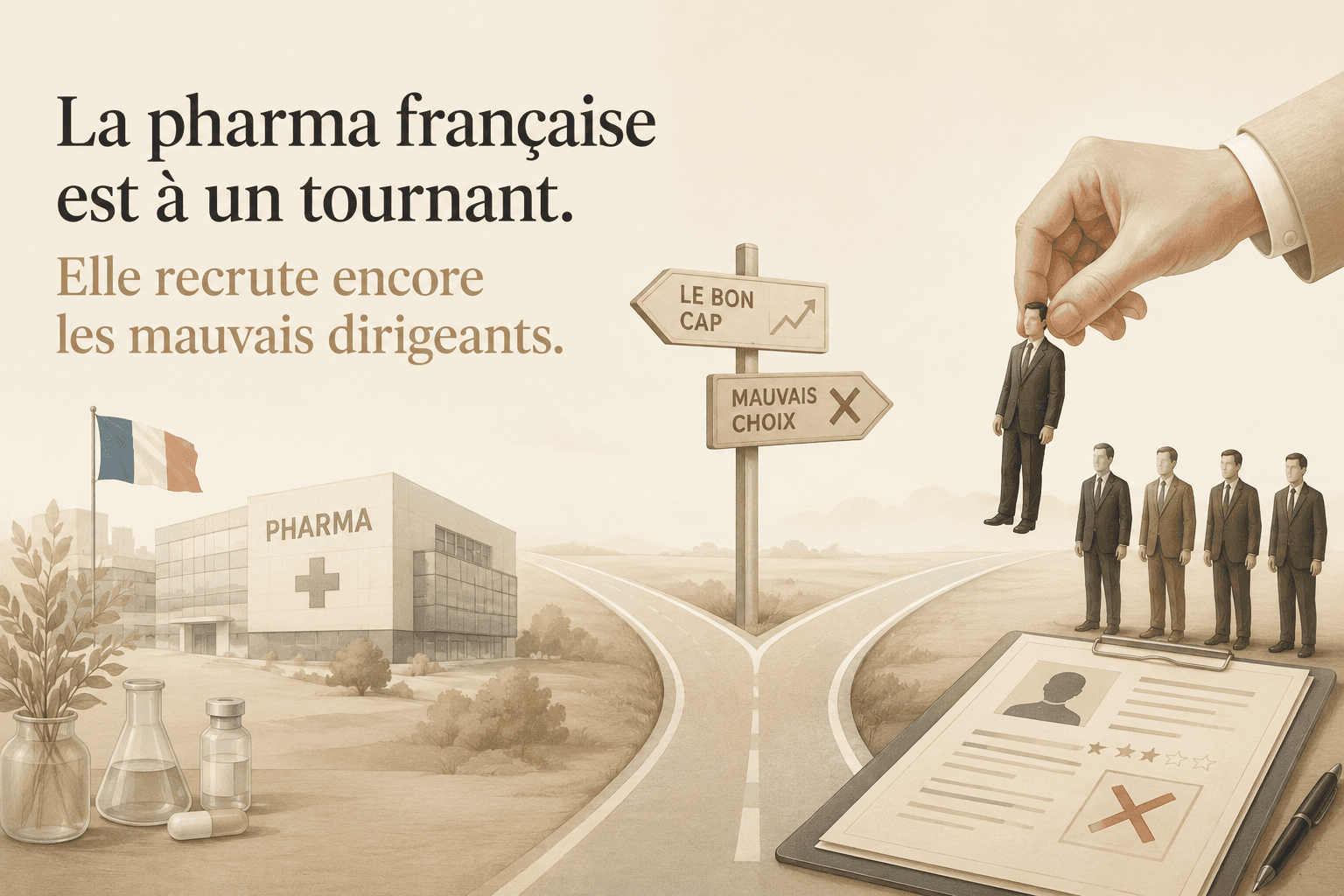
French Pharma: recruiting the right leaders for the new cycle
French Pharma: recruiting the right leaders for the new cycle
CONTACT
Let's talk about your next recruitment
Outline your needs in a few lines. Your request will be treated with the strictest confidentiality.
CONTACT
Let's talk about your next recruitment
Outline your needs in a few lines. Your request will be treated with the strictest confidentiality.
CONTACT
Let's talk about your next recruitment
Outline your needs in a few lines. Your request will be treated with the strictest confidentiality.