Hiring a CEO for a scale-up: when should the founder step aside?
Hiring a CEO for a scale-up: when should the founder step aside?
Hiring a CEO for a scale-up: when should the founder step aside?
Share
A founder should consider hiring a CEO when the decisions that drive the company's growth are no longer the ones that brought it to life. This moment most often arrives around a Series B or C funding round, when the company shifts from a working product to an organization that must deliver, recruit, sell internationally, and report to a board. It signifies neither a failure by the founder nor a demand from investors: it marks a fundamental change in role.
The French context makes this issue all the more pressing. According to the EY barometer published on October 7, 2026, French Tech raised €8.7 billion over nine months—57% more than a year earlier and nearly reaching 2021 levels. However, ten rounds exceeding €100 million captured 62% of that capital, while the Series B and C segment, which EY describes as “the moment when a proven startup must become an enterprise,” dropped by 10% in value over nine months.
For a founder, board chair, or fund partner, this means one thing: capital is not lacking, but it is concentrating on executive teams that seem capable of sustaining scale. The CEO is no longer an end-of-journey consideration. It is a vital component of the investment thesis.
This article addresses the questions faced by founders, board chairs, group HR directors, and venture capital as well as tech private equity funds: when to hand over the reins, what type of CEO to seek, how to structure the handover, and how to select an executive search firm for this placement. It is written by Sam Lozinguez, Tech & AI Partner at Laroze Partners, an executive search firm for tech and AI executives. In this perspective, recruitment is merely the outcome of a governance decision.
Definition. Scale-up: A technology company that has demonstrated product-market fit and whose challenge is no longer proving it can exist, but growing in a repeatable manner, typically post-Series B. Scale-up CEO: The executive tasked with structuring this growth before a board and investors, whether they are the founder or an appointed external leader.
Key Figures to Know
Metric | Value | Source (Media, Date) |
|---|---|---|
Capital raised by French Tech over nine months | €8.7B, +57% year-over-year, nearly matching 2021 levels | EY, Venture Capital Barometer, October 7, 2026 |
Number of deals | 397, compared to 428 a year earlier (-7%) | EY, October 7, 2026 |
Average ticket size | €22M | EY, October 7, 2026 |
Rounds over €100M | 10 rounds, €5.4B, representing 62% of raised capital (including Mistral AI, €3B) | EY, October 7, 2026 |
Series B and C | -10% in value over nine months following a stable first half (42 deals vs. 46) | EY, October 7, 2026 |
Deals under €100M | €3.3B (-6%) | EY, October 7, 2026 |
Software and AI | €5.1B, representing 59% of invested capital, with 26% fewer deals | EY, October 7, 2026 |
Geographic concentration | 86% of total capital in Île-de-France | EY, October 7, 2026 |
Startups planning to hire within twelve months | 78.5% (survey of 255 startups) | EY, Innovation Ecosystem Barometer, September 8, 2026 |
Founders still serving as CEO by Year 3 | 50% (212 US startups studied, late 1990s and early 2000s); fewer than 25% lead the IPO | Wasserman, Organization Science, 2003, via Harvard Business School |
Why This Issue Is Essential Today
Three specific developments explain why this topic is surfacing in boardrooms.
Capital is concentrating and becoming more selective in the mid-market. Mega-rounds drive the aggregate amounts, rounds under €100 million are down 6%, and Series B and C rounds—where a company shifts in nature—have declined by 10%. A scale-up aiming to raise in this segment must present an executive leadership team just as much as revenue numbers. This is our interpretation: EY documents the downturn, but does not provide its root cause.
Companies are preparing to expand headcount. 78.5% of startups surveyed by EY plan to hire within the next twelve months. Expanding headcounts without evolving decision-making processes is one of the most common sources of friction between a founder and their team.
The phenomenon is documented and therefore measurable. Noam Wasserman’s seminal study of 212 US startups reveals that half of founders are no longer CEO by the third year, with two events most often triggering the transition: the completion of product development and the arrival of each new funding round. Although the sample is dated and focused on the US, and does not serve as a direct forecast for 2026, it describes an underlying dynamic: completing a major milestone increases the likelihood of a CEO transition.
Three misconceptions continue to circulate.
“Replacing the founder implies failure.” More often than not, it reflects success: the company has reached a stage where the role of executive leadership is no longer about launching, but scaling.
“VC funds force the change.” A fund will raise the question, but rarely acts unilaterally. Governance decisions are made at the board level, according to the shareholders’ agreement. Founders who take charge of this transition themselves maintain control over the timeline and their subsequent role.
“An external CEO guarantees growth.” They secure growth only if chosen specifically for the upcoming phase, and if they are properly integrated. A strong CEO of a 500-person company is not necessarily equipped to lead a 50-person company building its structure, and vice versa.
Founder, CEO, Chair: Three Conflated Roles
Founders often carry all three titles simultaneously. Succession planning involves disentangling these responsibilities and establishing clear ownership. Four primary models exist.
Model | Key Shift | Best Suited For | Critical Consideration |
|---|---|---|---|
The founder remains CEO and strengthens their executive team (COO, CFO, CRO) | The founder delegates execution | When they have demonstrated an ability to hire peers who outperform them | The board must ensure delegation is genuine |
A COO or Executive Chair manages execution; the founder retains the vision | Two executives share the leadership function | When the founder remains indispensable to strategy and product | Requires a clear line of authority; otherwise, the split leads to gridlock |
A new CEO is appointed; the founder transitions to Chair, CPO, or CTO | The founder shifts roles while remaining with the company | When the company requires different operational expertise while keeping its founder as an anchor | Decision-making boundaries must be codified in writing before the CEO arrives |
A new CEO is appointed; the founder exits the executive team | A clean break | When working dynamics with the team or the board are no longer viable | Requires deliberate handoff of key client relationships and team leadership |
The right choice depends less on the founder’s competence than on what the company needs to become over the next two to three years. A delayed transition is imposed; an anticipated transition, structured before friction emerges, is negotiated.
Six Signals That It Is Time for a Transition
This list represents our perspective, drawn from extensive engagements with founders and boards. It does not reflect published statistical data.
The product is mature, and growth now hinges on commercial execution. This is one of the two core inflection points identified by Wasserman.
A new funding round is approaching with a new lead investor. The investment committee scrutinizes the management team as rigorously as the financial trajectory.
Second-line managers must operate autonomously. When every decision continues to escalate to the founder, the company has hit the operational ceiling of its initial model.
International expansion or M&A is on the horizon. These initiatives require operational execution experience that many founders have yet to develop.
Board composition is shifting. The addition of independent board members alters the cadence, scope, and rigor of governance and reporting.
The founder voices it themselves. This is the most reliable indicator. It often surfaces a year before the formal decision, during candid discussions with the board chair or a trusted director.
Selecting the Right CEO for the Right Stage: Three Profiles
There is no generic scale-up CEO. Three distinct profiles correspond to three specific organizational needs.
Profile | Core Mandate | Typical Background | Primary Risk |
|---|---|---|---|
The Scaling Leader | How do we build repeatable, structured growth? | Has scaled an organization from dozens to hundreds of employees | May lack product intuition |
The Commercial & Market Leader | How do we win market share and move upmarket? | Former VP of Sales or regional GM at an enterprise software or platform company | May underestimate technical debt and internal operational needs |
The Exit-Readiness Leader | How do we prepare the company for an IPO or strategic sale? | Has led an IPO, strategic acquisition, or post-merger integration | May arrive too early, deploying an overly rigid operating style that stifles the team |
The board must align on the required profile before shortlisting names. Hiring an exit-readiness CEO for a company that has yet to stabilize its go-to-market engine is one of the costliest errors a scale-up can make.
The Transition: Lessons from the Field
Two corporate precedents—viewed objectively without passing judgment on the individuals—showcase the friction that emerges when succession follows crisis rather than proactive design.
Paris-based AI company H Company raised a $220 million seed round in May 2024. Just over a year later, in June 2025, it appointed Gautier Cloix, former head of Palantir France, as CEO following the departure of several co-founders. One of them, Laurent Sifre, joined Microsoft in early 2026. In the US, Zenefits raised $500 million at a $4.5 billion valuation in May 2015; by February 2016, its founder had resigned under regulatory scrutiny.
These examples do not imply that founders fail. They demonstrate that succession managed under acute stress carries a far steeper cost: co-founder attrition, client hesitation, and reactive investor pressure. Conversely, a well-managed succession requires four operational parameters formalized in writing before the public announcement.
The founder's role post-transition. Chair, Chief Product Officer, Chief Technology Officer, or Director: the role must have genuine operational substance and unambiguous boundaries.
Decision-making frameworks. Clear delineation of who makes final determinations on product roadmaps, go-to-market strategy, executive hiring, and financial budgets. A one-page matrix is often sufficient.
The communication strategy. Internal teams first, key customers second. The messaging must remain unified: the founder stays anchored in the business, and the organization is transitioning into its next chapter of growth.
The first twelve months. A structured monthly check-in between the board chair, the CEO, and the founder with a fixed agenda. This cadence must continue beyond the first quarter—the window where initial friction typically surfaces.
Implications Across the Leadership Team
Role | Historical Core Competency | Emerging Requirement |
|---|---|---|
Founder | Building, pitching, fundraising | Embracing a role shift without losing impact, ensuring organizational clarity through the transition |
Fund Partner (VC, PE) | Selecting teams and markets | Surfacing succession at the right time without imposing it, and guiding the transition |
Board Chair | Convening directors and facilitating meetings | Driving the search process, arbitrating alignments between founder and candidate |
CFO | Managing reporting and leading fundraises | Equipping the incoming CEO with an accurate, granular financial assessment from week one |
Head of People / CHRO | Talent acquisition and organizational design | Securing the retention of key leadership during the transition period |
CTO or CPO | Architecting and shipping the product | Safeguarding the core product vision as executive leadership changes hands |
Two of these roles merit particular attention.
The Fund Partner. They are often the first to identify that the transition is necessary. Their role is not to mandate a change, but to introduce the discussion tactfully, with the right stakeholder first: directly with the founder, then with the board chair, and finally with the full board. Bringing the topic up cold during a formal board meeting is inevitably perceived as a vote of no confidence.
The Head of People / CHRO. They manage the most volatile variable during succession: retaining the second line of leadership. A CEO transition frequently triggers executive departures when direct reports are uncertain about their future mandate. Conducting individual, structured check-ins with every leadership team member prior to the new CEO's arrival substantially reduces flight risk.
A Six-Stage CEO Search Process
Executing a scale-up CEO search follows an orderly path that the board can methodically manage.
Codify the founder's forward-looking role prior to kicking off any active sourcing. This single decision governs the parameters of the entire search.
Align on the target profile for this specific growth phase: scaling operations, commercial expansion, or exit positioning, supported by three measurable success metrics for the first 12 months.
Establish a compact search committee, typically comprised of the board chair, the founder, and an investor director. Keep it under four people.
Map and target sitting executives through discrete, direct outreach. The broader organization should only be briefed once the process is concluded.
Run finalist candidate interviews with the founder, executive committee, and board, supported by rigorous reference checks with past chairs and directors.
Finalize equity incentives and governance terms prior to making an announcement: decision rights, board configuration, and long-term value-sharing.
Boards consistently underestimate the significance of Step 1. Kicking off a search before the founder has genuinely embraced their next role results in top candidates picking up on the ambiguity and exiting the process.
The Private Equity-Backed Scale-up Context
In a PE-backed scale-up, CEO succession is directly mapped to the value creation plan and the targeted investment horizon. The sponsor expects a direct correlation between the executive's track record and upcoming strategic milestones: accelerating enterprise sales, orchestrating M&A integrations, or prepping for a liquidity event. Three factors define this dynamic.
The CEO is hired to execute a specific playbook. The incoming leader must demonstrate how they have previously delivered on comparable mandates and scaled organizational structures accordingly.
Governance structures are more rigorous. Board committees, independent directors, and institutional reporting cadences are standard. A candidate whose operational background is strictly early-stage venture-backed startups must be evaluated for readiness to handle institutional scrutiny.
Management incentive packages are critical. High-caliber scale-up executives expect meaningful equity participation. Structuring these incentives—which involves the sponsor, founder, and broader executive team—must be fully resolved before signing, not left open after the appointment.
How to Select an Executive Search Firm for a Scale-Up CEO Search
A board or private equity sponsor should pose six critical questions to any executive search firm under consideration—including us.
Who will actively lead the engagement day-to-day? The senior partner who pitches the mandate must be the one driving it, from market mapping through onboarding.
What is their practical grasp of the underlying industry? For a tech scale-up CEO, this is demonstrated by their familiarity with executive career trajectories and operational benchmarks across the ecosystem, not by a roster of software tools.
How do they engage non-active, sitting executives? The best candidates rarely browse job boards. Discreet direct outreach and disciplined confidentiality are prerequisites for having substantive discussions.
How do they maintain strict confidentiality toward internal teams? In a scale-up, premature rumors of an impending CEO hire can trigger severe attrition and disruption.
How is the candidate shortlist presented and assessed? Profiles should be evaluated against documented past decisions, backed by thorough 360-degree referencing with former board chairs and directors.
What support is provided after the placement? Hands-on onboarding support during the executive's first year must be an integral part of the advisory engagement.
At Laroze Partners, leadership searches across tech and AI are led personally by Sam Lozinguez, Tech & AI Partner, from initial brief framing through the candidate's first year in office.
Common Pitfalls
Waiting for operational strain to turn into a crisis. A succession executed under duress compromises negotiation leverage, creates employee attrition, and breeds investor impatience.
Searching for a clone of the founder. If the mandate is to hire a mirror image of the founder, the transition is redundant. An external CEO must introduce capabilities the organization currently lacks.
Leaving the founder in the decision-making chain without clear boundaries. A founder who remains involved in day-to-day operational decisions fundamentally undermines the incoming CEO’s authority.
Neglecting second-line leadership. When a new chief executive steps in without the leadership team understanding how their own roles will evolve, key talent exits.
Hiring solely based on brand pedigree. A corporate leader from a legacy tech brand may falter in a fast-moving scale-up lacking brand recognition and established operational playbooks.
Treating executive equity as an afterthought. Exceptional leaders will not take on the operational risk of a scale-up without an attractive value-sharing structure. This framework must be defined well before the final offer stage.
How to Interview and Assess a Scale-Up CEO Candidate
Which companies have you guided through step-change growth, and what organizational structures did you adjust? This separates leaders who simply rode a wave of momentum from those who actively architected sustainable scale.
Have you successfully coexisted with a founder who stayed with the company? A leader whose experience is limited to environments where founders exited has not been tested in high-stakes governance partnerships.
How do you approach your first 100 days in a business you did not build? A sound executive talks first about listening, understanding the executive team, and meeting clients before executing reorganization plans.
What difficult, counter-intuitive recommendation have you defended before a board, and what was the outcome? The answer reveals their relationship with authority, intellectual integrity, and handling pushback.
How do you think about equity sharing across the broader leadership team? An executive focused exclusively on their personal equity package fails to understand that a scale-up’s value is built by the strength of its core team.
Frequently Asked Questions
When should a scale-up replace its founder CEO?
When the decisions that sustain company growth are no longer the ones that brought it to life: a mature core product, a major funding round, the requirement for middle management autonomy, or entering global expansion and M&A. Wasserman’s study across 212 US startups demonstrated that half of founders step down by Year 3, with product completion and new capital rounds directly increasing the likelihood of transition.
How many founders remain CEO all the way to an IPO?
In Wasserman's research, fewer than 25% of founders led their company through an initial public offering. While that dataset reflects a historic US sample (late 1990s and early 2000s), it illustrates a clear structural reality rather than a rigid rule for 2026.
How do you run an executive search for a scale-up CEO?
Through three distinct phases: first, defining the founder’s forward role; second, identifying the profile aligned with the current growth stage (operational scale, commercial expansion, or exit positioning); and third, running a discrete, direct-outreach search targeting sitting executives. Recruitment is the downstream execution of an upstream governance decision.
What is the role of an executive search firm during a scale-up CEO transition?
The search firm supports the board in articulating the hiring profile, engages sitting executives who are not in the job market, manages confidentiality, presents candidates vetted through comprehensive reference checks, and advises during the first-year integration. The firm advises; the board retains full ownership of the hiring decision.
Can a founder stay with the company once a new CEO is appointed?
Yes, in capacities such as Chair, Chief Product Officer, Chief Technology Officer, or Board Director—provided the position carries defined operational substance and the decision-making framework is formalized prior to the CEO's arrival. Leaving a founder in place without clear role boundaries is the single greatest cause of organizational friction.
Who makes the call to transition the CEO: the board or the investors?
Authority is dictated by the shareholders’ agreement and board voting rights. In practice, the decision is resolved inside the boardroom following private, structured alignment between the founder, the board chair, and primary institutional investors. Imposing a leadership change during a live board meeting without prior alignment carries the highest strategic cost.
Should a scale-up hire an external CEO before or after a Series B?
Both paths are viable. Appointing a CEO ahead of the round allows the new leader to participate in investor pitches alongside the founder. Appointing post-round allows the founder to secure the capital under their vision. The decision depends on operational urgency, alignment between the founder and the lead investor, and the maturity of the management team.
Key Takeaways
French Tech raised €8.7 billion over nine months (EY, October 7, 2026), yet Series B and C funding contracted by 10%: an experienced CEO is a critical asset in the investment thesis.
Succession moments typically track specific milestones: product maturity or an incoming funding round (Wasserman).
Four operational models exist, ranging from surrounding the founder with executive support to a complete executive departure.
Define the required CEO profile before focusing on candidates: scaling leader, commercial leader, or exit-readiness leader.
A proactively planned succession can be carefully negotiated; an involuntary transition often results in costly executive turnover.
The Laroze Partners Perspective
We frequently see the CEO succession question approached backward—treated simply as a recruiting task. In reality, it is a governance issue that concludes with an executive search. Once the founder's forward-looking mandate is clearly defined, the profile tailored to the current stage, and the leadership team aligned, the search becomes precise, and evaluation centers on verified track records. When these governance foundations are neglected, even the strongest executive will fail to integrate.
The Laroze Pattern®, our methodology for analyzing executive career trajectories, leadership behaviors, and performance dynamics, enables us to assess how a candidate has navigated critical inflection points: joining a company built by someone else, partnering with an active founder, and reporting to an institutional board. These are career-defining dynamics, reflected directly in the decisions leaders have made under pressure.
The scale-ups that successfully cross the bridge from Series B to long-term maturity will not be those that swapped their CEO the earliest, nor those that held on to their founders the longest. They will be the ones that decided, before friction escalated, who owns what.
Sources
EY, Venture Capital Barometer in France, First Nine Months of 2026, October 7, 2026 · EY, Venture Capital Barometer in France, H1 2026, July 9, 2026 · EY, French Innovation Ecosystem Barometer, September 8, 2026 · Noam Wasserman, “Founder-CEO Succession and the Paradox of Entrepreneurial Success,” Organization Science, March–April 2003, and Harvard Business School Working Knowledge · Maddyness, June 11, 2025, and September 7, 2026 (H Company) · Wikipedia and financial press, Zenefits (2015–2016).
See more
See more

AI Valuations in 2026: What 2015 SaaS Has Already Taught Us, and What It Cannot Teach Us
AI Valuations in 2026: What 2015 SaaS Has Already Taught Us, and What It Cannot Teach Us

Hiring a Biotech CEO: When the Scientist-Founder Passes the Torch to the Operator
Hiring a Biotech CEO: When the Scientist-Founder Passes the Torch to the Operator

Hiring a CTO in the Age of Coding Agents: What the Board Needs to Ask Them
Hiring a CTO in the Age of Coding Agents: What the Board Needs to Ask Them
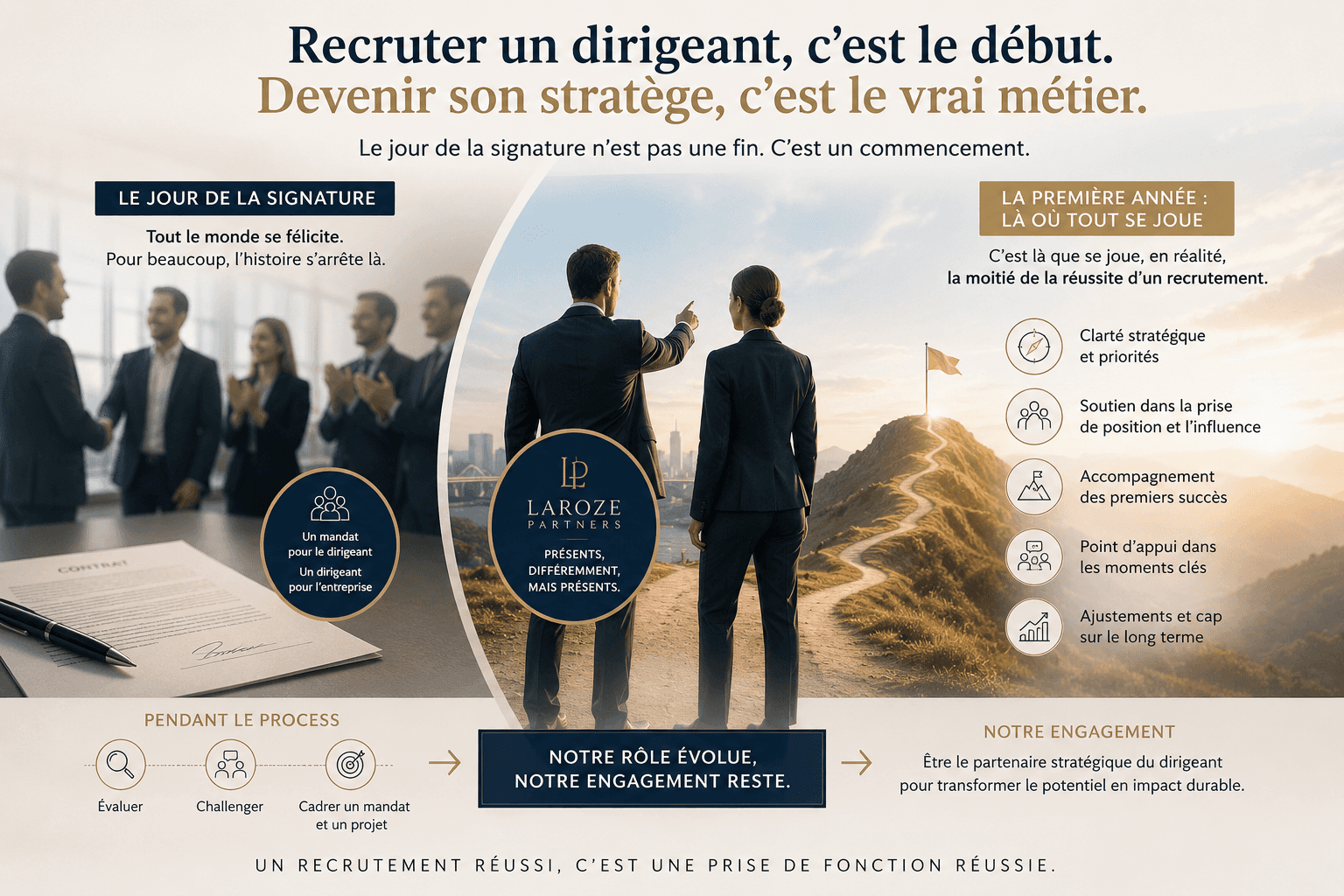
Accompanying a recruited executive: the key to their first year
Accompanying a recruited executive: the key to their first year

Executive succession: why boards prepare too late
Executive succession: why boards prepare too late

Generative AI: opportunities for investors and financial advice
Generative AI: opportunities for investors and financial advice
CONTACT
Let's talk about your next recruitment
Outline your needs in a few lines. Your request will be treated with the strictest confidentiality.
CONTACT
Let's talk about your next recruitment
Outline your needs in a few lines. Your request will be treated with the strictest confidentiality.
CONTACT
Let's talk about your next recruitment
Outline your needs in a few lines. Your request will be treated with the strictest confidentiality.